
Catalogue Search | MBRL


Are you sure you want to remove the book from the shelf?

{{itemTitle}}
7
result(s) for
"Poetry Translating China."
Sort by:

Multidimensional analysis of register variation in English translations of Shijing
This study employs Multidimensional Analysis (MDA) to compare the register of Arthur Waley’s and Ezra Pound’s translations of Shijing , and further explores the factors contributing to their differences. The key findings are as follows: (1) Waley’s translation corresponds to the “involved persuasion” register, characterized by high interactivity and extensive informational elaboration. In contrast, Pound’s translation aligns with the “general narrative exposition” register, emphasizing informativeness and narrativity; (2) The interactivity in Waley’s translation is primarily driven using analytic negation, first-person pronouns, and modal verbs, while the elaboration is attributed to the frequent use of demonstrative pronouns. In contrast, Pound’s translation exhibits strong informativeness due to the frequent use of nouns and prepositional phrases, while its narrativity is shaped by synthetic negation and public verbs; (3) Waley’s approach prioritizes an accurate reflection of ancient Chinese society and the preservation of cultural heterogeneity. In contrast, Pound’s translation focuses on didacticism, emotional energy, and precision. The differences in the translators’ ideologies and poetic philosophies are identified as the primary factors accounting for the register variations in their translations.
Journal Article

A Century of Chinese Literature in Translation (1919–2019)
This book delves into the Chinese literary translation landscape over the last century, spanning critical historical periods such as the Cultural Revolution in the greater China region.
Contributors from all around the world approach this theme from various angles, providing an overview of translation phenomena at key historical moments, identifying the trends of translation and publication, uncovering the translation history of important works, elucidating the relationship between translators and other agents, articulating the interaction between texts and readers and disclosing the nature of literary migration from Chinese into English.
This volume aims to benefit both academics of translation studies from a dominantly Anglophone culture and researchers in the greater China region. Chinese scholars of translation studies will not only be able to cite this as a reference book, but will be able to discover contrasts, confluence and communication between academics across the globe, which will stimulate, inspire and transform discussions in this field.
eBook
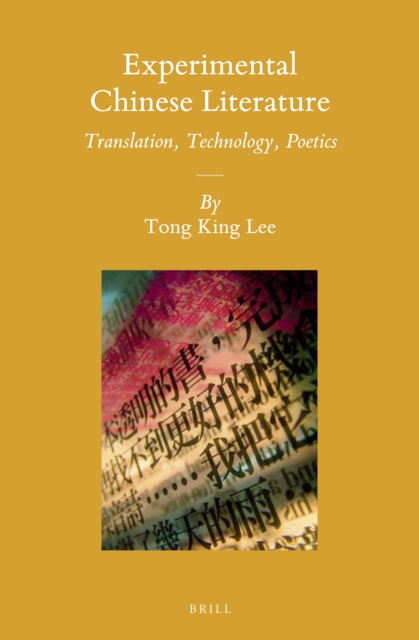
Experimental Chinese Literature
Experimental Chinese Literature is the first theoretical account of material poetics from the dual perspectives of translation and technology. Focusing on a range of works by contemporary Chinese authors including Hsia Yü, Chen Li, and Xu Bing, Tong King Lee explores how experimental writers engage their readers in multimodal reading experiences by turning translation into a method and by exploiting various technologies.The key innovation of this book rests with its conceptualisation of translation and technology as spectrums that interact in different ways to create sensuous, embodied texts. Drawing on a broad range of fields such as literary criticism, multimodal studies, and translation, Tong King Lee advances the notion of the translational text, which features transculturality and intersemioticity in its production and reception.
eBook

A Hard-Won Success: Australian Literary Studies in China
Guanglin explores Haun Saussy's COMPARATIVE LITERATURE IN AN AGE OF GLOBALIZATION that shows Saussy's great optimism about the future of comparative literature studies. This is really a hard-won success for Saussy, considering the confluence of cultures brought about by globalization, and behind these battles is the fact that the transitional dimension of literature and culture is universally recognized. The fate of Australian literature in China is a case in point wherein Australian literary studies in China are divided into three stages: piecemeal efforts in the early years; literature-focused research later on; and multi-subject study in the third stage.
Journal Article
Transnational (Il)literacies: Reading the \New Chinese Literature in Australia\ in China
Ommundsen talks about the transnational in Australian literary studies which was the lively critical debate at the time when her colleagues Alison Broinowski, Paul Sharrad and she in 2008 embarked on the ARC-supported project \"Globalizing Australian literature: Asian Australian writing, Asian perspectives on Australian literature.\" As organizers of the 2008 conference of the Association for the Study of Australian Literature conference, the Wollongong team decided to focus on this articulation between the transnational/global and the national in Australian literary studies, hoping that the papers would shed further light on these debates, at the same time enriching the theoretical arguments underpinning their own project.
Journal Article

Translation theory and translation studies in China
This dissertation is a comparative study of \"translation theory” and \"translation studies” in China and the West. Its focus is to investigate whether there is translation theory in the Chinese tradition. My study begins with an examination of the debate in China over whether there has already existed a system of translation studies with Chinese characteristics. Centering on the debate, Chinese scholars of translation studies have split into two groups with opposite opinions. The first group that adopts an affirmative stance claims that the continuum of \"Following the Source – Seeking Faithfulness – Spiritual Similarity – Supreme Realm\" has already formed a systematic study of its own, therefore could be viewed as \"translation studies with Chinese characteristics.\" The other group who rejects the idea argues that there is no need for proposing \"translation studies with Chinese characteristics,\" because an over-emphasis on \"Chinese characteristics\" would confine the research topics of Chinese scholars inside national borders and consequently block the interaction between translation studies in China and the West. To assess the pros and cons of the debate, my study first reviews the history of translation studies in the Western and Chinese traditions and re-maps theories of translation studies in the West into a conceptual framework for my study. Then, my study examines several features of the Chinese language and conducts a linguistic analysis of translation between Chinese and English. To extend my critical and scholarly investigation, my study then turns to a linguistic analysis of several Chinese poems translated into English with the aim to see to what extent Chinese poetry is or is not translatable. The insights obtained from the linguistic analysis suggest that the proposal of \"translation studies with Chinese characteristics” is a topic that requires more systematic and in-depth research in the future. Therefore, I have drawn a tentative conclusion: there is a Chinese theory of translation in the Chinese tradition, but the claim to a full-fledged translation studies with Chinese characteristics does not stand on solid ground because the existing system is conceptually weak and lacks adequate supporting research.
Dissertation