
Catalogue Search | MBRL


Are you sure you want to remove the book from the shelf?

{{itemTitle}}
6,443
result(s) for
"Poitiers"
Sort by:
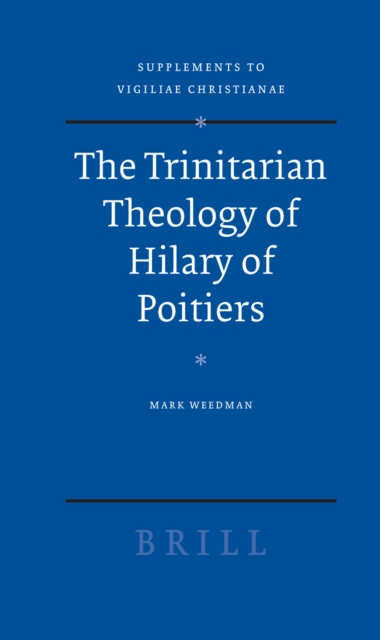
The Trinitarian Theology of Hilary of Poitiers
This book offers a new reading of Hilary's Trinitarian theology that takes into account the historical context of Hilary's thought. It shows how Hilary's exile altered his theological sensibility, and it examines the theological themes that emerged from this new context.
eBook

A Model for the Christian Life
In this examination of Hilary's treatise, Paul C. Burns discusses the intended audience of Hilary's text and the use of the Psalms by Christians in the fourth century. He identifies Hilary's distinctive perspectives; his dependence on Origen; his Latin theological and exegetical tradition; and the creative directions of Hilary's thought.
eBook

Radegund of Poitiers in Modern Scholarship: Recurrent Themes and Portrayals
Radegund of Poitiers (520–587) was a princess of the Thuringian kingdom, wife to the Merovingian king Clothar I, and ultimately domina of the abbey of Sainte-Croix in Poitiers. The literary persona of Saint Radegund, as constructed by the poet-hagiographer Venantius Fortunatus and, a few years later, by the nun Baudonivia, underpins the historical figure. The saint exerted a significant cultural influence across Frankish territories, and over the ages her image has been continuously received, reinterpreted, and expanded. The purpose of this study is to provide a survey of the critical reception of Radegund’s character, in order to explore how modern scholarship has interpreted and reimagined her persona over time.
Journal Article

HILARY OF POITIERS AND THEOLOGICAL LANGUAGE
Hilary of Poitiers deals with the question concerning our knowledge of God. Knowledge of God will never be attained by human efforts. God is only known through Jesus who is God in the human flesh. We learn this not from philosophy, but from the apostle John. The reality of God in Christ precedes our knowledge of God, and this knowledge dominates language. The word “Trinity” refers to this knowledge, but it has no meaning apart from the confession that Christ is homoousios with both the Father and the Spirit. Consequently, Hilary does not attempt to render the Trinity understandable. It is simply another word for homoousios.
Journal Article
Hilary of poitiers and theological language
Hilary of Poitiers deals with the question concerning our knowledge of God. Knowledge of God will never be attained by human efforts. God is only known through Jesus who is God in the human flesh. We learn this not from philosophy, but from the apostle John. The reality of God in Christ precedes our knowledge of God, and this knowledge dominates language. The word “Trinity” refers to this knowledge, but it has no meaning apart from the confession that Christ is homoousios with both the Father and the Spirit. Consequently, Hilary does not attempt to render the Trinity understandable. It is simply another word for homoousios.
Journal Article
Digging Up the Past, Complicating the Present, and Damaging the Future: Post-Postmodernism and the Postracial in Percival Everett’s IThe Trees/I
Percival Everett has published almost thirty books of fiction in forty years, and The Trees is his 22nd novel. It revisits ideas from Everett’s earlier works while asking questions that, in some ways, tie his oeuvre together—these questions can be linked to temporality and history, problematic literary ideas such as post-postmodernism, and both racialised trauma and the flawed cultural concept of the postracial. In this article, I argue that The Trees specifically problematises claims of the postmodern end of history by suggesting that African American literary narrative can productively reckon with a history of mistreatment by literally digging up the past and actively (impossibly) changing it.
Journal Article

Sickle Cell Disease — A History of Progress and Peril
Given sickle cell disease’s prevalence among black Americans, questions of race and stigma have shadowed the history of its medical treatment. Recent developments in treating pain crises and gene therapy are part of a history of slow progress tinged with constant peril.
Given the prevalence of sickle cell disease among black Americans, vexing questions of race and stigma have shadowed the history of its medical treatment. Recent developments in treating pain crises and gene therapy are part of a complex history of slow progress tinged with constant peril.
A century ago, people with sickle cell disease were clinically invisible. Even after James Herrick identified the “peculiar elongated and sickle-shaped red blood cells” associated with the disorder in 1910, it was often and easily misdiagnosed. Vulnerable to infectious diseases in a time when infant mortality ran high, most children would have been diagnosed . . .
Journal Article

UN ANÁLISIS SOBRE LA DIMENSIÓN ÉTICA Y SOTERIOLÓGICA DE LA POBREZA Y LA RIQUEZA EN LA OBRA DE HILARIO DE POITIERS
Hilario de Poitiers trata de manera tangencial la relación del hombre con los bienes materiales en varias de sus obras. En su reflexión sobre estas cuestiones, encontramos que las variables de riqueza y pobreza trascienden su significado puramente material para denotar estados espirituales de la humanidad en relación con el cambio de paradigma que se opera a raíz de la encarnación. Exploraremos la exégesis del obispo de Poitiers en torno a episodios tan significativos para comprender el tema abordado como el concepto de pobreza de espíritu emanado de la primera bienaventuranza, la parábola del joven rico y el relato del pobre Lázaro, así como otros motivos bíblicos relacionados con los bienes y la justa retribución en el mundo sensible y en el más allá.
Journal Article

Trinity – Simply: These three are one
Trinity has been one of the core topics of theology during the last half century. Especially, the idea of a social Trinity has been promoted by leading theologians. This interpretation of the Trinity is often related to the theology of the Cappadocian fathers at the end of the 4th century, in contrast to the individualistic trinitarian discourse of Augustine, the father of Western theology. It appears that this theory is an untenable construct. The first leading theologian who developed the concept of the social Trinity, Jürgen Moltmann, did not relate it to the Cappadocians but to Augustine. It was especially John Zizioulas who promoted Cappadocian trinitarian theology as a base for social relations. By doing so, he not only neglected the social interpretation of Augustine by Moltmann but also disregarded the fundamentally apophatic character of Cappadocian theology. The discourse of the Cappadocians is about the way God is different from human beings, and its focus is not on relations of persons but about mutual indwelling of divine expressions of being. A social Trinity could rather be related to the African Tertullian. However, finally, the Trinity is not more than a formula for telling that the Father, the Son and the Spirit are real persons, and really one, as well. It is a formula of God talk, which serves worship and Christian life, and has no analogy in human beings or relations, as Hilary of Poitiers argued. This conclusion returns the doctrine of the Trinity to its basic meaning within the discourse on God. It has its own stance, and it should not be burdened by speculations on desired human relations.Intradisciplinary and/or interdisciplinary implicationsFor the discipline of systematic theology the conclusion of this paper implies that the doctrine of the Trinity should not be mirrored in theological anthropology but should be restricted to the discourse on God. This will challenge theological anthropology to be developed from another perspective, with a clearer distinction of Creator and creation
Journal Article

'Nobody who saw the play would ever think that it was set in Australia originally': The Negro Ensemble company's production of 'Summer of the Seventeenth Doll'
On the surface, Ray Lawler's Australian play Summer of the Seventeenth Doll might seem an unlikely choice for the inaugural season of the New York-based Negro Ensemble Company (NEC). Premiering in Melbourne in 1955, The Doll explores the relation- ships of two white sugarcane cutters and their girlfriends during the summer hiatus between cane-cutting seasons. The Doll is a canonical play in Australian drama, portraying - for the first time - white working-class Australians in an urban milieu, speaking in the accent of Australians. The NEC, founded in 1967 at the height of the civil rights movement, explicitly aimed to culturally and materially improve the lives of African Americans by producing work about Black experiences, for Black audiences, and by Black theatre prac- titioners. 1 However, in apparent contradiction to these aims, the NEC's co-founder and Artistic Director, Douglas Turner Ward, programmed The Doll in the company's debut season. In a move that would surprise Australian readers, he relocated it from Melbourne to New Orleans and cast it entirely with Black actors. What had been seen as a quintessentially (white) Australian play now spoke about Black lives and Black experiences.
Journal Article