
Catalogue Search | MBRL


Are you sure you want to remove the book from the shelf?

{{itemTitle}}
6
result(s) for
"Pol d 2"
Sort by:

Comparative Assessment of the Allergenicity of Hyaluronidases from Polistes dominula (Pol d 2), Vespula vulgaris (Ves v 2), and Apis mellifera Venom (Api m 2)
Sensitization to cross-reactive allergens complicates identifying the culprit insect in Hymenoptera venom allergy via diagnostic tests. This study evaluates sensitization to hyaluronidases (Api m 2 from honey bee (Apis mellifera) venom, HBV; Pol d 2 from European paper wasp (Polistes dominula) venom, PDV; and Ves v 2.0101 and Ves v 2.0201 from yellow jacket (Vespula vulgaris) venom, YJV) and their cross-reactivity in allergic patients from Italy, Spain, and Germany using ImmunoCAPs, ELISA, and basophil activation tests. Sensitization rates were 45% for Api m 2 in HBV-allergic subjects, 25% for Pol d 2 in PDV-allergic individuals, and 20% and 10% for Ves v 2.0201 and Ves v 2.0101 in YJV-allergic patients, respectively. Patients primarily sensitized to Api m 2 showed minimal cross-reactivity to vespid hyaluronidases, whereas those primarily sensitized to Pol d 2 or Ves v 2.0201 exhibited IgE reactivity to Api m 2. Neither Pol d 2 nor Ves v 2.0201 triggered basophil activation. Cross-reactivity of Api m 2, Pol d 2, and Ves v 2.0201 depends on the primary sensitizing venom. Sensitization to Pol d 2 and Ves v 2.0201 remains below 25%, yet these patients may exhibit cross-reactivity to Api m 2. Conversely, HBV-allergic patients sensitized to Api m 2 show minimal reactivity to Pol d 2 or Ves v 2.0201.
Journal Article

The Rights of Others
The Rights of Others examines the boundaries of political community by focusing on political membership - the principles and practices for incorporating aliens and strangers, immigrants and newcomers, refugees and asylum seekers into existing polities. Boundaries define some as members, others as aliens. But when state sovereignty is becoming frayed, and national citizenship is unravelling, definitions of political membership become much less clear. Indeed few issues in world politics today are more important, or more troubling. In her Seeley Lectures, the distinguished political theorist Seyla Benhabib makes a powerful plea, echoing Immanuel Kant, for moral universalism and cosmopolitan federalism. She advocates not open but porous boundaries, recognising both the admittance rights of refugees and asylum seekers, but also the regulatory rights of democracies. The Rights of Others is a major intervention in contemporary political theory, of interest to large numbers of students and specialists in politics, law, philosophy and international relations.
eBook

Cell cycle-dependent dynamic association of cyclin/Cdk complexes with human DNA replication proteins
We have previously described the isolation of a replication competent (RC) complex from calf thymus, containing DNA polymerase α, DNA polymerase δ and replication factor C. Here, we describe the isolation of the RC complex from nuclear extracts of synchronized HeLa cells, which contains DNA replication proteins associated with cell‐cycle regulation factors like cyclin A, cyclin B1, Cdk2 and Cdk1. In addition, it contains a kinase activity and DNA polymerase activities able to switch from a distributive to a processive mode of DNA synthesis, which is dependent on proliferating cell nuclear antigen.
In vivo
cross‐linking of proteins to DNA in synchronized HeLa cells demonstrates the association of this complex to chromatin. We show a dynamic association of cyclins/Cdks with the RC complex during the cell cycle. Indeed, cyclin A and Cdk2 associated with the complex in S phase, and cyclin B1 and Cdk1 were present exclusively in G
2
/M phase, suggesting that the activity, as well the localization, of the RC complex might be regulated by specific cyclin/Cdk complexes.
Journal Article

Asia's next giant : South Korea and late industrialization
The important book contends that South Korea's phenomenal economic growth is attributable to \"late industrialization,\" the process in which a nation's industries learn or borrow from other innovator nations, rather than innovate themselves. Amsden focuses on the principle of reciprocity and compares South Korea's experience to that of Japan and other late industrializing nations.
eBook
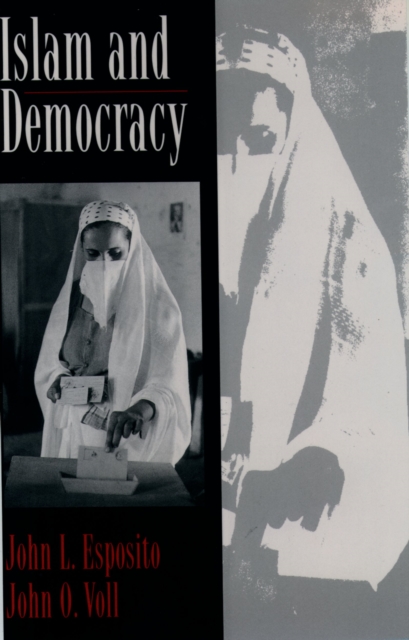
Islam and democracy
Religious resurgence and democratization have been two of the most significant developments of the last quarter of the twentieth century. Frequently they work together; other times they are at odds. In the muslim world, this relationship is of special importance because of the strength of the Islamic resurgence, and the intensity of muslim demands for greater popular participation in political processes Esposito and Voll use six case studies to look at the history of this relationship and the role played by new Islamic movements. At one end of the spectrum, Iran and Sudan represent two cases of militant, revolutionary Islam opposing the political system. In Algeria and Malaysia however, the new movements have been legally recognized and made part of the political process. The authors identify several important factors, such as the legality or illegality of the new Islamic movements and the degree to which they cooperate with existing rulers, as being key to understanding the success or failure of these movements. Still, the case studies prove that despite the commonalities, differing national contexts and identities give rise to differences in agenda and method. This broad spectrum of experience contains important lessons for understanding this complex and subtle relationship, and will also provide insight into the powerful forces of religion and democracy in a broader global context.
eBook
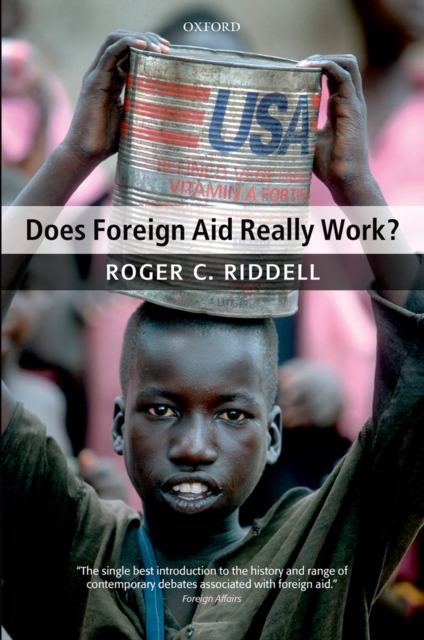
Does Foreign Aid Really Work?
Provided for over 60 years, and expanding more rapidly today than it has for a generation, foreign aid is now a 100bn business. But does it work? Indeed, is it needed at all? In this first-ever, overall assessment of aid, Roger Riddell provides a rigorous but highly readable account of aid, warts and all.
eBook