
Catalogue Search | MBRL


Are you sure you want to remove the book from the shelf?

{{itemTitle}}
230
result(s) for
"Polish drama"
Sort by:

Nowe przestrzenie subiektywności: Radiowy genotyp dramaturgii współczesnej
Artykuł dowodzi, że najważniejszym bohaterem nowej polskiej dramaturgii stał się sam dyskurs dramatyczny, uwolniony spod reżimu tekstowej struktury i tradycyjnej organizacji. Autor przekonuje, że zapisywane w postaci językowego streamingu dramatyczne kolaże, montaże i hybrydy swoim kształtem odwzorowują sposób komunikowania się ludzi współczesnych w zmediatyzowanej rzeczywistości. Naczelną cechą tego procesu jest wielokanałowość przekazu, którą autor skojarzył z nowymi technologiami zapisu dźwięku, jego nadawania i odbioru w słuchowisku radiowym (system dźwięku przestrzennego 5.1). Porównanie poetyki dramatów współczesnych z utworami pisanymi specjalnie dla radia (takich autorów jak Tomasz Man czy Krzysztof Czeczot) ujawnia zaskakujące zbieżności, wśród których najważniejszą jest głęboka subiektywizacja świata przedstawionego dramatu. Analizując utwory Mariusza Bielińskiego (i wspominając twórczość Zyty Rudzkiej, Artura Pałygi, Weroniki Murek czy Mateusza Pakuły), autor formułuję tezę o radiowym genotypie nowej polskiej dramaturgii, która rzadko pojawia się na scenach, za to bardzo często realizowana jest w Teatrze Polskiego Radia.
Journal Article
Wczesna dramaturgia Stefana Żeromskiego w świetle jego fascynacji teatrem
Artykuł prezentuje kontekstową interpretację dwóch wczesnych dramatów Stefana Żeromskiego, Grzech i Dramatu akt pierwszy, niepublikowanych i niewystawianych za życia pisarza i odkrytych dopiero w 1945 i 1959 roku. Żeromski przez całe życie fascynował się teatrem, czego wyrazem może być na przykład jego nieukończony esej \"Pochwała sztuki teatru\" z 1924 roku lub odpowiedź na ankietę przygotowaną przez \"Przegląd Warszawski\" dotyczącą Teatru Narodowego w Warszawie, który wtedy ponownie otwierał swoje podwoje. Jego poglądy są bliskie ideom głoszonym przez twórcę narodowej sceny, Wojciecha Bogusławskiego, a także wszystkim formułowanym w XIX wieku poglądom, które podkreślały społeczną i patriotyczną misję polskiego teatru. Artystyczna wyobraźnia pisarza kształtowała się na podstawie konwencji teatru XIX wieku, opartego na iluzji scenicznej, zasadzie psychologicznej wiarygodności i wymaganiach naturalnego wyrazu aktorskiego. Głosząc pierwszeństwo deklamacji i słowa poetyckiego w teatrze, Żeromski opowiadał się za literackimi teoriami dramatu. Grzech i Dramatu akt pierwszy (który pozostał nieukończony) to dowód zdolności dramaturgicznych autora. W obu tekstach jego nowatorskie podejście do tematyki i problemów społecznych łączy się z konwencjami dramatu i teatru XIX wieku. Pierwsza inscenizacja Grzechu z nowym zakończeniem napisanym przez Leona Kruczkowskiego w 1950 roku stanowi interesujący epizod w historii polskiego życia teatralnego w połowie XX wieku, świadczący o ówczesnych ograniczeniach ideologicznych i politycznych.
Journal Article
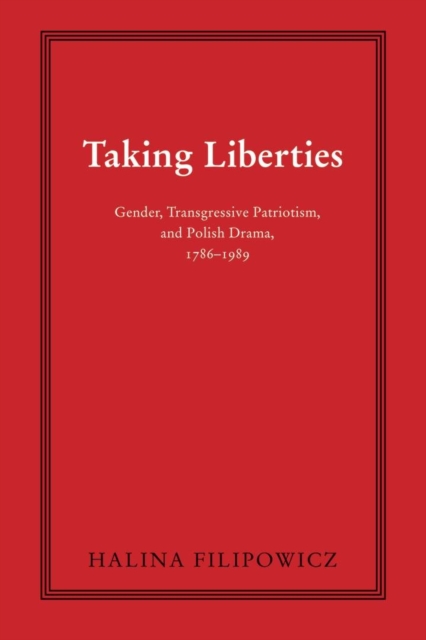
Taking Liberties
As narrow, nationalist views of patriotic allegiance have become widespread and are routinely invoked to justify everything from flag-waving triumphalism to xenophobic bigotry, the concept of a nonnationalist patriotism has vanished from public conversation.Taking Libertiesis a study of what may be called patriotism without borders: a nonnational form of loyalty compatible with the universal principles and practices of democracy and human rights, respectful of ethnic and cultural diversity, and, overall, open-minded and inclusive.Moving beyond a traditional study of Polish dramatic literature, Halina Filipowicz turns to the plays themselves and to archival materials, ranging from parliamentary speeches to polemical pamphlets and verse broadsides, to explore the cultural phenomenon of transgressive patriotism and its implications for society in the twenty-first century.In addition to recovering lost or forgotten materials, the author builds an innovative conceptual and methodological framework to make sense of those materials. The result is not only a significant contribution to the debate over the meaning and practice of patriotism, but a masterful intellectual history.
eBook
Jakiego «Sokratesa» nie wystawili Lenartowiczowi aktorzy warszawscy w 1884 roku?
Teofil Lenartowicz’s “dramatic poem” Sędziowie ateńscy (The Judges of Athens, 1895), eventually published after his death, not only took several years to write, but was also probably rewritten from scratch a number of times, under different titles (including Socrates). Some versions have survived in printed excerpts, others in manuscripts. One of the early redactions, different from the published text based on the last autograph, was the theater version prepared in 1884. The piece was not staged, for reasons that remain unclear. The copy retrieved from the theater is presently highly incomplete (with only one of five acts extant), but its text coincides with another surviving copy; based on the latter, the present article attempts a reconstruction of the performance, as designed by Lenartowicz. Attention has been paid to the stage design, metatheatrical devices, the unstable arrangement of the acts, and the relationship between word and gesture. The article also emphasises that both the theater project and the dramatic text differ strongly from the posthumously published version of the play.
Journal Article
Opium nieszkodliwe teatru, czyli o «Tragedii Eumenesa» Tadeusza Rittnera
According to Zbigniew Raszewski, Tragedia Eumenesa (The Tragedy of Eumenes) was one of Tadeusz Rittner’s worst plays. The present article engages polemically with this opinion. It evokes favourable reviews that followed the play’s 1920 premiere at the Juliusz Słowacki Theater in Kraków, as well as Lesław Eustachiewicz’s positive assessment from 1961. It also revisits the reviews of the 1922 flop at the Reduta Theater, which, paradoxically, reveal the text’s potential, namely the possibility of reading of the manuscript. Rittner’s comedy employs a poetics of the grotesque, farce, and irony, and, above all, uses overt theatricality and the category of dream as quasi reality. The author of the article identifies the theoretical foundations of this late drama in Rittner’s programmatic essay O snach i bajkach (On Dreams and Fairy Tales, 1909), where he does not renounce kitsch or fairy-tale props. The analysis leads to the conclusion that in The Tragedy of Eumenes, Rittner consciously engages in a dialogue with the aesthetics characteristic of the decline of the Habsburg monarchy—with its fascination with masquerade and Spanish theatre, as well as the poetics of dream and adventurous fairy-tale—and at the same time opens his text to multiple staging possibilities.
Journal Article
Psy, ludzie i Bóg: Ekoteologia w dramatach Mariusza Bielińskiego i Jarosława Jakubowskiego
Mariusz Bielinski’s Księga Psa (The Book of Dog) and Jarosław Jakubowski’s Pies (The Dog) are two dramatic texts portraying the relationship between humans and animals in an original way. In both plays, the dog is an entity in its own right, a representative of the “companion species” to the human being (Haraway), “member of the family group” (Baratay) and the “zoe-egalitarian” community as understood in contemporary posthumanism (Braidotti). The author of the essay evokes these categories and then transcends them by exploring the metaphysical concept of human-animal relations depicted in the plays under discussion. Bieliński’s and Jakubowski’s protagonists turn to retrospective, which takes the form of writerly and existential mourning rite for a dead dog, leading to a profound transformation of their consciousness. By juxtaposing the fate of the suffering animal with the Passion of Christ, both authors deconstruct the petrified truths of Christian faith, renewing and incorporating them into the space of their own experience and discourse. Therefore, the proposed interpretation of the dramas combines the ecological perspective with theology. The author refers to Linzey’s concept of “animal theology” (the sacrifice of Jesus Christ as a model of interspecies relations) and posits, drawing on Gadamer and Lévinas, that both plays are centred around the hermeneutical question of whether the “spiritual distance” that has arisen between God and humans in our era can be overcome by modern humanity by turning towards the animal in order to “assimilate” its “strangeness” and thus open up to the “strangeness” of God.
Journal Article
Wolność, historia, pacyfizm: O dramatach Stanisława Hadyny
This article discusses the dramatic output of Stanisław Hadyna, a folklorist and composer, known above all as the founder of Śląsk Song and Dance Ensemble. The author analyzes Hadyna’s four unpublished dramas, written in 1969–1976, originally in English, then in Polish, and awarded at UNESCO competitions. Their protagonists include Thomas Paine, Martin Luther King, and Mahatma Gandhi. The article also draws on the documentation of the staging of one of these plays, Declaration 76, at Krakow’s Juliusz Słowacki Theatre in 1977; during the decline of the communist Polish People’s Republic, it carried a courageous civic message. The author presents Hadyna’s works as dramas of freedom and oppression in different historical periods; he interprets them as letters from a besieged world and, at the same time, as poetic treatises on the experience of loneliness and separateness. He emphasizes the homiletic dimension of these works, which are constructed as sermons written for many voices, and points to the Lutheran provenance of Hadyna’s evangelical-spiritual vision of man. Hermeneutical analyses highlight the eclectic nature of the playwright’s dramaturgical solutions and interpret his use of various theatrical and performative conventions (mystery play, tableau vivant, epic theater, happening) and religious traditions.
Journal Article