
Catalogue Search | MBRL


Are you sure you want to remove the book from the shelf?

{{itemTitle}}
12
result(s) for
"Polish language Grammaticalization."
Sort by:

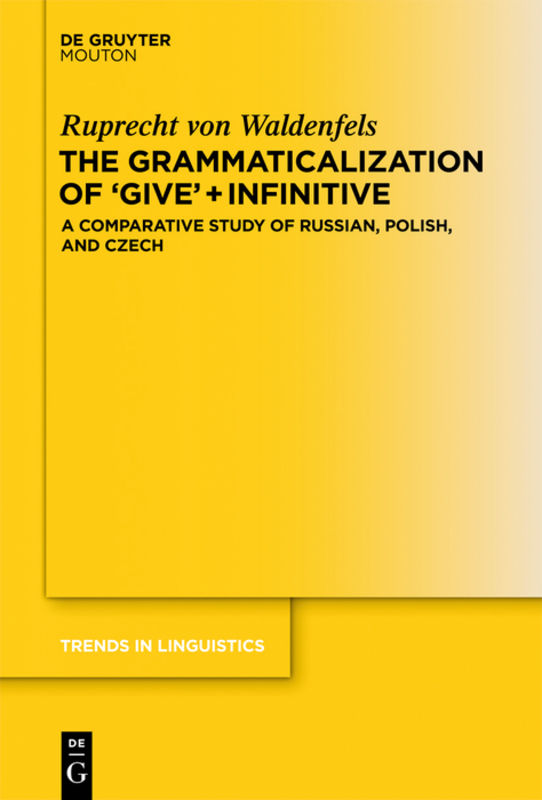
The Grammaticalization of 'Give' + Infinitive
Verbs denoting 'to give' have developed grammatical meanings in many languages of the world. The present study analyses the grammaticalization of give in causative and modal constructions in the closely related Slavic languages Russian, Polish and Czech.
Adopting a corpus driven approach, it takes departure from a detailed analysis of the use of these constructions in large reference corpora. This synchronic approach is supplemented by an analysis of the use of these constructions in Old Church Slavonic and by diachronic corpus-based accounts of the developments in Czech and Polish.
The study provides thorough descriptions of the syntax and semantics of causative constructions, ranging from permissive (letting someone do something) and reflexive permissive (letting something be done to oneself) to factitive causative (having something done by someone). It traces the development and synchronic status of modals that have developed out of reflexive permissives in Polish and Czech. General issues discussed in the study include polarity sensitivity in causatives, types of causee coding, the emergence of non-agreeing diathesis structures in Polish and the role of language contact with German.
eBook

Temporal Affixation in Polish Sign Language
The following article undertakes another analysis of affixation in Polish Sign Language (PJM). This time the question concerns affixes carrying temporal significance. In a previous issue of this journal, negative affixation in PJM was discussed. As it turns out, in addition to these negative morphemes, PJM also possesses suffixes that relate to time: year, day, hour, minute and second. It has been observed that these affixes have undergone partial or complete grammaticalization. As discussed in this paper, there are some restrictions on the use of temporal suffixes, which are caused by numeral incorporation. In addition to these affixes, there are also two morphemes in PJM, which do not represent a time measure. One of these signifies the completion of an educational stage and the other refers to the future performance of an action.
Journal Article

Constraints on Negative Prefixation in Polish Sign Language
The aim of this article is to describe a negative prefix, NEG-, in Polish Sign Language (PJM) which appears to be indigenous to the language. This is of interest given the relative rarity of prefixes in sign languages. Prefixed PJM signs were analyzed on the basis of both a corpus of texts signed by 15 deaf PJM users who are either native or near-native signers, and material including a specified range of prefixed signs as demonstrated by native signers in dictionary form (i.e. signs produced in isolation, not as part of phrases or sentences). In order to define the morphological rules behind prefixation on both the phonological and morphological levels, native PJM users were consulted for their expertise. The research results can enrich models for describing processes of grammaticalization in the context of the visual-gestural modality that forms the basis for sign language structure.
Journal Article

Studi italiani sull'aspetto verbale slavo
The aim of this article is to present the Italian studies on Slavic verbal aspect published between the years 1990-2020. Issues analyzed in this survey include (but are not limited to) the meanings of the perfective and imperfective aspects, actionality, the role of prefixes and suffixes in the grammaticalization of aspect, the interaction between aspect and other verbal categories, and the pragmatic uses of aspect. Moreover, the diachronic and typological perspectives are considered as well as the acquisitional perspective. Verbal aspect is explored in a group of Slavic languages, including Russian, Czech, Polish, Bulgarian, Serbian, Croatian, Slovenian, and Resian. It is argued that further research on verbal aspect in other Slavic languages can shed a new light on this issue.
Journal Article

Przyimki polskie a tendencja analityczna języków indoeuropejskich
Polish prepositions and analytic tendencies in Indo-European languagesAs analytic tendencies in Indo-European languages intensify, grammatical forms and lexemes become generalised. In the realm of prepositions, we observe not only semantical generalisation of a limited set of units (including at least de and à) but also their grammaticalization. Both these prepositions: 1. can perform grammatical functions; 2. due to their general and blurry semantics can easily replace a number of specific prepositions, including dans, sur, vers and contre, either introducing a slight change in meaning or without causing such change. In examples like le train de Paris, le chemin de Fatima, which signify place of origin or direction (place of destination), the preposition can be replaced by e.g. pour. In the examples quoted, the preposition signifies a clarification rather than a spatial relation.Polish preposition are, in their turn, all semantical. One argument in favour of this assertion is that the most frequently occurring Polish preposition w is a textual equivalent of the more specific French dans rather than the less specific en. Les prépositions polonaises et la tendance analytique des langues indo-européennesAu fur et à mesure de la tendance analytique qui se manifeste dans les langues indo-européennes, les formes grammaticales et les lexèmes tendent à la généralisation. Dans le domaine des prépositions on observe non seulement la généralisation de la sémantique d’un groupe réduit d’unités (au moins de de et à), mais aussi leur grammaticalisation. Les deux 1º peuvent exercer des fonctions grammaticales et 2º en vertu de leur sémantique générale et affaiblie, sont susceptibles de se substituer à un certain nombre de prépositions concrètes telles dans, sur, vers, contre et autres en introduisant une légère modification de sens ou non. Dans les exemples tels que le train de Paris, le chemin de Fatima, qui expriment soit la provenance soit la destination, la préposition peut être remplacée entre autres par pour. Dans ces exemples elle marque la détermination plutôt qu’une relation spatiale.Les prépositions polonaises sont toutes sémantiques. Un argument est que w, la plus fréquente préposition polonaise, est un équivalent textuel plus souvent de fr. dans, plus spécifique, que de en, moins spécifique.
Journal Article
Polish in the light of grammaticalization theory
The paper is concerned with \\textit{grammaticalization}, a type of language change whereby lexical items, in specific contexts, come to serve grammatical functions, and grammatical items acquire new grammatical functions. The aim is twofold: to shed light at the main properties of rammaticalization, and to demonstrate its applicability to Polish data. Some prominent examples in Polish are discussed: the grammaticalization of modals, imperative and avertive constructions. The paper closes with a non-exhaustive list of leads for further research into grammaticalization in Polish.
Journal Article

Kongruenzbrüche in slovakischen possessiven Resultativa (Evidenz aus dem Slovakischen Nationalkorpus)
Possessive resultative constructions containing a HAVE-verb and a past passive participle have been used in West Slavic languages for centuries without showing a rapid grammaticalisation into a perfect (cf. evidence from Polish and Czech). The same holds for Slovak, where examples can be found at least from the 17th century on without rapidly changing on the grammaticalisation chain. At the same time, Krupa demonstrated in 1960 a loss of congruence between object and past passive participle in possessive resultatives in colloquial Slovak distinguishing different types. Loss of congruence is often considered to be an important grammaticalisation step for emerging participial perfects. A sought in the Slovak National Corpus brought some evidence for such constructions in journalistic texts and from the Internet (the same types as used by Krupa), but their frequency is very low so far.
Journal Article

Configuraciones espaciales estables en procesos de gramaticalización: un ejemplo en polaco/The Stability of Spatial Configurations in Grammaticalization Processes: A Case Example in Polish
Abstract The Stability of Spatial Configriratíons in Grammaticalization Processes: A CaseExample in Polish Cognitive scientific tools have opened up a new path-way to the stady of gramniaticalization. Using some of these tools such as Blending theory, image-schemata, and connexionist networks in the analysis of Polish prefixes, we demonstrate that spatial configuration plays a prominent role in the implementation of grammatícalization. Spatial Language and Consírained Connectionism, MIT Press, Cambridge. VARELA, F., THOMPSON, E., ROSCH, E. (1991): The Embodied Mind: Cognitive Sciences and Human Experience, MIT Press, Cambridge.
Journal Article
The role of gender in the rise of numerals as a separate category
The paper presents evidence concerning the trigger of numeralization of Polish higher numerals based on diachronic facts pertinent to their development. We focus on the reasons behind this process and argue that it resulted from a combination of two historical facts: (i) the development of the category of animacy/ personhood/masculinity, in particular masculine personal, and (ii) its grammaticalization via the introduction of a new Acc/Gen syncretism into the paradigms of masculine animate and masculine personal nouns. We propose that the developing new gender distinction in the plural constituted the trigger for numeralization of the nominal numerals which shifted from NP to NumP and as lexicalizations of NumP they began spelling out the gender information it introduced. As a result of this process, numerals have lost their own nominal properties (-features: number, gender), and formed a separate category with its own new declension.
Paper