
Catalogue Search | MBRL


Are you sure you want to remove the book from the shelf?

{{itemTitle}}
16,675
result(s) for
"Political Scientists"
Sort by:


What Has This Got to Do with the Liberation of Black People?
It is rare that a major leader of a protest movement also becomes
an accomplished scholar who provides valuable insight into the
movement in which he participated. Yet this was precisely what
Ronald W. Walters (1938-2010) did. Born in Wichita, Kansas, the
young Walters led the first modern sit-in protest during the summer
of 1958, nearly two years before the more famous Greensboro sit-in
of 1960. After receiving a doctorate from American University,
Walters embarked on an extraordinary career of scholarship and
activism. Shaped by the civil rights and black power movements and
the African and Caribbean liberation struggles, Walters was a
pioneer in the development of black studies and \"black science\" in
political science. A public intellectual, as well as advisor and
strategist to African American leaders, Walters founded numerous
organizations that shaped the post-civil rights era. A must read
for scholars, students, pundits, political leaders, and activists,
What Has This Got to Do with the Liberation of Black
People? is a major contribution to the historiography of the
civil rights and black power movements, African American
intellectual history, political science, and black studies.
eBook


Disrupting science
In the decades following World War II, American scientists were celebrated for their contributions to social and technological progress. They were also widely criticized for their increasingly close ties to military and governmental power--not only by outside activists but from among the ranks of scientists themselves. Disrupting Science tells the story of how scientists formed new protest organizations that democratized science and made its pursuit more transparent. The book explores how scientists weakened their own authority even as they invented new forms of political action.
eBook

Democratic theorists in conversation : turns in contemporary thought
\"The principles and practices of democracy in the twenty-first century have changed drastically from how they were understood hundreds and even thousands of years ago. In the world today, we not only think about democracy differently and practice it differently, we are also predicting new and distinct futures for it. On top of this, the origins of democracy have been brought into question while democratic theory has been picked apart and the practice of democracy has been presented with new challenges. This book argues that the result of these changes is a new understanding of democracy termed 'new democratic theory'. Through interviews with renowned democratic theorists working today, Ulrich Beck, Noam Chomsky, John Dryzek, John Dunn, Francis Fukuyama, David Held, Ramin Jahanbegloo, John Keane, Pierre Rosanvallon, Thomas Seeley, and Albert Weale, this book provides an in-depth exploration of new democratic theory. The result is striking with each interview highlighting new dimensions and changes to our understanding of democracy.\"--Publisher's website.
Book

The triumph of partisanship: political scientists in the public debate about Catalonia’s independence crisis (2010–2018)
Participation in the public debate constitutes one of the most evident avenues for political scientists to demonstrate the social relevance of the discipline. This article focuses on two questions: the types of roles political scientists adopt in their public interventions and the potential tensions between their public engagement and the epistemic norms regulating academic and research activities. We investigate these questions in the context of very salient political debates, involving a high degree of political confrontation, where basic political beliefs, values, identities, and interests are at stake. Focusing on the case of the public debate surrounding the Catalan independence crisis (2010–2018), we demonstrate that in this type of context, (1) political scientists mostly adopt a partisan stance in their public interventions, yet it is also frequent that this is combined with the presence of academic elements in their discourse; (2) demand side factors (media outlets’ editorial lines) reinforce these partisan dynamics. These findings show that opportunities for increasing the social relevance of political scientists in these highly contentious contexts might come at the price of creating tensions that could erode the legitimacy of political science knowledge before the public.
Journal Article

Political philosophy in the twentieth century : authors and arguments
\"We demonstrate the rich diversity and depth of political philosophy in twentieth century essays on the lives and works of eighteen eminent political theorists, including representative of the three main political alternatives--in the first half of the twentieth century, emigres like Hannah Atendt and Leo Strauss who brought a continental perspective to the U.S. after World War II, more recent defenders of libralism, and its many critics. There is no other book on the market like this, aimed at professors and students of political theory\"-- Provided by publisher.
Book
Tackling the challenge of liberal democracy in Israel: the role of political scientists in the civic studies debate
Recent trends suggest that liberal democracy in Israel experiences tensions. Although such a crisis calls for the involvement of political scientists in this public debate, the bulk of political scientists has refrained from visible activity. The exception to this rule is the civic studies arena in which a small group of political scientists is deeply and visibly engaged. Civic education, which Israel integrates into the civic studies subject, is a central political socialization tool. As a deep controversy rages in Israel regarding the meaning of the “democratic” and the “Jewish” components of the state’s identity, civic studies arouse strong emotions. This arena enables political scientists, who are divided into the liberal and the conservative camps, to remain out of the limelight of the general public debate about the illiberal turn, while at the same time engaging heavily in its shaping. The civic studies issue constitutes an example of how collective engagement of political scientists on specific policy issues, may constitute an opportunity for these scholars, their visibility and enhance to therefore, their social relevance. A qualitative analysis of the case study of civic studies in Israel demonstrates the various ways of involvement employed by political scientists in the illiberal turn debate.
Journal Article

The man who understood democracy : the life of Alexis de Tocqueville
\"Alexis de Tocqueville (1805-1859)-who was born in the shadow of the French Revolution and died a few years before the American Civil War-witnessed a remarkable era in the history of the West. His aristocratic family survived the revolutionary period, though many branches were cut down during the Terror, and Alexis grew up with a keen understanding that one world was ending and a new one was being born. Adventurous and curious, he traveled extensively in North America as a young man. There, he trained his observant eyes on his official duties-documenting conditions in the prison system-but became fascinated with America's experiments in democracy. Tocqueville was an avid political theorist, and he recorded his impressions in Democracy in America, still read to this day and considered one of the most provocative and insightful commentaries on the American experience. Tocqueville remained both an intellectual and an active politician for the majority of his life. He watched the revolutions take hold in 1848 across Europe, and he died in 1859, after penning his other famous work, The Old Regime and the Revolution. In this book, Olivier Zunz aims to convey how the world in which Tocqueville lived became his laboratory for political theory. Without downplaying Tocqueville's anxieties about the future, or about democracy's potential pathologies, Zunz places dedication to achieving a new kind of democracy at the center of his subject's life and work. He takes seriously Tocqueville's attempts to apply the lessons of his texts to French politics, and, throughout, he looks to Tocqueville's political career and activism as a guide to the meaning of his major texts. Drawing on his unparalleled familiarity with Tocqueville's own words and letters, Zunz offers a definitive biography of a remarkable thinker whose life formed a ligature between the ancien régime and the emerging democratic age\"-- Provided by publisher.
Book
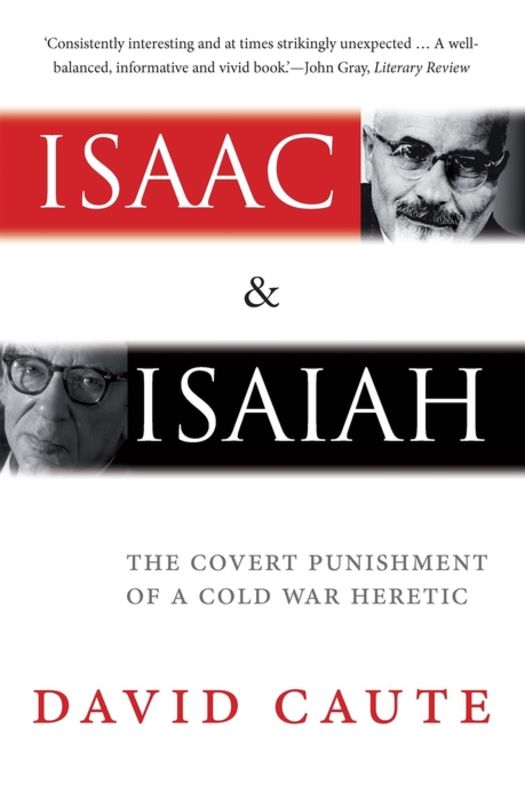
Isaac and Isaiah
Rancorous and highly public disagreements between Isaiah Berlin and Isaac Deutscher escalated to the point of cruel betrayal in the mid-1960s, yet surprisingly the details of the episode have escaped historians' scrutiny. In this gripping account of the ideological clash between two of the most influential scholars of Cold War politics, David Caute uncovers a hidden story of passionate beliefs, unresolved antagonism, and the high cost of reprisal to both victim and perpetrator.
Though Deutscher (1907-1967) and Berlin (1909-1997) had much in common-each arrived in England in flight from totalitarian violence, quickly mastered English, and found entry into the Anglo-American intellectual world of the 1950s-Berlin became one of the presiding voices of Anglo-American liberalism, while Deutscher remained faithful to his Leninist heritage, resolutely defending Soviet conduct despite his rejection of Stalin's tyranny. Caute combines vivid biographical detail with an acute analysis of the issues that divided these two icons of Cold War politics, and brings to light for the first time the full severity of Berlin's action against Deutscher.
eBook