
Catalogue Search | MBRL


Are you sure you want to remove the book from the shelf?

{{itemTitle}}
507
result(s) for
"Political activists Russia."
Sort by:


Staging Democracy
Focusing on the experiences of people in Russia and Ukraine, Staging Democracy shows how some national leaders' seeming popularity rests on local economic compacts. Jessica Pisano draws on long-term research in rural communities and company towns, analyzing how local political and business leaders, seeking favor from incumbent politicians, used salaries, benefits, and public infrastructure to pressure citizens to participate in command performances. Pisano looks at elections whose outcome was known in advance, protests for hire, and smaller mises en scène to explain why people participate, what differs from spectacle in totalitarian societies, how political theater exists in both authoritarian and democratic systems, and how such performances reshape understandings of the role of politics. Staging Democracy moves beyond Russia and Ukraine to offer a novel economic argument for why some people support Putin and similar politicians. Pisano suggests we can analyze politics in both democracies and authoritarian regimes using the same analytical lens of political theater.
eBook

Citizens in the Making in Post-Soviet States
The political outlook of young people in the countries of the former Soviet Union is crucial to their countries' future political development. This is particularly relevant now as the first generation without firsthand experience of communism at first hand is approaching adulthood. Based on extensive original research and including new survey research amongst young people, this book examines young people's political outlook in countries of the former Soviet Union; it compares and contrasts Russia, where authoritarianism has begun to reassert itself, and Ukraine, which experienced a democratic breakthrough in the aftermath of the Orange Revolution.
The book examines questions such as: How supportive is this new generation of the new political order? What images of the Soviet Union prevail in the minds of young people? How much trust does youth place in current political and public institutions? Addressing these questions is crucial to understanding the extent to which the current regimes can survive on the wave of public support. The book argues that Russian adolescents tend to place more trust in the incumbent president and harbour more regrets about the disintegration of the Soviet Union than their peers in Ukraine; it demonstrates that young people distrust political parties and politicians, and that patriotic education shapes social and political values.
eBook
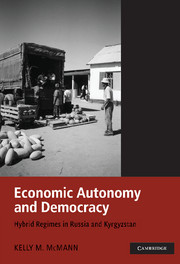
Economic Autonomy and Democracy
How do individuals decide to exercise their democratic rights? This 2006 book argues that they first assess their economic autonomy, meaning their ability to make a living independent of government authorities. Before individuals consider whether their resources and organizational abilities are adequate to act on their interests, they calculate the risk of political activism to their livelihood. This is particularly evident in regions of the world where states monopolize the economy and thus can readily harass activists at their workplaces. Economic autonomy links capitalism and democracy through individuals' calculations about activism. Accounts of activists' decisions about establishing independent media, leading political organizations, and running for office and descriptions of government harassment in Russia and Kyrgyzstan, along with examples from most regions of the world, illustrate these arguments. Economic autonomy and the interaction among democratic rights help explain the global proliferation of hybrid regimes, governments that display both democratic and authoritarian characteristics.
eBook

Online Social Media and Political Awareness in Authoritarian Regimes
Do online social media undermine authoritarianism? The conditions under which online social networks can increase public awareness of electoral fraud in non-democracies are examined in this article and it is argued that a given online social network will only increase political awareness if it is first politicized by elites. Survey data from the 2011 Russian parliamentary elections show that usage of Twitter and Facebook, which were politicized by opposition elites, significantly increased respondents’ perceptions of electoral fraud, while usage of Russia's domestic social networking platforms, VKontakte and Odnoklassniki, which were not politicized by opposition activists, had no effect on perceptions of fraud. This study elucidates the causes of post-election protest by uncovering a mechanism through which knowledge of electoral fraud spreads.
Journal Article

The Defending “Defenders”
This article focuses on the opportunities for allowing protests in contemporary Russia despite military censorship and a ban on any public action or criticism of the ongoing war against Ukraine. The research analyzes the tactics of the women’s activism that were used on Red Square in November 2023, demanding the return of their mobilized relatives. The study shows how women activists manage risks, declare demands, and avoid detention while interacting with police and officials of the Communist Party of the Russian Federation (KPRF). Through the analysis of framing perspective, the study examines the demonstration and interactions in the community’s blog. Findings indicate that the actualization of several specific framings in the movement’s action—including appropriation of the KPRF’s rhetoric and self-representation as responsible and patriotic soldiers’ wives with minor support from the KPRF—presents a space for protest in Russia’s closed political system.
Journal Article
Gender Egalitarianism of Recent Emigrants from Russia
Despite Russia’s relatively low ranking on gender equality, recent emigrants who left the country after February 2022 exhibit significantly higher levels of gender egalitarianism compared to their counterparts in Russia. This study investigates whether these attitudes are attributable to socio-demographic factors such as education and urban residence, or if deeper ideological and political factors play a role. Using data from the OutRush project on Russian emigration after 2022 and the World Values Survey, we analyze two key questions: Do recent emigrants demonstrate more egalitarian attitudes than socio-demographically similar Russians? Does gender equality of host countries influence emigrants’ attitudes? Our findings suggest that emigrants exhibit higher levels of gender egalitarianism than comparable groups in Russia, even after controlling for socio-demographic predictors. These differences persist after controlling for socioeconomic predictors, reflecting deeply ingrained values that were probably developed by the pre-migration experiences of political opposition actions and social activism. The results challenge theories of rapid acculturation and highlight the role of self-selection as a key factor underlying gender egalitarian attitudes.
Journal Article

Vote Brokers, Clientelist Appeals, and Voter Turnout: Evidence from Russia and Venezuela
Modern clientelist exchange is typically carried out by intermediaries—party activists, employers, local strongmen, traditional leaders, and the like. Politicians use such brokers to mobilize voters, yet little about their relative effectiveness is known. The authors argue that broker effectiveness depends on their leverage over clients and their ability to monitor voters. They apply their theoretical framework to compare two of the most common brokers worldwide, party activists and employers, arguing the latter enjoy numerous advantages along both dimensions. Using survey-based framing experiments in Venezuela and Russia, the authors find voters respond more strongly to turnout appeals from employers than from party activists. To demonstrate mechanisms, the article shows that vulnerability to job loss and embeddedness in workplace social networks make voters more responsive to clientelist mobilization by their bosses. The results shed light on the conditions most conducive to effective clientelism and highlight broker type as important for understanding why clientelism is prevalent in some countries but not others.
Journal Article


Popular Theopolitics and the Last Russian Tsar’s Intangible Remains
The article tells the story of the remains of the last Russian Tsar Nicholas II and his family, who were killed in Ekaterinburg in 1918, discovered in 1979, found again in 1991, solemnly buried in 1998, and canonized as saints by the Russian Orthodox Church in 2000. Thoroughly researched in the cause of official criminal investigation and identified with genetic tests in several labs in Russia and abroad, the royal remains have not been recognized by the Church. The failure to reach a consensus on the veracity of the remains of the Romanovs occurred in parallel with the inability to decide what to do with the mummified body of Soviet founder Vladimir Lenin, a contemporary of Nicholas II who has been kept in a mausoleum in the Red Square since the 1920s. Though, after 1991, voices have been raised for removing his body from this symbolic center of the country, no consensus has been reached so far as to where to move it and why. Revisiting Verdery’s famous work, the present article argues that such a movement necessitates a political commitment to voicing new notions of belonging and citizenship. The liminal status of these two bodies proves that the contemporary state in Russia is a continuation of both the Soviet and imperial state programs, not a new political structure like other post-socialist countries. Based on the works by Kantorowicz and Cherniavsky, this research develops the concept of popular theopolitics and aims to examine how people’s political and religious ontologies make use of the Tsar’s image.
Journal Article