
Catalogue Search | MBRL


Are you sure you want to remove the book from the shelf?

{{itemTitle}}
5,464
result(s) for
"Political campaigns Law and legislation."
Sort by:

Plutocrats united : campaign money, the Supreme Court, and the distortion of American elections
\"Campaign financing is one of today's most divisive political issues. The left asserts that the electoral process is rife with corruption. The right protests that the real aim of campaign limits is to suppress political activity and protect incumbents. Meanwhile, money flows freely on both sides. In Plutocrats United, Richard Hasen argues that both left and right avoid the key issue of the new Citizens United era: balancing political inequality with free speech. The Supreme Court has long held that corruption and its appearance are the only reasons to constitutionally restrict campaign funds. Progressives often agree but have a much broader view of corruption. Hasen argues for a new focus and way forward: if the government is to ensure robust political debate, the Supreme Court should allow limits on money in politics to prevent those with great economic power from distorting the political process\"--Jacket.
Book

Choices and Changes
Choices and Changesis the most comprehensive examination to date of the impact of interest groups on recent American electoral politics. Richly informed, theoretically and empirically, it is the first book to explain the emergence of aggressive interest group electioneering tactics in the mid-1990s-including \"soft money\" contributions, issue ads, and \"527s\" (IRS-classified political organizations).
Michael Franz argues that changing political and legal contexts have clearly influenced the behavior of interest groups. To support his argument, he tracks in detail the evolution of campaign finance laws since the 1970s, examines all soft money contributions-nearly $1 billion in total-to parties by interest groups from 1991-2002, and analyzes political action committee (PAC) contributions to candidates and parties from 1983-2002. He also draws on his own interviews with campaign finance leaders.
Based on this rigorous data analysis and a formidable knowledge of its subject,Choices and Changessubstantially advances our understanding of the significance of interest groups in U.S. politics.
eBook

Issue: Campaign Money
U.S. campaign fund-raising practices have made news headlines since the integrity of this political activity was questioned after the 1996 presidential election. \"Here's a road map to help you follow the expanding controversy over the campaign fund- raising practices.\" (STUDENT BRIEFINGS)
Web Resource
High Court Looks at Open Primaries
\"The Supreme Court...will hear arguments in a California case that could determine whether voters in future 'open' presidential primaries across the country will be able to cast ballots for candidates of political parties they do not belong to.\" (PHILADELPHIA INQUIRER) The debate's central issues are defined and each position's rationale is presented.
Newspaper Article
Money, Politics Find a Way to Mix
\"When the government created the rules for funding modern elections, one goal was to ensure that rich people couldn't buy influence with politicians by donating millions of dollars to their campaigns. So one might wonder this year how it is that wealthy donors, corporations and labor unions appear to be doing just that?\" (Wall Street Journal (Classroom edition)) Learn more about campaign-finance rules and why they were created.
Magazine Article

Small change
Reformers lament that, with every effort to regulate the sources of campaign funding, candidates creatively circumvent the new legislation. But in fact, political fundraisers don't need to look for loopholes because, as Raymond J. La Raja proves, legislators intentionally design regulations to gain advantage over their partisan rivals. La Raja traces the history of the U.S. campaign finance system from the late nineteenth century through the passage of the Bipartisan Campaign Reform Act (BCRA) of 2002. Then, using the 2004 presidential election as a case study, he compares the ways in which Democrats and Republicans adapted their national fund-raising and campaigning strategies to satisfy BCRA regulations. Drawing upon this wealth of historical and recent evidence, he concludes with recommendations for reforming campaign finance in ways that promote fair competition among candidates and guarantee their accountability to voters.
eBook
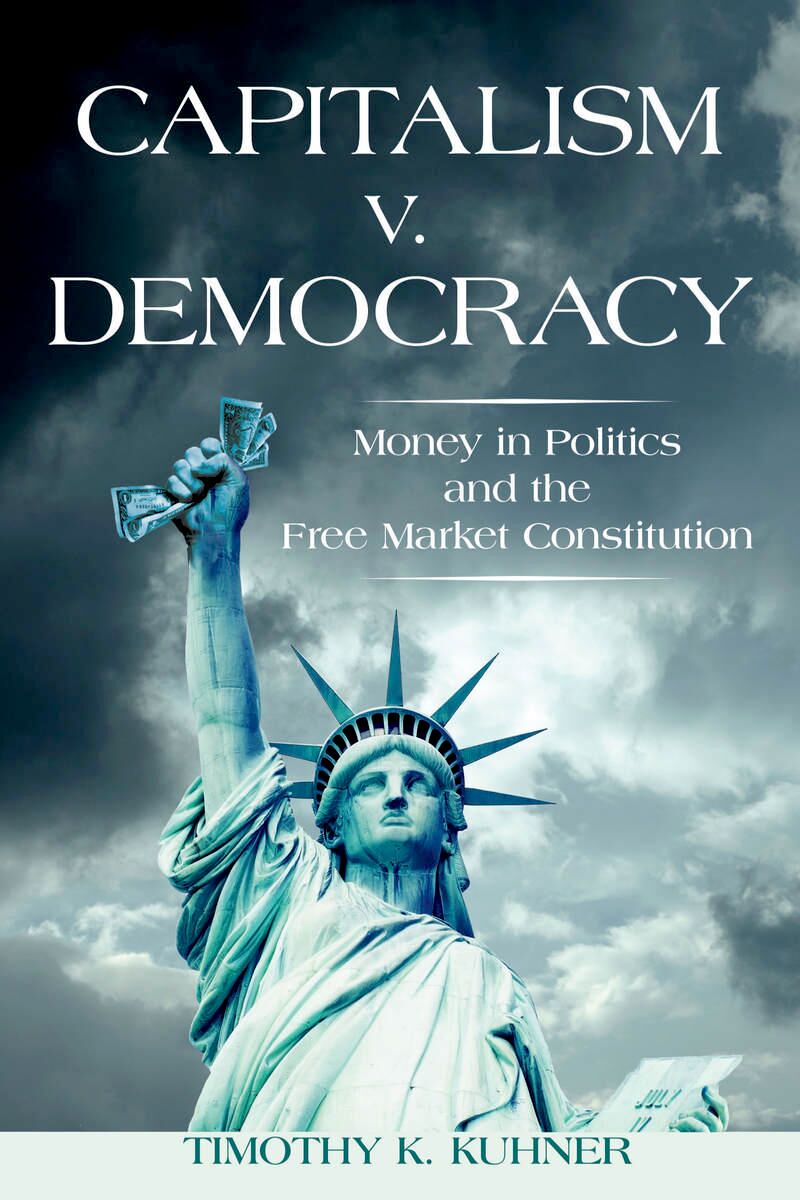
Capitalism v. democracy : money in politics and the free market constitution
As of the latest national elections, it costs approximately $1 billion to become president, $10 million to become a Senator, and $1 million to become a Member of the House. High-priced campaigns, an elite class of donors and spenders, superPACs, and increasing corporate political power have become the new normal in American politics. In Capitalism v. Democracy, Timothy Kuhner explains how these conditions have corrupted American democracy, turning it into a system of rule that favors the wealthy and marginalizes ordinary citizens. Kuhner maintains that these conditions have corrupted capitalism as well, routing economic competition through political channels and allowing politically powerful companies to evade market forces. The Supreme Court has brought about both forms of corruption by striking down campaign finance reforms that limited the role of money in politics. Exposing the extreme economic worldview that pollutes constitutional interpretation, Kuhner shows how the Court became the architect of American plutocracy.
Capitalism v. Democracy offers the key to understanding why corporations are now citizens, money is political speech, limits on corporate spending are a form of censorship, democracy is a free market, and political equality and democratic integrity are unconstitutional constraints on money in politics. Supreme Court opinions have dictated these conditions in the name of the Constitution, as though the Constitution itself required the privatization of democracy. Kuhner explores the reasons behind these opinions, reveals that they form a blueprint for free market democracy, and demonstrates that this design corrupts both politics and markets. He argues that nothing short of a constitutional amendment can set the necessary boundaries between capitalism and democracy.
eBook

Constructing Countervailing Power: Law and Organizing in an Era of Political Inequality
This Article proposes an innovative approach to remedying the crisis of political inequality: using law to facilitate organizing by the poor and working class, not only as workers, but also as tenants, debtors, welfare beneficiaries, and others. The piece draws on the social-movements literature, and the successes and failures of labor law, to show how law can supplement the deficient regimes of campaign finance and lobbying reform and enable lower-income groups to build organizations capable of countervailing the political power of the wealthy. As such, the Article offers a new direction forward for the public-law literature on political power and political inequality. It also offers critical lessons for government officials, organizers, and advocates seeking to respond to the inequalities made painfully evident by the COVID-19 pandemic.
Journal Article