
Catalogue Search | MBRL


Are you sure you want to remove the book from the shelf?

{{itemTitle}}
111
result(s) for
"Political campaigns United States History 21st century."
Sort by:


The roads to Congress 2012
The 2012 congressional elections played an equally vital role in determining the future course of America as the presidential race that topped the electoral ticket. Readers of this book will gain insights about the formative aspects of the 2012 campaign season as well as in depth coverage of key races for Congress. Exclusive to this volume are three chapters that look at important processes which impacted the campaign cycle: voter suppression laws passed in nearly every state, the role of Super PACs and independent expenditures in the wake of the Citizens United Supreme Court decision, and the results of redistricting and partisan gerrymandering throughout the country. Then the case studies follow the path of seven House and six Senate races from inception to election postmortem. The chapters are both narrative and provide analysis of an array of interesting and diverse contests from throughout the country. Each entry was written by one or more experts living in the state or region of the race. The authors provide succinct and highly readable chapters meant to illustrate the distinctive nature of the campaigns they are examining. Readers will see individual campaigns and elections “up close” and be able to compare and contrast one from another because of the common format employed throughout the book. Taken together, the chapters reveal that the roads to Congress, while similar in so many ways, each follow a unique route to Capitol Hill.
eBook

The election of Barack Obama : how he won
\"This book examines the historical election of Barack Obama as the first African-American president from the perspective of racial relations. To trace the effect of time, Liu links Obama's multiracial winning coalition to the two-party system and the profound impact of racial changes since 1965. Contrary to the popular momentum theory which emphasizes the early victories in mainly two states, Iowa and New Hampshire, this book demonstrates that state context matters. Obama's electoral performance in a state is better explained by its level of racial tension, rather than the emotional need of Americans to elect a black president\"--Provided by publisher.
BOOK

The elections of 2016
This book delivers a nuanced analysis of a momentous cycle of political contests. Whether discussing particular races or taking a broader look at the national trends, the book engages students with political drama, while weaving in scholarship and expert analysis.
eBook

Cases in Congressional campaigns : split decision
\"This carefully chosen sample of 2018 congressional campaigns provides readers with an account of the campaign battles that took place across the nation. Although Democrats seemed to be poised for a big blue wave of victory following Donald Trump's historic and divisive 2016 election, the Midterms yielded instead a split decision. Looking at issues ranging from the Kavanaugh confirmation, health care, the economy, and the impact of President Trump, this book traces the dynamics at work in the 2018 Midterm elections. The editors open with an explanation of the trends in this election cycle, followed by eight in-depth case studies of House and Senate toss-up races involving seats held by endangered Republican incumbents. The book shows how 2018 fits into the context of precursor midterm campaigns and what the analysis of competitive states and districts holds for 2020. Aimed at a wide variety of college courses as well as general interest readers, this book tells the story of the 2018 Midterms in fascinating detail\"-- Provided by publisher.
Book

Back in the Game
The years from 1996 to 2008 mark an important watershed in American
politics. During this period changes in the political, demographic,
regulatory, and technological landscape created an opportunity for
political parties to increase their relevance in the electoral
system. In Back in the Game , Brian J. Brox argues that
while political parties still provide services to candidates, as
they did in the 1970s and 1980s, they have now become influential
and independent campaigners in their own right. In addition to
providing services, parties now work with candidates as true
partners, and increasingly parties act independently of their
candidates to pursue collective party goals. Drawing on sources
such as interviews with top party staffers and Federal Election
Commission data, Brox carefully reveals how modern parties choose
among races in an effort to allocate resources in a way that
satisfies individual candidates, while simultaneously advancing
broader party goals.
eBook


A rhetoric of divisive partisanship
A Rhetoric of Divisive Partisanship: The 2016 American Presidential Campaign Discourse of Bernie Sanders and Donald Trump examines the campaign speeches of Bernie Sanders and Donald Trump as they targeted members of the American public that were ideologically different but equally emotionally vulnerable. Each appealed to marginalized segments of the electorate, groups at opposite ends of the political spectrum, joined through a shared distrust and fear of politics instead of political or even party affiliation. Both Sanders and Trump polarized and reinforced their respective bases as “outsiders.” Both relied on anti-establishment arguments and discussions grounded in personal attacks against “enemies” during which they joined their target audiences as marginalized outsiders united through a desire to overthrow the status quo and re-claim America. The book expands on previous ideas about dialogue and political talk and asserts that rather than serving as a model of civic and civil discourse, the rhetoric of Sanders and Trump was reactionary and divisive, begun with different intentions and producing different results
eBook

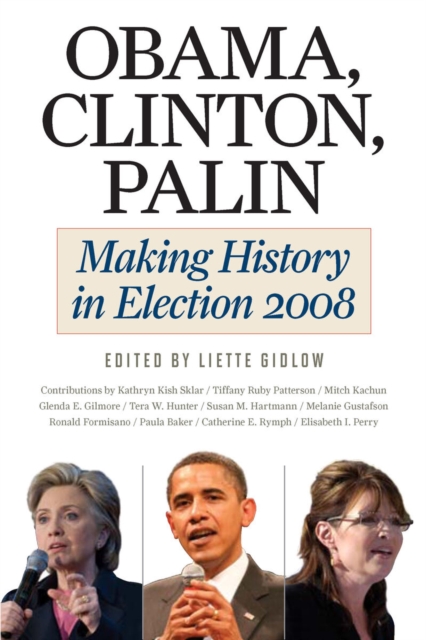
Obama, Clinton, Palin
Election 2008 made American history, but it was also the product of American history. Barack Obama, Hillary Clinton, and Sarah Palin smashed through some of the most enduring barriers to high political office, but their exceptional candidacies did not come out of nowhere. In these timely and accessible essays, a distinguished group of historians explores how the candidates both challenged and reinforced historic stereotypes of race and sex while echoing familiar themes in American politics and exploiting new digital technologies._x000B__x000B_Contributors include Kathryn Kish Sklar on Clintons gender masquerade; Tiffany Ruby Patterson on the politics of black anger; Mitch Kachun on Michelle Obama and stereotypes about black womens bodies; Glenda E. Gilmore on black womens century of effort to expand political opportunities for African Americans; Tera W. Hunter on the lost legacy of Shirley Chisholm; Susan M. Hartmann on why the U.S. has not yet followed western democracies in electing a female head of state; Melanie Gustafson on Palin and the political traditions of the American West; Ronald Formisano on the populist resurgence in 2008; Paula Baker on how digital technologies threaten the secret ballot; Catherine E. Rymph on Palins distinctive brand of political feminism; and Elisabeth I. Perry on the new look of American leadership.
eBook