
Catalogue Search | MBRL


Are you sure you want to remove the book from the shelf?

{{itemTitle}}
223,154
result(s) for
"Political change"
Sort by:

Change and the politics of certainty
Despite the imperative for change in a world of persistent inequality, racism and violence, difficulties arise once we try to bring it about. We may want to change the world, but we are not separate, looking in, but rather part of the world. We cannot be certain what impact our actions will have. What are we to do, if this is the case? Chapters scrutinise the role of intellectuals, experts and activists in famine aid, the Iraq war, humanitarianism, memory, enforced disappearance, and Grenfell. Plays and films are considered, and autobiographical accounts probe the author's background. The book is essential reading for all who strive for a better world. It will be of particular interest to students embarking on the study of politics, international politics and the social sciences more broadly, as well as new and established academics and researchers.
Book

Power in a Warming World
After nearly a quarter century of international negotiations on climate change, we stand at a crossroads. A new set of agreements is likely to fail to prevent the global climate's destabilization. Islands and coastlines face inundation, and widespread drought, flooding, and famine are expected to worsen in the poorest and most vulnerable countries. How did we arrive at an entirely inequitable and scientifically inadequate international response to climate change? InPower in a Warming World, David Ciplet, J. Timmons Roberts, and Mizan Khan, bring decades of combined experience as negotiators, researchers, and activists to bear on this urgent question. Combining rich empirical description with a political economic view of power relations, they document the struggles of states and social groups most vulnerable to a changing climate and describe the emergence of new political coalitions that take climate politics beyond a simple North-South divide. They offer six future scenarios in which power relations continue to shift as the world warms. A focus on incremental market-based reform, they argue, has proven insufficient for challenging the enduring power of fossil fuel interests, and will continue to be inadequate without a bolder, more inclusive and aggressive response.
eBook
The rhythm of modernization : how values change over time
\"In this chapter I review the three main theories of values, the still limited literature on value change, and the contributions of socialization studies to understanding the dynamics of sociopolitical orientations. I devote special attention to Inglehart's general theory of modernization upon which I base my subsequent empirical analysis. I reflect on what values are and the main approaches to the study of values, those of Rokeach, Schwartz, and Inglehart\"-- Provided by publisher.
Book

Climate Change Justice
Climate change and justice are so closely associated that many people take it for granted that a global climate treaty should--indeed, must--directly address both issues together. But, in fact, this would be a serious mistake, one that, by dooming effective international limits on greenhouse gases, would actually make the world's poor and developing nations far worse off. This is the provocative and original argument ofClimate Change Justice. Eric Posner and David Weisbach strongly favor both a climate change agreement and efforts to improve economic justice. But they make a powerful case that the best--and possibly only--way to get an effective climate treaty is to exclude measures designed to redistribute wealth or address historical wrongs against underdeveloped countries.
In clear language,Climate Change Justiceproposes four basic principles for designing the only kind of climate treaty that will work--a forward-looking agreement that requires every country to make greenhouse--gas reductions but still makes every country better off in its own view. This kind of treaty has the best chance of actually controlling climate change and improving the welfare of people around the world.
eBook


Strategies of the Sámi movement in Sweden: mobilization around grievances related to the ecological conditions of reindeer pastoralism, 2012–2022
Reindeer pastoralism, practiced by groups of the Indigenous Sámi people in Sweden, is being threatened by a new wave of encroachments. In this paper I take stock of how the Sámi movement has mobilized around grievances related to the ecological conditions that support natural pasture-based reindeer pastoralism. I apply the contentious politics approach to social movement theory, and Felix Kolb’s conceptualization of five strategies that social movements have used when interacting with the state to achieve political change. Drawing upon 10 years of data from the Sámi public news service, my study makes three main contributions. First, I identify a set of themes found in the public grievances connected to ecological conditions articulated by reindeer pastoralist organizations in the public sphere that are a focus for mobilization. Second, I present an overview of the five strategies that the Sámi movement applies in claims-making to address those grievances: the public preference mechanism, the political access mechanism, the judicial mechanism, the international politics mechanism, and the disruption mechanism, and show how they relate to one another. Third, I discuss the limitations of current mobilization efforts, and argue that cross-movement coalitions are needed to challenge the hegemonic bloc.
Journal Article

Another politics
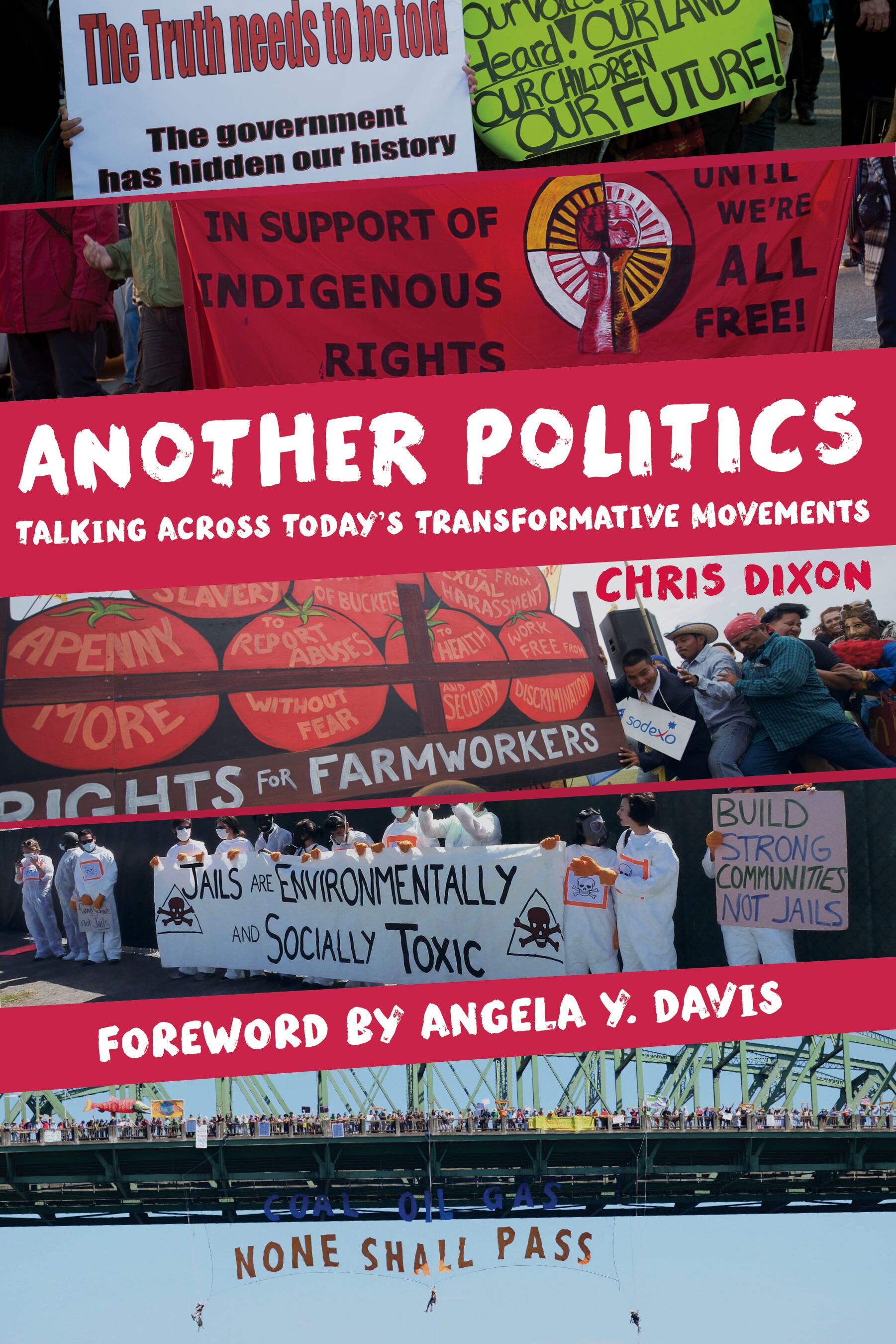
Amidst war, economic meltdown, and ecological crisis, a \"new spirit of radicalism is blooming\" from New York to Cairo, according to Chris Dixon. In Another Politics, he examines the trajectory of efforts that contributed to the radicalism of Occupy Wall Street and other recent movement upsurges. Drawing on voices of leading organizers across the United States and Canada, he delivers an engaging presentation of the histories and principles that shape many contemporary struggles. Dixon outlines the work of activists aligned with anti-authoritarian, anti-capitalist, and anti-oppression politics and discusses the lessons they are learning in their efforts to create social transformation. The book explores solutions to the key challenge for today’s activists, organizers, fighters, and dreamers: building a substantive link between the work of \"against,\" which fights ruling institutions, and the work of \"beyond,\" which develops liberatory alternatives.
eBook

Political Muslims : understanding youth resistance in a global context
In \"Political Muslims,\" Abbas, Hamid, and their contributors seek to provide a new perspective on Muslim youth, presenting them as agents of creative social change--as emerging adults who are participating in cultural, organizational, community, and socially oriented projects to positively influence socio-political transformation in response to the everyday challenges they face. Each case study brings the reader to a new geographic location, providing original contributions on how a new generation of Muslim youth are engaging in issues relating to their faith, gender, identity, community, social injustice, and globalization, and confronting social change and the negative impacts of Islamophobia and radicalization.
Book

Threatened Island Nations
Rising seas are endangering the habitability and very existence of several small island nations, mostly in the Pacific and Indian oceans. This is the first book to focus on the myriad legal issues posed by this tragic situation: if a nation is under water, is it still a state? Does it still have a seat at the United Nations? What becomes of its exclusive economic zone, the basis for its fishing rights? What obligations do other nations have to take in the displaced populations, and what are these peoples' rights and legal status once they arrive? Should there be a new international agreement on climate-displaced populations? Do these nations and their citizens have any legal recourse for compensation? Are there any courts that will hear their claims, and based on what theories? Leading legal scholars from around the world address these novel questions and propose answers.
eBook