
Catalogue Search | MBRL


Are you sure you want to remove the book from the shelf?

{{itemTitle}}
12,359
result(s) for
"Political consciousness"
Sort by:


Returning to the Source: Black Teachers Centering Justice with Black Students in Chicago Public Schools
In 1996, Dr. Timuel D. Black collected and archived 36 oral histories with alumni and current students and staff from DuSable and Phillips high schools, Chicago’s first two all-Black high schools. Several of those interviews were with alumni who returned to their alma mater as teachers. In this study, I drew on analyses of the interview transcripts collected by Dr. Black and other primary source data to piece together narratives detailing the socio-political forces that influenced the educational praxes of three Black teachers at DuSable and Phillips High Schools. As the findings of the study detail, each of the teachers developed socio-political consciousness prior to entering the teaching profession and during their professional careers. Their relationships to the moments and movements that shaped Black life in Chicago and elsewhere influenced the pedagogical and curricular conditions they attempted to create in their classrooms. As a result of their socio-political analyses each teacher in this study constructed educational spaces in their schools for Black students to reimagine and actualize more just futures. By understanding the consciousness of Black teachers of the past—returning to the source—contemporary Black teachers may be better equipped to navigate the complexities of their roles in schools today.
Journal Article


Intersectional Masculinities and Gendered Political Consciousness: How Do Race, Ethnicity and Sexuality Shape Men’s Awareness of Gender Inequality and Support for Gender Activism?
Gendered political consciousness refers to having an awareness of gender inequality, viewing this inequality as illegitimate, and supporting collective efforts to bring about greater gender equality. The present study draws from social psychology, theories of masculinities, and intersectionality to assess the factors associated with men’s political consciousness of gender. Multivariate regression analyses of data from the U.S.-based 2012 Evaluations of Government and Society Study (
N
= 598) (American National Election American National Election Study
2012
) highlights how social statuses of race/ethnicity and sexuality—along with beliefs about racial/ethnic and sexuality-based inequalities—correlate with men’s awareness of gender inequality and support for women fighting for greater gender equality. Results show that Non-Hispanic Black men and married men are significantly more likely than are non-Hispanic White men and unmarried men to see high levels of gender inequality. Men who see high levels of racial/ethnic and sexuality-based inequalities are also significantly more likely to perceive high levels of gender inequality. Bivariate analyses show that Non-Hispanic Black men, as well as men who see high levels of other inequalities, are also more likely than are other men to support women fighting for greater gender equality, but in multivariate regression models these effects are eclipsed by political ideology—the single best predictor of men’s support for women fighting for gender equality. Results underscore the need to differentiate awareness of gender inequality and support for efforts to challenge gender inequality, and they highlight the potential of intersectionality for conceptualizing men’s gendered political consciousness.
Journal Article


Race, Ethnicity, Sexuality, and Women's Political Consciousness of Gender
Existing research emphasizes the importance of group identification and perceived similarity in the development of group consciousness. Intersectionality suggests that for many women, a political consciousness of gender may also stem from experiences with race, ethnicity, and sexuality and may be interconnected with a consciousness of other forms of inequality. This study analyzes data from a recent national survey to investigate how race, ethnicity, and sexuality intersect with women's gendered political consciousness. Analyses reveal no support for the proposition that membership in racial, sexual, and ethnic minority groups significantly reduces women's gendered political consciousness. In addition, women who perceive high levels of racial, ethnic, or sexuality-based discrimination are more likely than other women to hold a strong political consciousness of gender. Results challenge the idea that gendered political consciousness emerges primarily from perceived similarity and highlight the need to conceptualize gendered political consciousness within the context of multiple inequalities.
Journal Article

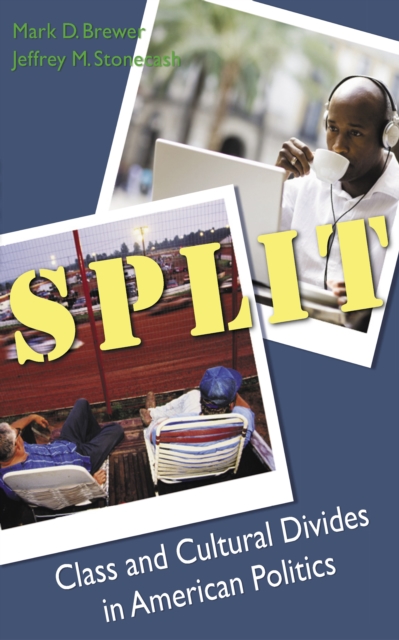
Split : class and cultural divides in American politics
Talk of politics in the United States today is abuzz with warring red and blue factions. The message is that Americans are split due to deeply-held beliefs--over abortion, gay marriage, stem-cell research, prayer in public schools. Is this cultural divide a myth, the product of elite partisans? Or is the split real? Yes, argue authors Mark Brewer and Jeffrey Stonecash--the cultural divisions are real. Yet they tell only half the story. Differences in income and economic opportunity also fuel division--a split along class lines. Cultural issues have not displaced class issues, as many believe. Split shows that both divisions coexist meaning that levels of taxation and the quality of healthcare matter just as much as the debate over the right to life versus the right to choose. The authors offer balanced, objective analysis, complete with a wealth of data-rich figures and tables, to explain the social trends underlying these class and cultural divides and then explore the response of the parties and voters. Offering solid empirical evidence, the authors show that how politicians, the media, and interest groups perceive citizen preferences--be they cultural or class based--determines whether or not the public gets what it wants. Simply put, each set of issues creates political conflict and debate that produce very different policies and laws. With a lively and highly readable narrative, students at every level will appreciate the brevity and punch of Split and come away with a more nuanced understanding of the divisions that drive the current American polity.
eBook

Health-related shame: an affective determinant of health?
Despite shame being recognised as a powerful force in the clinical encounter, it is underacknowledged, under-researched and undertheorised in the contexts of health and medicine. In this paper we make two claims. The first is that emotional or affective states, in particular shame, can have a significant impact on health, illness and health-related behaviours. We outline four possible processes through which this might occur: (1) acute shame avoidance behaviour; (2) chronic shame health-related behaviours; (3) stigma and social status threat and (4) biological mechanisms. Second, we postulate that shame's influence is so insidious, pervasive and pernicious, and so critical to clinical and political discourse around health, that it is imperative that its vital role in health, health-related behaviours and illness be recognised and assimilated into medical, social and political consciousness and practice. In essence, we argue that its impact is sufficiently powerful for it to be considered an affective determinant of health, and provide three justifications for this. We conclude with a proposal for a research agenda that aims to extend the state of knowledge of health-related shame.
Journal Article

Does Changing a Light Bulb Lead to Changing the World? Political Action and the Conscious Consumer
As the prevalence of \"conscious\" consumption has grown, questions have arisen about its relationship to political action. An influential argument holds that political consumption individualizes responsibility for environmental degradation and \"crowds out\" genuine forms of activism. While European and Canadian empirical research contradicts this perspective, finding that conscious consumption and political engagement are positively connected, no studies of this relationship have been conducted for the United States. This article presents ordinary least squares (OLS) regression models for two datasets, the 2004 General Social Survey and a detailed survey of approximately 2,200 conscious consumers conducted by the authors, to assess the nature of the relationship between conscious consumption and political activism. The authors find that measures of conscious consumption are significantly and positively related to political action, even when controlling for political involvement in the past. The results suggest that greater levels of political consumption are positively related to a range of political actions.
Journal Article