
Catalogue Search | MBRL


Are you sure you want to remove the book from the shelf?

{{itemTitle}}
1,511
result(s) for
"Political corruption Africa."
Sort by:

Neopatrimonialism in Africa and Beyond
Neopatrimonialism, a system whereby rulers use state resources for personal benefit and to secure the loyalty of clients in the general population, is central to any teaching or conceptualisation of contemporary African politics. This book is a theoretical and comparative study of neopatrimonialism in Africa and across world regions.
Although such practices are widespread in other parts of the world, the African neopatrimonial state has also become a global prototype of the anti-developmental state. This volume calls for a reappraisal of the genesis and interpretations of the concepts of patrimonialism and neopatrimonialism. Expert contributors consider recent debates in Africa through the study of democracy, clientelism, the 'big man' syndrome (Kenya), the rise of 'godfatherism' (Nigeria), 'warlordism' (Liberia) and the neopatrimonial state on a day to day basis (Niger). They discuss patrimonialism and neopatrimonialism from Latin America to Europe, Central Asia and Asia-Pacific, to weave a comparative analysis of the interplay between public policies and private interest.
Neopatrimonialism in Africa and Beyond is an important and timely volume that will be of interest to students and scholars of international politics, African studies, sociology and international development.
eBook

The dialectics of transformation in Africa
A discussion of political and religious crisis in Africa, this book covers such topics as democratic transition, good governance, civil society and the African renaissance. Elias K. Bongmba proposes humanistic interventions centred on the recovery of interpersonal relations and seeks to understand the ongoing struggles in Africa.
eBook

Corruption and governance in Africa : Swaziland, Kenya, Nigeria
\"This volume analyzes the corruption phenomenon in Africa and how to combat it from a governance perspective with illustrated case studies from three of the most corrupt of those nations covering, respectively, the southern Africa region (Swaziland); the eastern Africa region (Kenya); and the western Africa region (Nigeria). Drawing on the available data, research literature, and field practice experience, the nature and extent of corruption are identified; the factors influencing the causes and determining the consequences of corruption are delineated; measures that have been put in place to control corruption are outlined and discussed; and new policy solutions are proposed and advocated to more effectively control the corruption menace in Africa.\"--Page 4 of cover.
Book
Corruption as an empty signifier : politics and political order in Africa
Corruption as an Empty Signifier critically explores the ways in which corruption in Africa has been equated with African politics and political order, and offers a novel approach to understanding corruption as a potentially emancipatory discourse of political transformation. Conventionally, both academic literature as well as development policies depict corruption as the lynchpin of politics in Africa, locking African societies into political orders which subvert democratic change.
eBook


The wages of corruption
Corruption is endemic in Cameroon. Twice, Transparency International have accorded the country the infamous first place in corruption. As one of many concerned Cameroonians, Sammy Oke Akombi was moved and they realized that something was in fact wrong somewhere and something had to be done somehow. This collection of short stories is his contribution to the collective resolve by concerned Cameroonians to wage a war against this most unusual friend of fairness. The stories seek to elicit awareness about a social ill that is ironically championed by the very politicians, functionaries, educator, leaders and power elite whose duty it is to keep society healthy and on the rails. The stories are on corruption in different segments of society and about the people who perpetrate it. Almost everyone is immersed in it and so must make every effort to resurface from it. It takes only the will to stay alive because the wages of corruption like any other sin can only be death.
eBook

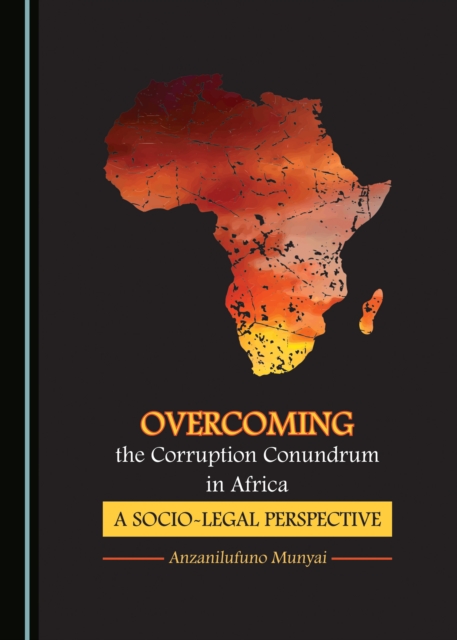
Overcoming the Corruption Conundrum in Africa
This book adopts a holistic approach to identifying what could be done to surmount the corruption conundrum in the African continent. It acknowledges the objective reality of corruption in Africa, and identifies primary solutions to the issue. The volume takes a socio-legal approach in order to reveal the nature and extent of corruption, and suggests that solutions can be found simply by interrogating how society reacts to it. In conjunction with this, the book identifies and critiques constraints in the formation of a definitive definition of corruption. As shown here, although it is critical for African states to develop anti-corruption strategies, the solution to the problem requires an understanding of the significance of political will, and how the lack thereof has led to the endurance of corruption in Africa.
eBook