
Catalogue Search | MBRL


Are you sure you want to remove the book from the shelf?

{{itemTitle}}
721
result(s) for
"Political culture -- United States -- History -- 20th century"
Sort by:

Modern conspiracies in America : separating fact from fiction
\"America is awash with alleged conspiracies. It seems like today, no one with a cell phone escapes the vortex of skepticism, cynicism, paranoia, and fear that occupy our thoughts almost constantly. Seeking out valid answers in this cacophony can be confusing and deeply frustrating. In this book, historian Michael D. Gambone provides case studies of popular conspiracy theories in America from the past 100 years, from Protocol of the Elders of Zion to #stopthesteal. He offers an approach, based on basic logic and historical case studies, not designed to win arguments, but to help reads separate truth from the avalanche of nonsense descending on us every day. In each case, Gambone outlines the conspiracy claim, provides historical context for the conspiracy, presents evidence of the conspiracy claim and analyzes the claim, context, and evidence. Modern Conspiracies in American History will appeal to a broad audience of readers interested in American history and those seeking to become better informed consumers of news in an era when social media spreads misinformation widely and quickly\"-- Provided by publisher.
Book

The Hidden 1970s
The 1970s were a complex, multilayered, and critical part of a long era of profound societal change and an essential component of the decade before-several of the most iconic events of \"the sixties\" occurred in the ten years that followed.The Hidden 1970sexplores the distinctiveness of those years, a time when radicals tried to change the world as the world changed around them.This powerful collection is a compelling assessment of left-wing social movements in a period many have described as dominated by conservatism or confusion. Scholars examine critical and largely buried legacies of the 1970s. The decade of Nixon's fall and Reagan's rise also saw widespread indigenous militancy, prisoner uprisings, transnational campaigns for self-determination, pacifism, and queer theories of play as political action. Contributors focus on diverse topics, including the internationalization of Black Power and Native sovereignty, organizing for Puerto Rican independence among Latinos and whites, and women's self-defense. Essays and ideas trace the roots of struggles from the 1960s through the 1970s, providing fascinating insight into the myriad ways that radical social movements shaped American political culture in the 1970s and the many ways they continue to do so today.
eBook

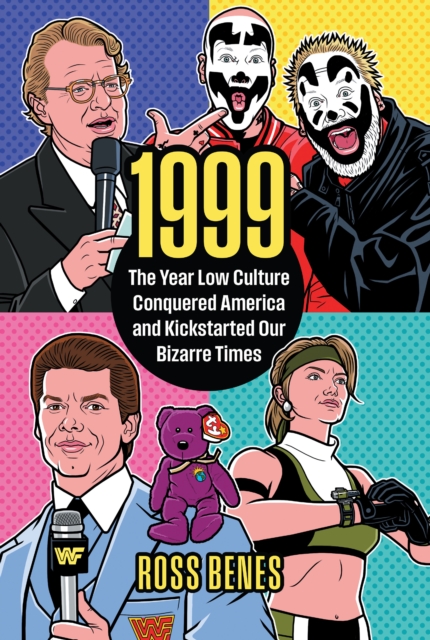
1999
From pro wrestling and Pokémon to Insane Clown Posse
and Jerry Springer, this look at the low culture of the late
’90s reveals its profound impact and how it continues to
affect our culture and society today.
The year 1999 was a high-water mark for popular culture.
According to one measure, it was the “best movie year
ever.” But as journalist Ross Benes shows, the end of the
’90s was also a banner year for low culture. This was the
heyday of Jerry Springer, Jenna Jameson, and Vince McMahon, among
many others. Low culture had come into its own and was poised for
world domination. The reverberations of this takeover continue to
shape American society.
During its New Year’s Eve countdown, MTV entered 1999
with Limp Bizkit covering Prince’s famous anthem to the new
year. The highlights of the lowlights continued when WCW and WWE
drew 35 million American viewers each week with sex appeal and
stories about insurrections. Insane Clown Posse emerged from the
underground with a Woodstock set and platinum records about magic
and murder. Later that year,
Dance Dance Revolution debuted in North America and
Grand Theft Auto emerged as a major video game
franchise. Beanie Babies and Pokémon so thoroughly seized
the wallets and imagination of collectors that they created
speculative investment bubbles that anticipated the faddish
obsession over nonfungible tokens (NFTs). The trashy talk show
Jerry Springer became daytime TV’s most-watched
program and grew so mainstream that
Austin Powers ,
Sabrina the Teenage Witch ,
The Wayans Bros. ,
The Simpsons , and
The X-Files incorporated Springer into their own plots
during the late ’90s. Donald Trump even explored a
potential presidential nomination with the Reform Party in 1999
and wanted his running mate to be Oprah Winfrey, whose own talk
show would make Dr. Oz a household name.
Benes shows us how so
many of the strangest features of culture in 1999 predicted and
influenced American life today. This wild ride through pop
culture uncovers the connections between the kayfabe of WWE and
the theatrics of politics, between the faddish obsession with
Beanie Babies and with NFTs, between faithful fans and political
loyalists, between violent video games and society’s
scapegoats, and much more.
1999 is not just a nostalgic look at the past. It is
also a window into our contentious present.
eBook


The Performative Presidency
The Performative Presidency brings together literatures describing presidential leadership strategies, public understandings of citizenship, and news production and media technologies between the presidencies of Theodore Roosevelt and Bill Clinton, and details how the relations between these spheres have changed over time. Jason L. Mast demonstrates how interactions between leaders, publics, and media are organized in a theatrical way, and argues that mass mediated plot formation and character development play an increasing role in structuring the political arena. He shows politics as a process of ongoing performances staged by motivated political actors, mediated by critics, and interpreted by audiences, in the context of a deeply rooted, widely shared system of collective representations. The interdisciplinary framework of this book brings together a semiotic theory of culture with concepts from the burgeoning field of performance studies.
eBook

The free world : art and thought in the Cold War
\"A history of the thinkers, writers, and artists who shaped intellectual culture in Cold War Europe and America\"-- Provided by publisher.
Book

Bodies of War
The United States lost thousands of troops during World War I, and the government gave next-of-kin a choice about what to do with their fallen loved ones: ship them home for burial or leave them permanently in Europe, in makeshift graves that would be eventually transformed into cemeteries in France, Belgium, and England. World War I marked the first war in which the United States government and military took full responsibility for the identification, burial, and memorialization of those killed in battle, and as a result, the process of burying and remembering the dead became intensely political. The government and military attempted to create a patriotic consensus on the historical memory of World War I in which war dead were not only honored but used as a symbol to legitimize America's participation in a war not fully supported by all citizens.The saga of American soldiers killed in World War I and the efforts of the living to honor them is a neglected component of United States military history, and in this fascinating yet often macabre account, Lisa M. Budreau unpacks the politics and processes of the competing interest groups involved in the three core components of commemoration: repatriation, remembrance, and return. She also describes how relatives of the fallen made pilgrimages to French battlefields, attended largely by American Legionnaires and the Gold Star Mothers, a group formed by mothers of sons killed in World War I, which exists to this day. Throughout, and with sensitivity to issues of race and gender, Bodies of War emphasizes the inherent tensions in the politics of memorialization and explores how those interests often conflicted with the needs of veterans and relatives.
eBook

