
Catalogue Search | MBRL


Are you sure you want to remove the book from the shelf?

{{itemTitle}}
4,507
result(s) for
"Political customs and rites"
Sort by:

Recording state rites in words and images : uigwe of Joseon Korea
'Recording State Rites in Words and Images' provides an engaging and in-depth exploration of the large corpus of court statutes compiled during the Joseon dynasty of Korea. The term uigwe, commonly translated as 'royal protocols', is the name given to the collection of nearly four thousand books that were commissioned and written to document the customs, rituals, rules, protocols, and ceremonial practices of the Joseon dynasty. In this generously illustrated book, Yi Song-mi introduces readers to the rich and varied documentary tradition embodied in the uigwe, sharing invaluable insights into time-honoured court customs through text and images and analysing changes in ritual practice over time.
Book
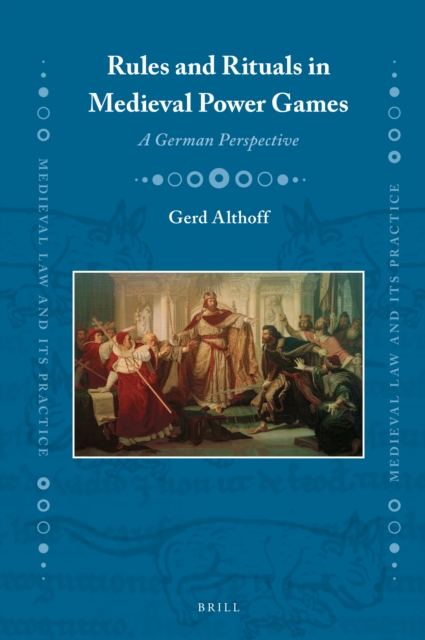
Rules and Rituals in Medieval Power Games
In Rules and Rituals in Medieval Power Games Gerd Althoff highlights the great impact of unwritten rules (Spielregeln) and rituals in establishing order in prestate societies. He underpins this view with new examples and insights taken from the German perspective and thus offers a model suitable for comparison with other societies.
eBook


Symbols and Legitimacy in Soviet Politics
Symbols and Legitimacy in Soviet Politics analyses the way in which Soviet symbolism and ritual changed from the regime's birth in 1917 to its fall in 1991. Graeme Gill focuses on the symbolism in party policy and leaders' speeches, artwork and political posters, and urban redevelopment, and on ritual in the political system. He shows how this symbolism and ritual were worked into a dominant metanarrative which underpinned Soviet political development. Gill also shows how, in each of these spheres, the images changed both over the life of the regime and during particular stages: the Leninist era metanarrative differed from that of the Stalin period, which differed from that of the Khrushchev and Brezhnev periods, which was, in turn, changed significantly under Gorbachev. In charting this development, the book lays bare the dynamics of the Soviet regime and a major reason for its fall.
eBook

The law of possession : ritual, healing, and the secular state
\"Rituals combining healing with spirit possession and court-like proceedings are found around the world and throughout history. For example, a person suffers from an illness that cannot be cured, and in order to be healed he performs a ritual involving prosecution and defense, a judge and witnesses. Divine beings give evidence through human oracles, spirits possess their human victims and are exorcized, and local gods intervene to provide healing and justice. Such practices seem to be the very antithesis of modernity and many modern, secular states have systematically attempted to eliminate them. Why are such rituals largely absent from modern societies, and what happens to them when the state attempts to expunge them from their health and justice systems, or even to criminalize them? Despite the prevalence of rituals involving some or all of these elements, The Law of Possession represents the first attempt to compare and analyze them systematically. The volume brings together historical and contemporary case studies from East Asia, South Asia, and Africa, and argues that, despite consistent attempts by states to discourage, eliminate, and criminalize them, such rituals persist and even thrive because they meet widespread human needs\"-- Provided by publisher.
Book

Identity, Ritual, and Power in Colonial Puebla
Located between Mexico City and Veracruz, Puebla has been a political hub since its founding as Puebla de los Ángeles in 1531. Frances L. Ramos's dynamic and meticulously researched study exposes and explains the many (and often surprising) ways that politics and political culture were forged, tested, and demonstrated through public ceremonies in eighteenth-century Puebla, colonial Mexico's \"second city.\"With Ramos as a guide, we are not only dazzled by the trappings of power-the silk canopies, brocaded robes, and exploding fireworks-but are also witnesses to the public spectacles through which municipal councilmen consolidated local and imperial rule. By sponsoring a wide variety of carefully choreographed rituals, the municipal council made locals into audience, participants, and judges of the city's tumultuous political life. Public rituals encouraged residents to identify with the Roman Catholic Church, their respective corporations, the Spanish Empire, and their city, but also provided arenas where individuals and groups could vie for power.As Ramos portrays the royal oath ceremonies, funerary rites, feast-day celebrations, viceregal entrance ceremonies, and Holy Week processions, we have to wonder who paid for these elaborate rituals-and why. Ramos discovers and decodes the intense debates over expenditures for public rituals and finds them to be a central part of ongoing efforts of councilmen to negotiate political relationships. Even with the Spanish Crown's increasing disapproval of costly public ritual and a worsening economy, Puebla's councilmen consistently defied all attempts to diminish their importance.Ramos innovatively employs a wealth of source materials, including council minutes, judicial cases, official correspondence, and printed sermons, to illustrate how public rituals became pivotal in the shaping of Puebla's complex political culture.
eBook

Demoting Vishnu : ritual, politics, and the unraveling of Nepal's Hindu monarchy
\"At the turn of the millennium, Nepal was the world's last remaining Hindu kingdom. Even the most skeptical of observers could hardly imagine that the institution of the monarchy could soon be in jeopardy. In 2001, however, Nepal's popular King Birendra was killed in the royal palace. Though the crown passed to his brother Gyanendra, the monarchy would never fully recover. Nepal witnessed an anti-king uprising in April 2006 and over the course of two years, an interim administration systematically took over all the king's duties and privileges. Most decisively, beginning in the summer of 2007 the government began blocking the king from participating in his many public rituals, sending the prime minister in his place instead. Demoting Vishnu argues that Nepal's dramatic political transformation from monarchy to republic was contested-and in key ways accomplished-through ritual performance. Mocko theorizes the role of public ritual in producing Nepal's state ideology. She examines how royal ritual once authorized kings to serve as the privileged apex of national governance and shows how in the twenty-first century those rituals stopped serving the king and began instead to authorize rule by a party-based \"head of state.\" By co-opting state ritual, the king's opponents were able to attack the monarchy's social identity at its foundations, enabling the final legal dissolution of kingship in 2008 to take place without physically harming the king himself. All once-royal rituals continue to be performed, but now they are handled by the country's president-a position created in 2008 to take over state ceremonial functions. Demoting Vishnu illustrates how upheaval in ritual contexts undermined the institutional logic of the monarchy by demonstrating in very public ways that kingship was contingent, opposable, and ultimately dispensable\"-- Provided by publisher.
Book

Theater State and the Formation of Early Modern Public Sphere in Iran
This first systematic study of a wide range of Persian and European archival and primary sources, analyzes how the Muharram rituals changed from being an orginally devotional practice to public events of political significance, setting the stage for the emergence of the early modern Iranian public sphere in the Safavid period.
eBook

Russia and courtly Europe : ritual and the culture of diplomacy, 1648-1725
\"In this new book on early modern diplomacy, Jan Hennings explores the relationship between European powers and Russia beyond the conventional East-West divide from the Peace of Westphalia to the reign of Peter the Great. He examines how, at a moment of new departure in both Europe and Russia, the norms shaping diplomatic practice emerged from the complex relations and direct encounters within the world of princely courts rather than from incompatible political cultures. He makes clear the connections between dynastic representation, politics and foreign relations and shows that Russia, despite its perceived isolation and cultural distinctiveness, participated in the developments and transformations that were taking place more broadly in diplomacy. The central themes of this study are the interlocking manifestations of social hierarchy, monarchical honour and sovereign status in both text and ritual. Related issues of diplomatic customs, institutional structures, personnel, negotiation practice, international law, and the question of cultural transfer, also figure prominently\"-- Provided by publisher.
Book

Court ceremonies and rituals of power in Byzantium and the medieval Mediterranean : comparative perspectives
Comparative approaches to political rituals and ceremonies in Byzantium and other court cultures of the Mediterranean basin form the subject of this collective volume, which examines related topics from the viewpoint of transformation, succession, appropriation, and representation in art and literature.
eBook