
Catalogue Search | MBRL


Are you sure you want to remove the book from the shelf?

{{itemTitle}}
105,820
result(s) for
"Political justice"
Sort by:


Rule By Law
Scholars have generally assumed that courts in authoritarian states are pawns of their regimes, upholding the interests of governing elites and frustrating the efforts of their opponents. As a result, nearly all studies in comparative judicial politics have focused on democratic and democratizing countries. This volume brings together leading scholars in comparative judicial politics to consider the causes and consequences of judicial empowerment in authoritarian states. It demonstrates the wide range of governance tasks that courts perform, as well as the way in which courts can serve as critical sites of contention both among the ruling elite and between regimes and their citizens. Drawing on empirical and theoretical insights from every major region of the world, this volume advances our understanding of judicial politics in authoritarian regimes.
eBook

Enduring injustice
\"Governments today often apologize for past injustices and scholars increasingly debate the issue, with many calling for apologies and reparations. Others suggest that what matters are victims of injustice today, not injustices in the past. Spinner-Halev argues that the problem facing some peoples is not just the injustice of the past, but that they still suffer from injustice today. They experience what he calls enduring injustices, and it is likely that these will persist without action to address them. The history of these injustices matters, not as a way to assign responsibility or because we need to remember more, but in order to understand the nature of the injustice and to help us think of possible ways to overcome it. Suggesting that enduring injustices fall outside the framework of liberal theory, Spinner-Halev spells out the implications of arguments for conceptions of liberal justice and progress, reparations, apologies, state legitimacy and post-nationalism\"-- Provided by publisher.
BOOK

Transformative justice
Can Israel be both Jewish and democratic? Transformative Justice, Leora Bilsky's landmark study of Israeli political trials, poses this deceptively simple question. The four trials that she analyzes focus on identity, the nature of pluralism, human rights, and the rule of law-issues whose importance extends far beyond Israel's borders. Drawing on the latest work in philosophy, law, history, and rhetoric, Bilsky exposes the many narratives that compete in a political trial and demonstrates how Israel's history of social and ideological conflicts in the courtroom offers us a rare opportunity to understand the meaning of political trials. The result is a bold new perspective on the politics of justice and its complex relationship to the values of liberalism. Leora Bilsky is Professor of Law, Tel Aviv University.
eBook

Why inequality matters : luck egalitarianism, its meaning and value
\"Equality is a key concept in our moral and political vocabulary. There is wide agreement on its instrumental value and its favourable impact on many aspects of society, but less certainty over whether it has a non-instrumental or intrinsic value that can be demonstrated. In this project, Shlomi Segall explores and defends the view that it does. He argues that the value of equality is not reducible to a concern we might have for the worse off, or to ensuring that individuals do not fall into poverty and destitution; instead he claims that undeserved inequalities, wherever and whenever we might find them, are bad in themselves. Assessing the strength of competing accounts, such as sufficientarianism and prioritarianism, he brings together for the first time discussions of the moral value of equality with luck- or responsibility-sensitive accounts of distributive justice. His book will interest readers in political and moral philosophy\"-- Provided by publisher.
Book

Civil Justice, Privatization, and Democracy
Privatization is occurring throughout the public justice system, including courts, tribunals, and state-sanctioned private dispute resolution regimes. Driven by a widespread ethos of efficiency-based civil justice reform, privatization claims to decrease costs, increase speed, and improve access to the tools of justice. But it may also lead to procedural unfairness, power imbalances, and the breakdown of our systems of democratic governance. Civil Justice, Privatization, and Democracy demonstrates the urgent need to publicize, politicize, debate, and ultimately temper these moves towards privatized justice.
Written by Trevor C.W. Farrow, a former litigation lawyer and current Chair of the Canadian Forum on Civil Justice, Civil Justice, Privatization, and Democracy does more than just bear witness to the privatization initiatives that define how we think about and resolve almost all non-criminal disputes. It articulates the costs and benefits of these privatizing initiatives, particularly their potential negative impacts on the way we regulate ourselves in modern democracies, and it makes recommendations for future civil justice practice and reform.
eBook


Conflicted Commitments
Conflicted Commitments analyzes a form of non-violent, direct transnational solidarity in which activists from the global North travel to support and protect people in the global South. Gada Mahrouse contends that this brand of activism is a compelling site of racialized power relations and is highly instructive for a nuanced understanding of systems of race. Mahrouse argues that the individuals who partake in this form of activism consciously deploy their white, western privilege to offer support and protection to those facing threats of violence. Moreover, given that this type of activism asserts itself as an exemplary form of anti-racist commitment, it illustrates that well-meaning practices can inadvertently reproduce racialized power structures that are embedded in imperial and colonial legacies. Mahrouse focuses on Palestine and Iraq in the post-9/11 era to contemplate the contemporary challenges that these regions pose for solidarity activism. By exploring how individual activists manage and negotiate their dominant positioning in these encounters, Mahrouse reflects more broadly on the ethics of social justice strategies in an increasingly transnational world. A detailed study of the racialized complexities and contradictions inherent in transnational solidarity activism, Conflicted Commitments makes a significant contribution to critical race and feminist studies.
eBook

Justice for earthlings : essays in political philosophy
\"In the past few decades social changes have impacted how we understand justice, as societies become both more multicultural and more interconnected globally. Much philosophical thought, however, seems to proceed in isolation from these developments. While philosophers from Plato onwards have portrayed justice as an abstract, universal ideal, Miller argues that principles of justice are always rooted in particular social contexts, and connects these ideas to the changing conditions of human life. In this important contribution to political philosophy, it is argued that philosophers need to pay more attention to the way that people actually think about what's fair, and only defend principles that are feasible to apply in the real world. To understand equality of opportunity, for example, we must explore the cultural constraints that people face when presented with life choices. Justice for Earthlings also explains how national boundaries make justice at global level different from social justice\"-- Provided by publisher.
Book
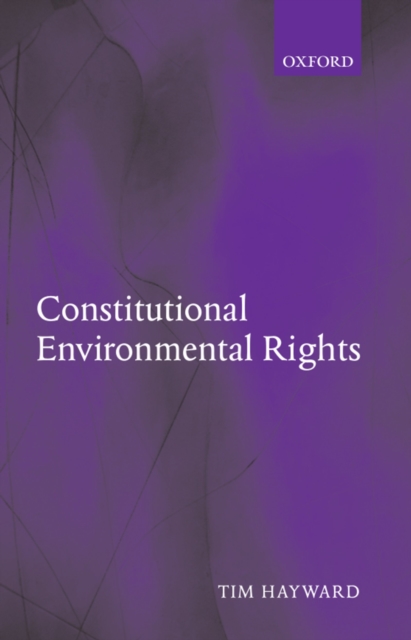
Constitutional environmental rights
This book shows why a fundamental right to an adequate environment ought to be provided in the constitution of any modern democratic state. Explains why the right to an environment adequate for one’s health and well-being is a genuine human right and why it ought to be constitutionalised. Elaborates this case and defends it in closely argued responses to critical challenges. Shows why there is no insurmountable obstacle to the effective implementation of this constitutional right, and why constitutionalising this right is not democratically illegitimate. With particular reference to European Union member states, it explains what this right adds to the states’ existing human rights and environmental commitments Concludes by showing how constitutional environmental rights can serve to promote the cause of environmental justice in a global context.
eBook