
Catalogue Search | MBRL


Are you sure you want to remove the book from the shelf?

{{itemTitle}}
95
result(s) for
"Political leadership United States History 19th century."
Sort by:


Lincoln and Leadership:Military, Political, and Religious Decision Making
A book that does something truly remarkable: says something new about Lincoln! Lincoln and Leadership offers fresh perspectives on the 16th president-making novel contributions to the scholarship of one of the more studied figures of American history. The book explores Lincoln's leadership through essays focused, respectively, on Lincoln as commander-in-chief, deft political operator, and powerful theologian. Taken together, the essays suggest the interplay of military, political, and religious factors informing Lincoln's thought and action and guiding the dynamics of his leadership. The contributors, all respected scholars of the Civil War era, focus on several critical moments in Lincoln's presidency to understand the ways Lincoln understood and dealt with such issues and concerns as emancipation, military strategy, relations with his generals, the use of black troops, party politics and his own re-election, the morality of the war, the place of America in God's design, and the meaning and obligations of sustaining the Union. Overall, they argue that Lincoln was simultaneously consistent regarding his commitments to freedom, democratic government, and Union but flexible, and sometimes contradictory, in the means to preserve and extend them. They further point to the ways that Lincoln's decision making defined the presidency and recast understandings of American \"exceptionalism.\" They emphasize that the \"real\" Lincoln was an unabashed party man and shrewd politician, a self-taught commander-in-chief, and a deeply religious man who was self-confident in his ability to judge men and to persuade them with words but unsure of what God demanded from America for its collective sins of slavery. Randall Miller's Introduction in particular provides essential weight to the notion that Lincoln's presidential leadership must be seen as a series of interlocking stories. In the end, the contributors collectively remind readers that the Lincoln enshrined as the \"Great Emancipator\" and \"savior of the Union\" was in life and practice a work-in-progress. And they insist that \"getting right with Lincoln\" requires seeing the intersections of his-and America's-military, political, and religious interests and identities.
eBook


Abraham Lincoln, Philosopher Statesman
What constitutes Lincoln’s political greatness as a statesman? As a great leader, he saved the Union, presided over the end of slavery, and helped to pave the way for an interracial democracy. His great speeches provide enduring wisdom about human equality, democracy, free labor, and free society. Joseph R. Fornieri contends that Lincoln’s political genius is best understood in terms of a philosophical statesmanship that united greatness of thought and action, one that combined theory and practice. This philosophical statesmanship, Fornieri argues, can best be understood in terms of six dimensions of political leadership: wisdom, prudence, duty, magnanimity, rhetoric, and patriotism. Drawing on insights from history, politics, and philosophy, Fornieri tackles the question of how Lincoln’s statesmanship displayed each of these crucial elements. Providing an accessible framework for understanding Lincoln’s statesmanship, this thoughtful study examines the sixteenth president’s political leadership in terms of the traditional moral vision of statecraft as understood by epic political philosophers such as Aristotle and St. Thomas Aquinas. Fornieri contends that Lincoln’s character is best understood in terms of Aquinas’s understanding of magnanimity or greatness of soul, the crowning virtue of statesmanship. True political greatness, as embodied by Lincoln, involves both humility and sacrificial service for the common good. The enduring wisdom and timeless teachings of these great thinkers, Fornieri shows, can lead to a deeper appreciation of statesmanship and of its embodiment in Abraham Lincoln. With the great philosophers and books of western civilization as his guide, Fornieri demonstrates the important contribution of normative political philosophy to an understanding of our sixteenth president. Informed by political theory that draws on the classics in revealing the timelessness of Lincoln’s example, his interdisciplinary study offers profound insights for anyone interested in the nature of leadership, statesmanship, political philosophy, political ethics, political history, and constitutional law.
eBook

The impossible presidency : the rise and fall of America's highest office
Why have recent presidents failed to create the change they promised? Should we blame the individual men, all flawed in their own ways? Or are there fundamental reasons why modern presidents fail to deliver, time and time again? In The Impossible Presidency, historian Jeremi Suri charts the long rise and quick fall of the world's most important job, from the 1790s to the present day. As he shows, early presidents greatly expanded the power of the office beyond the limited role envisioned by the founders. Suri argues that the immense accomplishments of Washington, Jackson, Lincoln and FDR left their successors with outsized and unrealistic expectations. John F. Kennedy, Lyndon B. Johnson and Ronald Reagan lost control of their agendas as they were buffeted by the onrush of events and threats their predecessors never had to face. Clinton and Obama were propelled to the presidency by their personal stories but hamstrung by prurient, partisan, and prejudiced criticisms of their leadership. Contemporary presidents must react to a truly globalized world and a rapid twenty-four-our news cycle. There is little room left for bold, strategic thinking. Suri traces our disenchantment with recent presidents to the current mismatch between presidential promises and the limitations of the office.
Book

Lincoln's enduring legacy
Coming on the heels of the bicentennial of Abraham Lincoln's birth, Lincoln's Enduring Legacy offers highly readable and accessible perspectives on Lincoln at 200 in terms of his impact on great leaders and thinkers and his place in American history. The book explores how Lincoln's words and deeds have influenced the pursuit of justice and freedom and the practice of democracy in the century and a half since he governed. Lincoln, as an abolitionist, the architect of Reconstruction, an avowed Unionist, a wordsmith and rhetorician, his age's foremost prophet for democracy, and America's greatest president remains an iconic image in American memory.
eBook

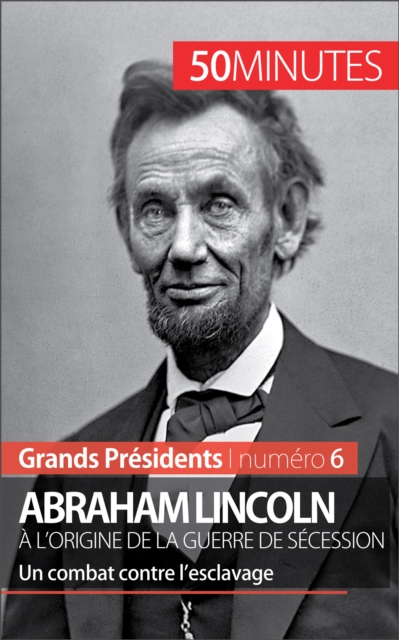
Abraham Lincoln, à l'origine de la guerre de Sécession
Découvrez enfin tout ce qu'il faut savoir sur Abraham Lincoln en moins d'une heure! Si aujourd'hui Abraham Lincoln est reconnu comme l'une des figures les plus célèbres de l'histoire des États-Unis, son élection en 1860 est pourtant à l'origine de la guerre civile. Pendant quatre ans, il mènera ses généraux sur le champ de bataille pour enfin obtenir la réunification du pays. Mais quelques jours à peine après la fin du conflit, il est froidement assassiné au cours d'une représentation théâtrale. Ce livre vous permettra d'en savoir plus sur: • La vie du président • Le contexte politique et social de l'époque • Les temps forts de son action politique • Les répercussions de ses mandats Le mot de l'éditeur: « Dans ce numéro de la collection « 50MINUTES|Grands Présidents », Mélanie Mettra nous plonge au cœur de la vie tragique du géant de la Maison-Blanche, Abraham Lincoln. S'il est parvenu par la force de sa volonté à atteindre l'échelon suprême, son élection est à l'origine d'une guerre fratricide des plus violentes. Le conflit a malheureusement contribué à occulter ses autres contributions. S'opposant à l'esclavagisme, Lincoln n'hésite pas à rédiger l'un des textes les plus controversés de l'époque: le XIIIe amendement. » Stéphanie DagrainÀ PROPOS DE LA SÉRIE 50MINUTES | Grands Présidents La série « Grands Présidents » de la collection « 50MINUTES » présente plus de cinquante hommes politiques qui ont marqué l'histoire. Chaque livre a été pensé pour les lecteurs curieux qui veulent faire le tour d'un sujet précis, tout en allant à l'essentiel, et ce en moins d'une heure. Nos auteurs combinent les faits historiques, les analyses et les nouvelles perspectives pour rendre accessibles des siècles d'histoire.
eBook


Judging Lincoln
Judging Lincoln collects nine of the most insightful essays on the topic of the sixteenth president written by Frank J. Williams, chief justice of the Rhode Island Supreme Court and one of the nation’s leading authorities on Abraham Lincoln. For Judge Williams, Lincoln remains the central figure of the American experience—past, present, and future.   Williams begins with a survey of the interest in—and influence of—Lincoln both at home and abroad and then moves into an analysis of Lincoln’s personal character with respect to his ability to foster relationships of equality among his intimates. Williams then addresses Lincoln’s leadership abilities during the span of his career, with particular emphasis on the Civil War.  Next, he compares the qualities of Abraham Lincoln, Franklin Delano Roosevelt, and Winston Churchill. The final essay, cowritten with Mark E. Neely Jr., concerns collecting Lincoln artifacts as a means of preserving and fostering the Lincoln legacy.
eBook