
Catalogue Search | MBRL


Are you sure you want to remove the book from the shelf?

{{itemTitle}}
842,721
result(s) for
"Political leadership."
Sort by:

The art of leadership : perspectives from distinguished thought leaders
\"Focusing on leadership and issues pertinent to our global landscape, The Art of Leadership: Perspectives from Distinguished Thought Leaders is an in-depth analysis and enriching collection of knowledge and perspectives from illustrious thought leaders who have spoken at the podium of Singapore Management University (SMU). SMU's thought leadership series seeks to inspire Asia and beyond with the views and opinions of internationally eminent and outstanding academics, scholars, business or political leaders who have achieved distinction in their respective fields. The book provides valuable insights on topics ranging from economics and politics to entrepreneurship and management\"--Back cover.
Book

Machiavelli's Children
Two late-developing nations, Japan and Italy, similarly obsessed with achieving modernity and with joining the ranks of the great powers, have traveled parallel courses with very different national identities. In this audacious book about leadership and historical choices, Richard J. Samuels emphasizes the role of human ingenuity in political change. He draws on interviews and archival research in a fascinating series of paired biographies of political and business leaders from Italy and Japan. Beginning with the founding of modern nation-states after the Meiji Restoration and the Risorgimento, Samuels traces the developmental dynamic in both countries through the failure of early liberalism, the coming of fascism, imperial adventures, defeat in wartime, and reconstruction as American allies. Highlights ofMachiavelli's Children include new accounts of the making of postwar Japanese politics-using American money and Manchukuo connections-and of the collapse of Italian political parties in the Clean Hands (Mani Pulite) scandal.The author also tells the more recent stories of Umberto Bossi's regional experiment, the Lega Nord, the different choices made by Italian and Japanese communist party leaders after the collapse of the USSR, and the leadership of Silvio Berlusconi and Ishihara Shintar on the contemporary right in each country.
Two late-developing nations, Japan and Italy, similarly obsessed with achieving modernity and with joining the ranks of the great powers, have traveled parallel courses with very different national identities. In this audacious book about leadership and historical choices, Richard J. Samuels emphasizes the role of human ingenuity in political change. He draws on interviews and archival research in a fascinating series of paired biographies of political and business leaders from Italy and Japan.
Beginning with the founding of modern nation-states after the Meiji Restoration and the Risorgimento, Samuels traces the developmental dynamic in both countries through the failure of early liberalism, the coming of fascism, imperial adventures, defeat in wartime, and reconstruction as American allies. Highlights ofMachiavelli's Children include new accounts of the making of postwar Japanese politics-using American money and Manchukuo connections-and of the collapse of Italian political parties in the Clean Hands (Mani Pulite) scandal. The author also tells the more recent stories of Umberto Bossi's regional experiment, the Lega Nord, the different choices made by Italian and Japanese communist party leaders after the collapse of the USSR, and the leadership of Silvio Berlusconi and Ishihara Shintar on the contemporary right in each country.
eBook


Charismatic leadership and social movements
Much of the writing on charisma focuses on specific traits associated with exceptional leaders, a practice that has broadened the concept of charisma to such an extent that it loses its distinctiveness - and therefore its utility. More particularly, the concept's relevance to the study of social movements has not moved beyond generalizations. The contributors to this volume renew the debate on charismatic leadership from a historical perspective and seek to illuminate the concept's relevance to the study of social movements. The case studies here include such leaders as Mahatma Gandhi; the architect of apartheid, Daniel F. Malan; the heroine of the Spanish Civil War, Dolores Ibarruri (la pasionaria); and Mao Zedong. These charismatic leaders were not just professional politicians or administrators, but sustained a strong symbiotic relationship with their followers, one that stimulated devotion to the leader and created a real group identity.
eBook

Poor leadership and bad governance : reassessing presidents and prime ministers in North America, Europe and Japan
This work breaks ground by looking systematically into the manifestations and causes of poor leadership and bad governance in some of the world's most powerful democracies.
Book

Presidents and the dissolution of the union
The United States witnessed an unprecedented failure of its political system in the mid-nineteenth century, resulting in a disastrous civil war that claimed the lives of an estimated 750,000 Americans. In his other acclaimed books about the American presidency, Fred Greenstein assesses the personal strengths and weaknesses of presidents from George Washington to Barack Obama. Here, he evaluates the leadership styles of the Civil War-era presidents.
Using his trademark no-nonsense approach, Greenstein looks at the presidential qualities of James K. Polk, Zachary Taylor, Millard Fillmore, Franklin Pierce, James Buchanan, and Abraham Lincoln. For each president, he provides a concise history of the man's life and presidency, and evaluates him in the areas of public communication, organizational capacity, political skill, policy vision, cognitive style, and emotional intelligence. Greenstein sheds light on why Buchanan is justly ranked as perhaps the worst president in the nation's history, how Pierce helped set the stage for the collapse of the Union and the bloodiest war America had ever experienced, and why Lincoln is still considered the consummate American leader to this day.
Presidents and the Dissolution of the Unionreveals what enabled some of these presidents, like Lincoln and Polk, to meet the challenges of their times--and what caused others to fail.
eBook


Delivering the People’s Message
Presidents have long invoked electoral mandates to justify the use of executive power. In Delivering the People's Message, Julia R. Azari draws on an original dataset of more than 1,500 presidential communications, as well as primary documents from six presidential libraries, to systematically examine choices made by presidents ranging from Herbert Hoover in 1928 to Barack Obama during his 2008 election. Azari argues that Ronald Reagan's election in 1980 marked a shift from the modern presidency formed by Franklin Delano Roosevelt to what she identifies as a more partisan era for the presidency. This partisan model is a form of governance in which the president appears to require a popular mandate in order to manage unruly and deeply contrary elements within his own party and succeed in the face of staunch resistance from the opposition party.
Azari finds that when the presidency enjoys high public esteem and party polarization is low, mandate rhetoric is less frequent and employs broad themes. By contrast, presidents turn to mandate rhetoric when the office loses legitimacy, as in the wake of Watergate and Vietnam and during periods of intense polarization. In the twenty-first century, these two factors have converged. As a result, presidents rely on mandate rhetoric to defend their choices to supporters and critics alike, simultaneously creating unrealistic expectations about the electoral promises they will be able to fulfill.
eBook

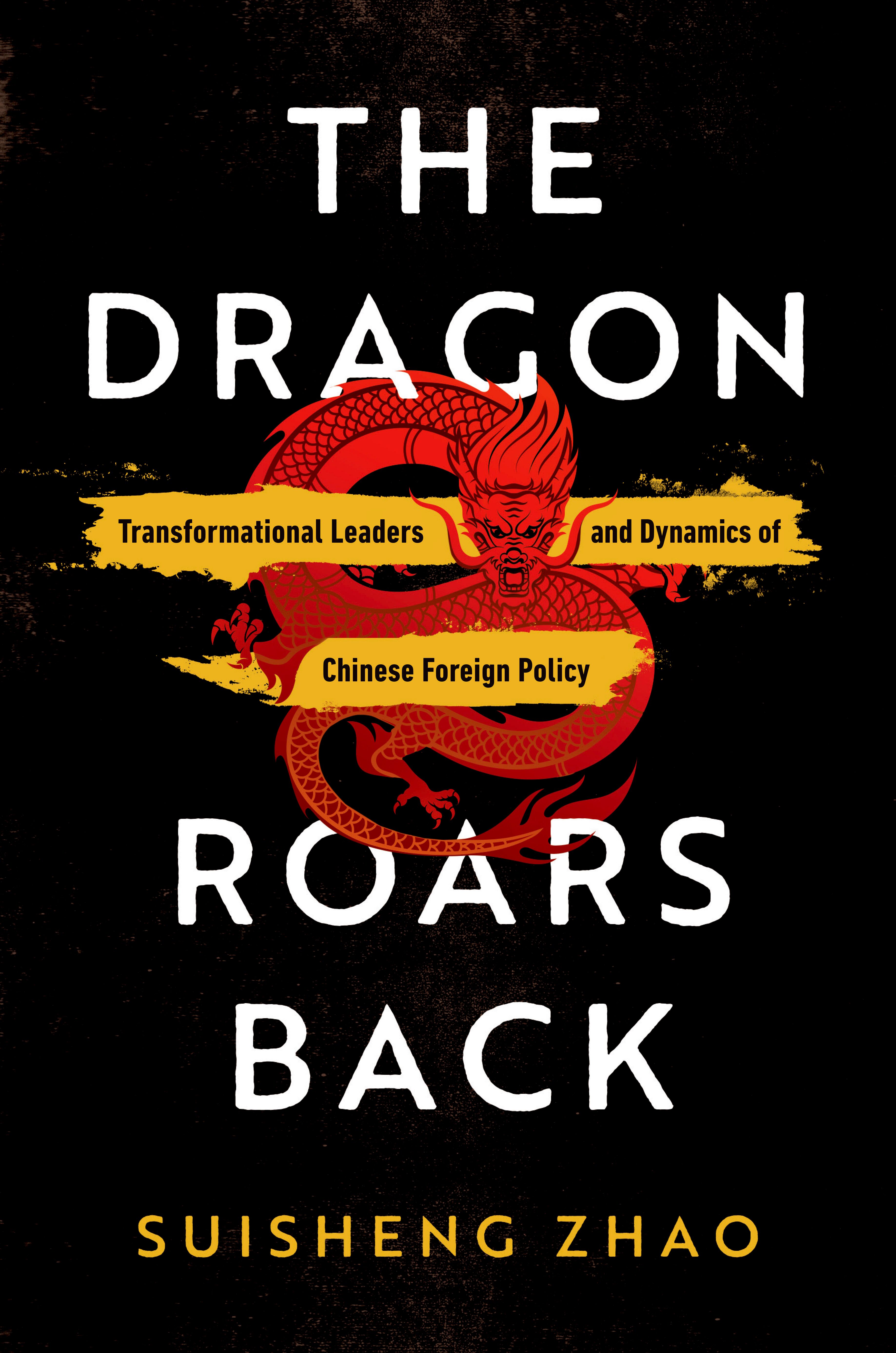
The dragon roars back : transformational leaders and dynamics of Chinese foreign policy
Selected among Foreign Affairs's \"Best of Books 2024\"
China is unique in modern world history. No other rising power has experienced China's turbulent history in its relations with neighbors and Western countries. Its sheer size dominates the region. With leader Xi Jinping's political authority unmatched, Xi's sense of mission to restore what he believes is China's natural position as a great power drives the current course of the nation's foreign policy. When China was weak, it was subordinated to others. Now, China is strong, and it wants others to subordinate, at least on the issues involving what it regards as core national interests.
What are the primary forces and how have these forces driven China's reemergence to global power? This book weaves together complex events, processes, and players to provide a historically in-depth, conceptually comprehensive, and up-to-date analysis of Chinese foreign policy transition since the founding of the People's Republic of China (PRC), arguing that transformational leaders with new visions and political wisdom to make their visions prevail are the game changers. Mao Zedong, Deng Xiaoping, and Xi Jinping are transformational leaders who have charted unique courses of Chinese foreign policy in the quest for security, prosperity, and power. With the ultimate decision-making authority on national security and strategic policies, these leaders have made political use of ideational forces, tailoring bureaucratic institutions, exploiting the international power distribution, and responding strategically to the international norms and rules to advance their foreign policy agendas in the path of China's ascendance.
eBook