
Catalogue Search | MBRL


Are you sure you want to remove the book from the shelf?

{{itemTitle}}
174
result(s) for
"Political parties Cross cultural studies."
Sort by:


Party System Change in Legislatures Worldwide
In this book, Carol Mershon and Olga Shvetsova explore one of the central questions in democratic politics: how much autonomy do elected politicians have to shape and reshape the party system on their own, without the direct involvement of voters in elections? Mershon and Shvetsova's theory focuses on the choices of party membership made by legislators while serving in office. It identifies the inducements and impediments to legislators' changes of partisan affiliation, and integrates strategic and institutional approaches to the study of parties and party systems. With empirical analyses comparing nine countries that differ in electoral laws, territorial governance and executive-legislative relations, Mershon and Shvetsova find that strategic incumbents have the capacity to reconfigure the party system as established in elections. Representatives are motivated to bring about change by opportunities arising during the parliamentary term, and are deterred from doing so by the elemental democratic practice of elections.
eBook


The Comparative Study of Electoral Systems
Citizens living in presidential or parliamentary systems face different political choices as do voters casting votes in elections governed by rules of proportional representation or plurality. Political commentators seem to know how such rules influence political behaviour. They firmly believe, for example, that candidates running in plurality systems are better known and held more accountable to their constituencies than candidates competing in elections governed by proportional representation. However, such assertions rest on shaky ground simply because solid empirical knowledge to evaluate the impact of political institutions on individual political behaviour is still lacking. The Comparative Study of Electoral Systems has collected data on political institutions and on individual political behaviour and scrutinized it carefully. In line with common wisdom results of most analyses presented in this volume confirm that political institutions matter for individual political behaviour but, contrary to what is widely believed, they do not matter much.
eBook

Party System Change in Legislatures Worldwide : Moving Outside the Electoral Arena
\"In this book, Carol Mershon and Olga Shvetsova explore one of the central questions in democratic politics: How much autonomy do elected politicians have to shape and reshape the party system on their own, without the direct involvement of voters in elections? Mershon and Shvetsova's theory focuses on the choices of party membership made by legislators while serving in office\"-- Provided by publisher.
Book
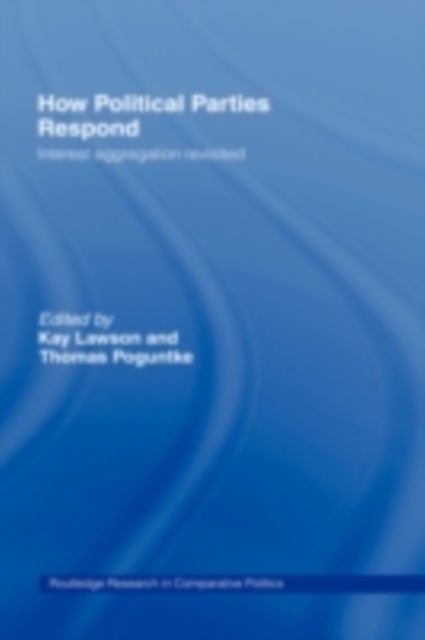
How Political Parties Respond
How Political Parties Respond focuses specifically on the question of interest aggregation. Do parties today perform that function? If so, how? If not, in what different ways do they seek to show themselves responsive to the electorate? This fascinating book studies these questions with reference to Great Britain, France, Germany, Italy, Spain, Denmark, Norway, Sweden, and Canada. A chapter on Russia demonstrates how newly powerful private interest groups and modern techniques of persuasion can work together to prevent effective party response to popular interests in systems where the authoritarian tradition remains strong.
Kay Lawson is Professor Emerita, San Francisco State University, and General Editor of the International Political Science Review. Her research and publications have focussed on the comparative study of political parties, including Political Parties and Democracy in the United States, The Comparative Study of Political Parties, Political Parties and Linkage (co-edited), When Parties Fail (co-edited), How Political Parties Work (editor), and Cleavages, Parties and Voters (co-edited). She is also the author of The Human Polity , now in its fifth edition. She is the 2003 recipient of the Eldersveld Award (for a lifetime of outstanding scholarly and professional contributions to the study of parties and political organizations). Thomas Poguntke is Professor of Political Science at SPIRE, Keele University, UK and Fellow at the Mannheim Centre for European Social Research. He is author of Parteiorganisation im Wandel: Gesellschaftliche Verankerung und organisatorische Anpassung im Europäischen Vergleich (Westdeutscher Verlag 2000), Alternative Politics: The German Green Party , (Edinburgh University Press 1993) and co-editor of several volumes politics and parties in western democracies. His main research interests are political parties and the comparative analysis of democratic regimes.
eBook


The many faces of strategic voting : tactical behavior in electoral systems around the world
\"Strategic voting is classically defined as \"voting for one's second preferred option to prevent one's least preferred option from winning when one's first preference has no chance.\" Voters want their votes to be effective, and casting a ballot that will have no influence on an election is undesirable--therefore, some voters cast a strategic ballot when they decide it is useful. This edited volume includes case studies of strategic voting behavior in Israel, Germany, Japan, Belgium, Spain, Switzerland, Canada, and the UK, and provides a conceptual framework for understanding strategic voting behavior in all types of electoral systems. The classic definition explicitly considers strategic voting in a single race with a single winner, which has at least three candidates. This situation is more common in electoral systems that have single member districts that employ plurality or majoritarian electoral rules and have multiparty systems. Indeed, much of the literature on strategic voting to date has considered systems like those in Canada and the United Kingdom. This book contributes to a more general understanding of strategic voting behavior by taking into account a wide variety of institutional contexts, such as single transferable vote rules, proportional representation, two round and mixed electoral systems\"-- Provided by publisher.
Book
