
Catalogue Search | MBRL


Are you sure you want to remove the book from the shelf?

{{itemTitle}}
232
result(s) for
"Political parties United States History 19th century."
Sort by:

The nationalization of American political parties, 1880-1896
\"This book investigates the creation of the first truly nationalized party organizations in the United States in the late nineteenth century, an innovation that reversed the parties' traditional privileging of state and local interests in nominating campaigns and the conduct of national campaigns. Between 1880 and 1896, party elites crafted a defense of these national organizations that charted the theoretical parameters of American party development into the twentieth century. With empowered national committees and a new understanding of the parties' role in the political system, national party leaders dominated American politics in new ways, renewed the parties' legitimacy in an increasingly pluralistic and nationalized political environment, and thus maintained their relevance throughout the twentieth century. The new organizations particularly served the interests of presidents and presidential candidates, and the little-studied presidencies of the late nineteenth century demonstrate the first stirrings of modern presidential party leadership\"--Provided by publisher.
Book
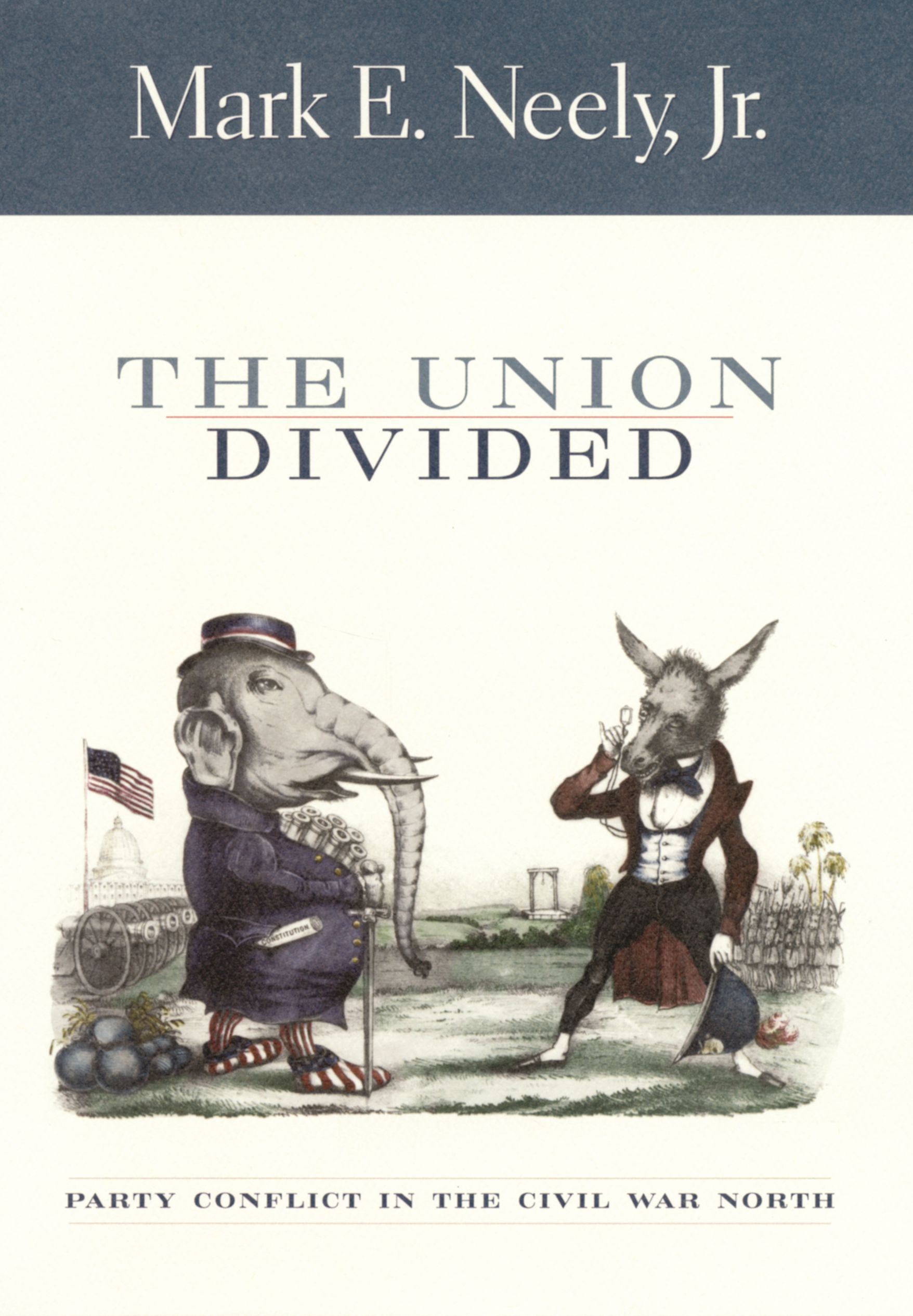
The Union Divided
In 1863, Union soldiers from Illinois threatened to march
from the battlefield to their state capital. Springfield had
not been seized by the Rebels--but the state government was in
danger of being captured by the Democrats. In
The Union Divided , Pulitzer Prize-winning historian
Mark E. Neely, Jr., vividly recounts the surprising story of
political conflict in the North during the Civil War. Examining
party conflict as viewed through the lens of the developing
war, the excesses of party patronage, the impact of wartime
elections, the highly partisan press, and the role of the loyal
opposition, Neely deftly dismantles the argument long
established in Civil War scholarship that the survival of the
party system in the North contributed to its victory. The many
positive effects attributed to the party system were in fact
the result of the fundamental operation of the Constitution, in
particular a four-year president who was commander in chief. In
several ways, the party system actually undermined the Northern
war effort; Americans uneasy about normal party operations in
the abnormal circumstances of civil war saw near-treason in the
loyal opposition. Engagingly written and brilliantly argued,
The Union Divided is an insightful and original
contribution to Civil War studies and American political
history.
eBook

Party ballots, reform, and the transformation of America's electoral system
\"This book explores the fascinating and puzzling world of nineteenth- and early-twentieth-century American elections. It examines the strategic behavior of nineteenth-century party politicians and shows how their search for electoral victory led them to invent a number of remarkable campaign practices. Why were parties dedicated to massive voter mobilization? Why did presidential nominees wage front-porch campaigns? Why did officeholders across the country tie their electoral fortunes to the popularity of presidential candidates at the top of the ticket? Erik J. Engstrom and Samuel Kernell demonstrate that the defining features of nineteenth-century electoral politics were the product of institutions in the states that prescribed how votes were cast and how those votes were converted into political offices. Relying on a century's worth of original data, this book uncovers the forces propelling the nineteenth-century electoral system, its transformation at the end of the nineteenth century, and the implications of that transformation for modern American politics\"-- Provided by publisher.
Book

A Political Nation
This impressive collection joins the recent outpouring of exciting new work on American politics and political actors in the mid-nineteenth century. For several generations, much of the scholarship on the political history of the period from 1840 to 1877 has carried a theme of failure; after all, politicians in the antebellum years failed to prevent war, and those of the Civil War and Reconstruction failed to take advantage of opportunities to remake the nation. Moving beyond these older debates, the essays in this volume ask new questions about mid-nineteenth-century American politics and politicians.
InA Political Nation,the contributors address the dynamics of political parties and factions, illuminate the presence of consensus and conflict in American political life, and analyze elections, voters, and issues. In addition to examining the structures of the United States Congress, state and local governments, and other political organizations, this collection emphasizes political leaders-those who made policy, ran for office, influenced elections, and helped to shape American life from the early years of the Second Party System to the turbulent period of Reconstruction.
The book moves chronologically, beginning with an antebellum focus on how political actors behaved within their cultural surroundings. The authors then use the critical role of language, rhetoric, and ideology in mid-nineteenth-century political culture as a lens through which to reevaluate the secession crisis. The collection closes with an examination of cultural and institutional influences on politicians in the Civil War and Reconstruction years. Stressing the role of federalism in understanding American political behavior,A Political Nationunderscores the vitality of scholarship on mid-nineteenth-century American politics.
Contributors:Erik B. Alexander, University of Tennessee, Knoxville · Jean Harvey Baker, Goucher College · William J. Cooper, Louisiana State University · Daniel W. Crofts, The College of New Jersey · William W. Freehling, Virginia Foundation for the Humanities · Gary W. Gallagher, University of Virginia · Sean Nalty, University of Virginia · Mark E. Neely Jr., Pennsylvania State University · Rachel A. Shelden, Georgia College and State University · Brooks D. Simpson, Arizona State University · J. Mills Thornton, University of Michigan, Ann Arbor
eBook


The origins of the Republican Party, 1852-1856
William Gienapp demonstrates that the organization of the Republican party was a difficult, complex, and lengthy process, and explains why, after an inauspicious beginning, it ultimately became a potent political force.
eBook


Practicing Democracy
InPracticing Democracy,eleven historians challenge conventional narratives of democratization in the early United States, offering new perspectives on the period between the ratification of the Constitution and the outbreak of the Civil War. The essays in this collection address critical themes such as the origins, evolution, and disintegration of party competition, the relationship between political parties and popular participation, and the place that parties occupied within the wider world of United States politics.
In recent years, historians of the early republic have demolished old assumptions about low rates of political participation and shallow popular partisanship in the age of Jefferson-raising the question of how, if at all, Jacksonian politics departed from earlier norms. This book reaffirms the significance of a transition in political practices during the 1820s and 1830s but casts the transformation in a new light. Whereas the traditional narrative is one of a party-driven democratic awakening, the contributors to this volume challenge the correlation of party with democracy. They both critique constricting definitions of legitimate democratic practices in the decades following the ratification of the Constitution and emphasize the proliferation of competing public voices in the buildup to the Civil War. Taken together, these essays offer a new way of thinking about American politics across the traditional dividing line of 1828 and suggest a novel approach to the long-standing question of what it meant to be part of \"We the People.\"
Contributors:Tyler Anbinder, George Washington University · Douglas Bradburn, Fred W. Smith National Library for the Study of George Washington at Mount Vernon · John L. Brooke, The Ohio State University · Andrew Heath, University of Sheffield · Reeve Huston, Duke University · Johann N. Neem, Western Washington University · Kenneth Owen, University of Illinois, Springfield · Graham A. Peck, Saint Xavier University · Andrew W. Robertson, Graduate Center of the City University of New York and Lehman College, CUNY
eBook

