
Catalogue Search | MBRL


Are you sure you want to remove the book from the shelf?

{{itemTitle}}
1,218
result(s) for
"Political science Italy History."
Sort by:

Machiavelli on freedom and civil conflict : an historical and medical approach to political thinking
In Machiavelli on Freedom and Civil Conflict, Marie Gaille discusses Machiavelli's conception of civil conflict, its historical and medical language, and its uses in contemporary conceptions of democracy.
eBook

Italy's encounters with modern China : imperial dreams, strategic ambitions
\"The history of relations between Italy and China has often been clouded by myths, projection biases, intellectualizations and, ultimately, stereotypes. This edited volume is proposed to the attention of the international community of undergraduate and graduate students, and scholars of Italy and China, as a first attempt to systematically engage this intellectual vacuum. To this end, the editors have distilled a selection of ten chapters produced by scholars based in Australia, China, Italy, the United Kingdom and the United States, complemented by a substantial introduction. While each chapter looks at the historical or contemporary relations between Italy and China from a specific perspective, they are assembled to offer a comprehensive diachronic account of the most salient historical junctures and intellectual debates shaping this reiterated encounter between two ancient civilizations. \"-- Provided by publisher.
Book
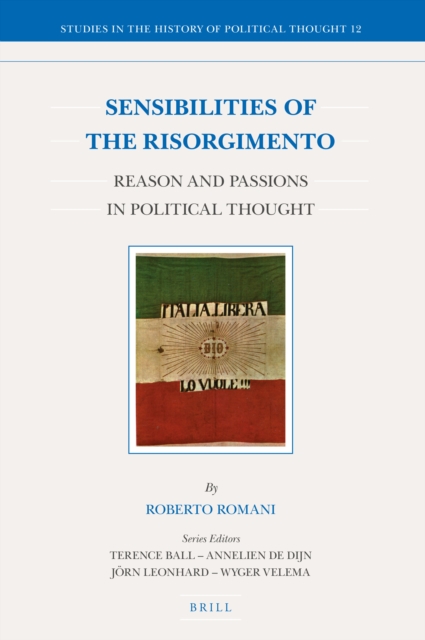
Sensibilities of the Risorgimento
A purely political framework does not capture the complexity of the culture behind Italians' struggle for liberty and independence during the Risorgimento (1815-1861). Roberto Romani identifies the sensibilities associated with each of the two main political programmes, Mazzini's republicanism and moderatism, which in fact were comprehensive projects for a political, moral, and religious resurgence. The moderates' espousal of reason entailed an ideal personality expressed by private virtue, self-possession, and a public morality informed by Catholicism, while Mazzini's advocacy of passions led to 'enthusiasm' and a total commitment to the cause. Romani demonstrates that the patriots' moral quest rested on a thick cultural bedrock, dating back to Stoicism and the Catholic Aufklärung, and passing through Rousseau and the Revolution.
eBook

Redeeming The prince : the meaning of Machiavelli's masterpiece
\"In Redeeming \"The Prince,\" one of the world's leading Machiavelli scholars puts forth a startling new interpretation of arguably the most influential but widely misunderstood book in the Western political tradition. Overturning popular misconceptions and challenging scholarly consensus, Maurizio Viroli also provides a fresh introduction to the work. Seen from this original perspective, five centuries after its composition, The Prince offers new insights into the nature and possibilities of political liberation.Rather than a bible of unscrupulous politics, The Prince, Viroli argues, is actually about political redemption--a book motivated by Machiavelli's patriotic desire to see a new founding for Italy. Written in the form of an oration, following the rules of classical rhetoric, the book condenses its main message in the final section, \"Exhortation to liberate Italy from the Barbarians.\" There Machiavelli creates the myth of a redeemer, an ideal ruler who ushers in an era of peace, freedom, and unity. Contrary to scholars who maintain that the exhortation was added later, Viroli proves that Machiavelli composed it along with the rest of the text, completing the whole by December 1513 or early 1514.Only if we read The Prince as a theory of political redemption, Viroli contends, can we at last understand, and properly evaluate, the book's most controversial pages on political morality, as well as put to rest the clichâe of Machiavelli as a \"Machiavellian.\"Bold, clear, and provocative, Redeeming \"The Prince\" should permanently change how Machiavelli and his masterpiece are understood\"-- Provided by publisher.
Book

Redeeming The Prince
InRedeeming \"The Prince,\"one of the world's leading Machiavelli scholars puts forth a startling new interpretation of arguably the most influential but widely misunderstood book in the Western political tradition. Overturning popular misconceptions and challenging scholarly consensus, Maurizio Viroli also provides a fresh introduction to the work. Seen from this original perspective, five centuries after its composition,The Princeoffers new insights into the nature and possibilities of political liberation.
Rather than a bible of unscrupulous politics,The Prince, Viroli argues, is actually about political redemption--a book motivated by Machiavelli's patriotic desire to see a new founding for Italy. Written in the form of an oration, following the rules of classical rhetoric, the book condenses its main message in the final section, \"Exhortation to liberate Italy from the Barbarians.\" There Machiavelli creates the myth of a redeemer, an ideal ruler who ushers in an era of peace, freedom, and unity. Contrary to scholars who maintain that the exhortation was added later, Viroli proves that Machiavelli composed it along with the rest of the text, completing the whole by December 1513 or early 1514.
Only if we readThe Princeas a theory of political redemption, Viroli contends, can we at last understand, and properly evaluate, the book's most controversial pages on political morality, as well as put to rest the cliché of Machiavelli as a \"Machiavellian.\"
Bold, clear, and provocative,Redeeming \"The Prince\"should permanently change how Machiavelli and his masterpiece are understood.
eBook

The third Rome, 1922-1943 : the making of the fascist capital
\"Rome underwent a spectacular transformation under Fascist rule; a transformation that was visual and topographical but also deeply symbolic. The 'third Rome' that Mussolini envisioned and sought to realise in the 1920s and 1930s was partly a new city, expanding in all directions from the historic centre, and partly a new vision for an ideal city that emerged from within a cityscape forged across millennia of history. This Rome was intended to be both the capital of a regenerated Italy and the sanctuary of a new international fascist political religion. Aristotle Kallis traces the plethora of visions and projects that sought to reimagine, reinvent, and reshape the city as a 'fascist capital' over the course of twenty short years. Extensive demolitions, reconfigurations of sites and monuments, as well as ambitious new constructions designed by an array of architects in wildly different styles, chronicle a fascinating story of conquering drive, ruthless appropriation, and interrupted ambition\"-- Provided by publisher.
BOOK

Genoa's freedom
This book investigates the economic, intellectual and political history of late medieval and early modern Genoa and the historical origins of the Genoese presence in the Spanish Atlantic. Salonia describes Genoa's late medieval economic expansion and commercial networks through several case studies, from the Black Sea to southern England, and briefly compares it to the state-run military expansion of Venice&rsquo s empire. The author links the adaptability and entrepreneurial skills of Genoese merchants and businessmen to the constitutional history of the Genoese commune and to the specific idea of freedom progressively protected by its constitutions and embodied by institutions like the Bank of St. George. Moreover, this book offers an unprecedented account of the actions with which Ferdinand the Catholic protected Genoese merchants in his dominions and of the later, mutual understanding between the Genoese community and emperor Charles V during the Italian Wars, and in particular during the 1520s. These developments in Hispanic-Genoese diplomatic and economic relations are of great significance. The sixteenth-century Hispanic-Genoese alliance is important to understand the characteristics of Habsburg governance and the resilience of Genoa's republican conservatism. Genoa's republicanism (based on private wealth and private arms) contradicts historiographical narratives that assume the inevitability of the emergence of the modern, militarized and centralized state. It also shows the inadequacy of Tuscan-centric historical accounts of Renaissance republicanism. The last chapter of the book reveals the consequences of the 1528 Hispanic-Genoese alliance by considering case studies that illustrate the Genoese presence in the Spanish Americas, from Chile to Mexico, since the early stages of conquest and settlement.
eBook

A bold and dangerous family : the remarkable story of an Italian mother, her two sons, and their fight against fascism
Mussolini was not only ruthless- he was subtle and manipulative. Black-shirted thugs did his dirty work for him- arson, murder, destruction of homes and offices, bribes, intimidation and the forcible administration of castor oil. His opponents - including editors, publishers, union representatives, lawyers and judges - were beaten into submission. But the tide turned in 1924 when his assassins went too far, horror spread across Italy and twenty years of struggle began. Antifascist resistance was born and it would end only with Mussolini's death in 1945. Among those whose disgust hardened into bold and uncompromising resistance was a family from Florence- Amelia, Carlo and Nello Rosselli.Caroline Moorehead's research into the Rossellis struck gold. She has drawn on letters and diaries never previously translated into English to reveal - in all its intimacy - a family driven by loyalty, duty and courage, yet susceptible to all the self-doubt and fear that humans are prey to. Readers are drawn into the lives of this remarkable family - and their loves, their loyalties, their laughter and their ultimate sacrifice.
Book

The Re-invention of the European Radical Right
Combining an in-depth case study of the Italian Northern League with a comparative focus on other parties, Andrej Zaslove employs a socio-economic, institutional, and ideological analysis to argue that the new wave of right-wing parties in Western Europe converged into a radical right populist party family in the 1990s. He examines the transformation of the Northern League from its regionalist roots while focusing on the party’s nationalism, authoritarianism, support for a market economy, opposition to globalization, and scepticism regarding Italian integration into the European Union. He also scrutinizes the Northern League’s participation in political power between 2001 and 2006 and its influence on federalism, immigration, economic policy, and European integration. A thorough and thought-provoking work, The Re-invention of the European Radical Right offers remarkable insight into the ongoing effects of radical right populism on politics and public policy in Europe.
eBook