
Catalogue Search | MBRL


Are you sure you want to remove the book from the shelf?

{{itemTitle}}
915
result(s) for
"Political stability Developing countries."
Sort by:

Anti-corruption strategies in fragile states : theory and practice in aid agencies
\"In a refreshing departure from existing literature on corruption, Anti-Corruption Strategies in Fragile States takes a public administration perspective, studying the role of organisational factors in the success of organisational anti-corruption strategies. It is widely acknowledged that governance and anti-corruption interventions play a crucial role in reducing fragility and building legitimate and resilient institutions. Policy makers have re-framed development goals for fragile states to achieve stability by addressing their special characteristics: weak institutions and governance; low capacity and legitimacy in government; and vulnerability to violence. This book shows how anti-corruption and state-building policies are often disconnected or incoherent, and how executional challenges prevent strategies from translating into results.\" -- Back cover.
Book

International Political Risk Management
'International Political Risk Management: Looking to the Future' is the third in a series of volumes based on the MIGA-Georgetown University Symposium in International Political Risk Management.Like its predecessors, this volume offers expert assessments of needs, trends, and challenges in the international political risk insurance industry.
eBook

Failed states and institutional decay : understanding instability and poverty in the developing world
\"Globalization and interdependence have had a great impact on state sovereignty. Some states have lost their ability to provide for their citizens, sustain stable borders, prevent internal conflict, and deal with transnational terrorist networks. Labeled \"failed states,\" they become the target of foreign intervention and preventative foreign policies. This book explains the causes and consequences of state failure by examining what constitutes a failed state and what is meant by institutional decay and by exploring the different types of institutional decay in terms of economic, military, political, and social institutions. It addresses failure in authoritarian states, its association with terrorism, its diffusion to other states, and the impact of regional challenges on state institutions. In addition to a comprehensive overview of the theories and models of state failure, this unique text features in-depth qualitative analyses, examples from around the developing world, and sidebars to clarify concepts and contexts. A synthesis of current research, it will offer students in comparative politics and international relations an invaluable contextual understanding of institutional decay, its roots, and consequences\"-- Provided by publisher.
Book
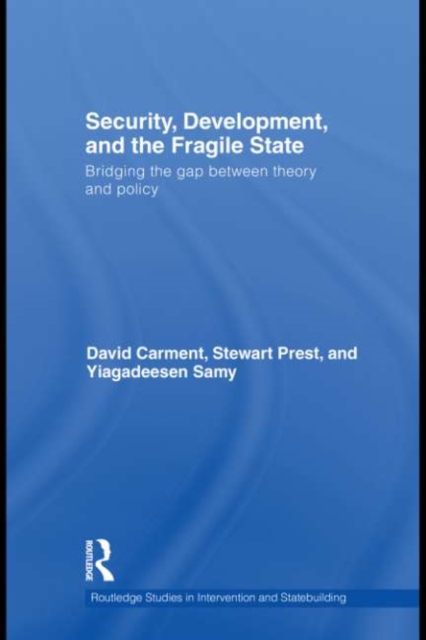
Security, Development and the Fragile State
This book provides theoretical clarity about the concepts of failed and fragile states, which have emerged strongly since the 9/11 attacks.
Recent contributions often see the fragile state as either a problem of development or of security. This volume argues that that neither perspective on its own is a sufficient basis for good policy. In a wide-ranging treatment, drawing on large samples as well as case studies, the authors create an alternative model of the fragile state emphasizing the multidimensional, multifaceted nature of the \"fragile state problematique\". On the basis of their model and empirical evidence, they then derive a number of policy-relevant insights regarding the need for contextualized and ongoing country analysis, the perils and pitfalls of unstructured development assistance, and the need to move whole-of-government approaches from the realm of rhetoric to reality. In offering both a synthesis of existing research and an innovative approach to understanding the fragile state, this volume will be of great interest to students of war and conflict studies, risk, conflict management, and international relations in general. It will also be of use to practitioners in policy circles and to NGOs.
1: Introduction 2: Policy Analysis: Contending and Complementary Approaches 3: A Fragile States Framework 4: The Determinants and Consequences of State Fragility: An Empirical Assessment 5: Assessing Policy Inputs: Aid Allocation and Effectiveness in Fragile States Environments 6: Profiles of Fragility for Effective Risk Analysis and Monitoring 7: Fragility Relevance and Impact Assessment
David Carment is Professor of International Affairs at the Norman Paterson School of International Affairs, Carleton University, Canada, and Fellow of the Canadian Defence and Foreign Affairs Institute (CDFAI). His book publications include Who Intervenes? Ethnic Conflict and Interstate Crises (2006) and Peacekeeping Intelligence (2006, Routledge). Stewart Prest is a PhD student in the department of political science at the University of British Columbia, Canada. Yiagadeesen Samy is Associate Professor of International Affairs at the Norman Paterson School of International Affairs, Carleton University, Canada.
eBook

Exiting the fragility trap : rethinking our approach to the world's most fragile states
\"State fragility is a much-debated yet underinvestigated concept in the development and international security worlds. Based on years of research as part of the Country Indicators for Foreign Policy project at Carleton University, Exiting the Fragility Trap marks a major step toward remedying the lack of research into the so-called fragility trap. In examining the nature and dynamics of state transitions in fragile contexts, with a special emphasis on states that are trapped in fragility, David Carment and Yiagadeesen Samy ask three questions: Why do some states remain stuck in a fragility trap? What lessons can we learn from those states that have successfully transitioned from fragility to stability and resilience? And how can third-party interventions support fragile state transitions toward resilience? Carment and Samy consider fragility's evolution in three state types: countries that are trapped, countries that move in and out of fragility, and countries that have exited fragility. Large-sample empirical analysis and six comparative case studies-Pakistan and Yemen (trapped countries), Mali and Laos (in and out countries), and Bangladesh and Mozambique (exited countries)-drive their investigation, which breaks ground toward a new understanding of why some countries fail to see sustained progress over time\"-- Provided by publisher.
Book

State Failure and State Weakness in a Time of Terror
The threat of terror, which flares in Africa and Indonesia, has given the problem of failed states an unprecedented immediacy and importance. In the past, failure had a primarily humanitarian dimension, with fewer implications for peace and security. Now nation-states that fail, or may do so, pose dangers to themselves, to their neighbors, and to people around the globe: preventing their failure, and reviving those that do fail, has become a strategic as well as a moral imperative. State Failure and State Weakness in a Time of Terror develops an innovative theory of state failure that classifies and categorizes states along a continuum from weak to failed to collapsed. By understanding the mechanisms and identifying the tell-tale indicators of state failure, it is possible to develop strategies to arrest the fatal slide from weakness to collapse. This state failure paradigm is illustrated through detailed case studies of states that have failed and collapsed (the Democratic Republic of the Congo, Sierra Leone, the Sudan, Somalia), states that are dangerously weak (Colombia, Indonesia, Sri Lanka, Tajikistan), and states that are weak but safe (Fiji, Haiti, Lebanon).
eBook
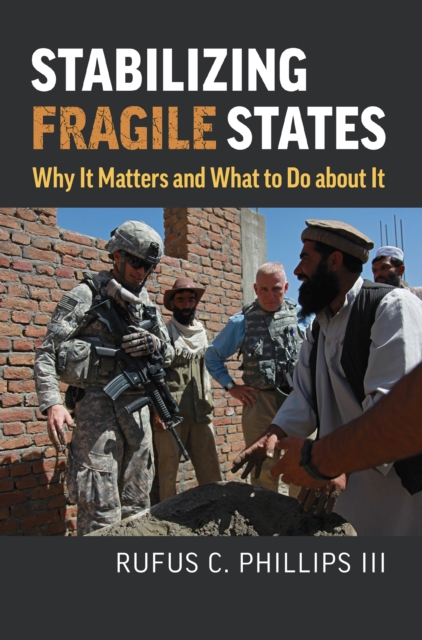
Stabilizing Fragile States
Stabilizing Fragile States: Why It Matters and What to Do About
It is a masterclass on intervening to help fragile states
stabilize in the face of internal challenges that threaten national
security and how the United States can do better at less cost with
improved chances of success. Written from the point of view of an
on-the-ground practitioner after exceptional government and
voluntary service abroad, Rufus C. Phillips III uses his experience
to explain why US efforts to help fragile countries stabilize is
important to national security. Helping stabilize fragile states
has been too much of a poorly informed, impersonal, technocratic,
and conflicted process that has been dominated by reactions to
events and missing a more human approach tailored to various
countries' circumstances. In his book, Phillips explains why we
have not been more successful and what it would take to make our
stabilization efforts effective, sustainable, and less expensive.
Recent US involvements have ranged in intensity and size from
Colombia, which did not put US boots on the ground, to massive
interventions in Iraq and Afghanistan, which did. The lack of
success in Afghanistan and Iraq has tended to dominate the national
conversation about dealing with fragile states. Stabilizing
Fragile States provides a thorough analysis of what has gone
wrong and what has gone right in US involvement. • Stabilizing
fragile states is more of an unconventional political and
psychological endeavor requiring an operational mindset rather than
conventional war or normal diplomacy. • Defines the focus of
counterinsurgency not as killing insurgents but as a positive
effort to win local people’s support by involving them in their
own self-defense and political, social, and economic development.
• Americans must understand the religious, historical, political,
and social context of the host country and be consistent, patient,
and persistent in what they do. • Security-force training in host
countries must include respect for civilians and the definition by
their leadership of a national cause that the trainees believe is
worth risking their lives to defend. • Recommends creating a
dedicated cadre of expeditionary diplomacy and development
professionals in Department of State/USAID and a special training
school as an addition to the Global Fragility Act.
eBook
International Political Risk Management, 3
International Political Risk Management: Looking to the Future is the third in a series of volumes based on the MIGA-Georgetown University Symposium in International Political Risk Management. Like its predecessors, this volume offers expert assessments of needs, trends, and challenges in the international political risk insurance industry. These assessments come from a dozen senior practitioners from the investor, financial, insurance, broker, and analytical communities. The volume leads off by examining the lessons that can be learned from recent investment losses, insurance claims, and arbitrations. It then turns to consider what the future may hold for coverage of project finance projects in emerging markets as well as recent public-private collaboration trends in the issuance of political risk insurance. It concludes by reconsidering both old and new political risk insurance products and innovations that seek to expand the tools that international investors can utilize to mitigate political risk abroad. A current in-depth analysis from the front lines of international political risk management, this book will be a valuable guide to those who are considering private sector investments and privatizations in the developing world, whether as equity sponsors, lenders, or insurers. It should also be of interest to independent analysts and scholars working in the field of political risk management.
Book

Fixing Failed States: A Cure Worse than the Disease?
The bipartisan Beltway consensus that sponsored the Iraq war is in the uncomfortable and unfamiliar position of having to justify its most basic tenets. After the Washington foreign policy community all but unanimously assured Americans of the prudence and necessity of starting a war with Iraq, other articles of faith in foreign policy circles are coming under attack. Failed states rarely present threats to the US, and attempting to \"fix\" them portends serious problems for US policy. Despite the vacuity of the concept of state failure, some scholars have been working from the assumption that people should embark on a policy of fixing failed states. Indeed, some students of international politics have moved far beyond advocating for the placement of state failure as the center of US national security policy. While perhaps not intentionally exploitative, postmodern imperialism certainly does appear to entail protracted and perhaps permanent rule by foreigners.
Journal Article
The Slippery Road: The Imperative for State Formation
\"State failure\" is the term used by scholars, development agencies, and politicians to describe a very complex situation in which such degeneration occurs. Perhaps the most powerful contemporary explanation for state failure, in terms of its political impact, is the argument that a powerful elite or \"state bourgeoisie\" manages to institutionalize theft and corruption, thus destroying the economy, social fabric, and state infrastructure. Colonial power had a further effect on institutions and organizations in post-independence states, as it created the functional structures of a modern state: administration, police, military, education, and health systems. When ruling elites were able to form a national consensus and maintain or adjust it through moments or cascades of crisis, the outcome was usually state resilience -- though this did not necessarily lead to accelerated development. Alternatively, when crises hit in a way that broke the consensus, periods of disintegration eventually led to the diminishment and eventual collapse of the formal bureaucratic state.
Journal Article