
Catalogue Search | MBRL


Are you sure you want to remove the book from the shelf?

{{itemTitle}}
42,524
result(s) for
"Political statistics."
Sort by:

Politicians manipulating statistics : how they do it and how to oppose them
\"Explore Billig and Marinho's highly original study of politicians misusing statistics, misleading the public, and manipulating statisticians. This book also highlights how the British and French statistical agencies aim to combat this increasingly serious problem. Tailored for all audiences, it is a clearly written, insightful, and witty work\"-- Provided by publisher.
BOOK

Sex, Drugs, and Body Counts
At least 200,000-250,000 people died in the war in Bosnia.
\"There are three million child soldiers in Africa.\" \"More than
650,000 civilians have been killed as a result of the U.S.
occupation of Iraq.\" \"Between 600,000 and 800,000 women are
trafficked across borders every year.\" \"Money laundering represents
as much as 10 percent of global GDP.\" \"Internet child porn is a $20
billion-a-year industry.\" These are big, attention-grabbing
numbers, frequently used in policy debates and media reporting.
Peter Andreas and Kelly M. Greenhill see only one problem: these
numbers are probably false. Their continued use and abuse reflect a
much larger and troubling pattern: policymakers and the media
naively or deliberately accept highly politicized and questionable
statistical claims about activities that are extremely difficult to
measure. As a result, we too often become trapped by these mythical
numbers, with perverse and counterproductive consequences.
This problem exists in myriad policy realms. But it is
particularly pronounced in statistics related to the politically
charged realms of global crime and conflict-numbers of people
killed in massacres and during genocides, the size of refugee
flows, the magnitude of the illicit global trade in drugs and human
beings, and so on. In Sex, Drugs, and Body Counts ,
political scientists, anthropologists, sociologists, and policy
analysts critically examine the murky origins of some of these
statistics and trace their remarkable proliferation. They also
assess the standard metrics used to evaluate policy effectiveness
in combating problems such as terrorist financing, sex trafficking,
and the drug trade.
Big, attention-grabbing numbers are frequently used in policy
debates and media reporting: \"At least 200,000-250,000 people died
in the war in Bosnia.\" \"There are three million child soldiers in
Africa.\" \"More than 650,000 civilians have been killed as a result
of the U.S. occupation of Iraq.\" \"Between 600,000 and 800,000 women
are trafficked across borders every year.\" \"Money laundering
represents as much as 10 percent of global GDP.\" \"Internet child
porn is a $20 billion-a-year industry.\"
Peter Andreas and Kelly M. Greenhill see only one problem: these
numbers are probably false. Their continued use and abuse reflect a
much larger and troubling pattern: policymakers and the media
naively or deliberately accept highly politicized and questionable
statistical claims about activities that are extremely difficult to
measure. As a result, we too often become trapped by these mythical
numbers, with perverse and counterproductive consequences.
This problem exists in myriad policy realms. But it is
particularly pronounced in statistics related to the politically
charged realms of global crime and conflict-numbers of people
killed in massacres and during genocides, the size of refugee
flows, the magnitude of the illicit global trade in drugs and human
beings, and so on. In Sex, Drugs, and Body Counts ,
political scientists, anthropologists, sociologists, and policy
analysts critically examine the murky origins of some of these
statistics and trace their remarkable proliferation. They also
assess the standard metrics used to evaluate policy effectiveness
in combating problems such as terrorist financing, sex trafficking,
and the drug trade.
Contributors: Peter Andreas, Brown University;
Thomas J. Biersteker, Graduate Institute of International and
Development Studies-Geneva; Sue E. Eckert, Brown University; David
A. Feingold, Ophidian Research Institute and UNESCO; H. Richard
Friman, Marquette University; Kelly M. Greenhill, Tufts University
and Harvard University; John Hagan, Northwestern University; Lara
J. Nettelfield, Institut Barcelona D'Estudis Internacionals and
Simon Fraser University; Wenona Rymond-Richmond, University of
Massachusetts Amherst; Winifred Tate, Colby College; Kay B. Warren,
Brown University
eBook

Bad data : how governments, politicians and the rest of us get misled by numbers
Our politicians make vital decisions and declarations every day that rely on official data. But should all statistics be trusted? In 'Bad Data', House of Commons Library statistician Georgina Sturge draws back the curtain on how governments of the past and present have been led astray by figures littered with inconsistency, guesswork and uncertainty.
Book
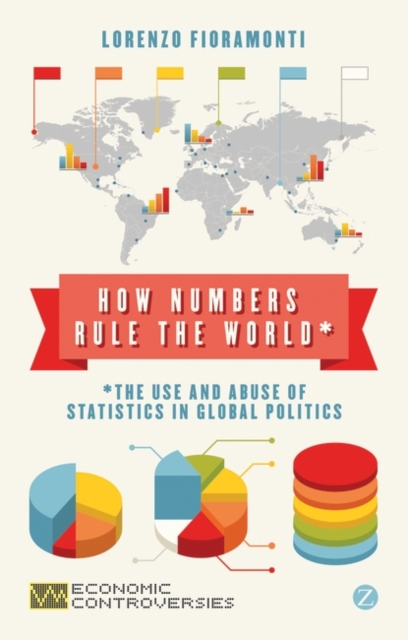
How numbers rule the world the use and abuse of statistics in global politics
Numbers dominate global politics and, as a result, our everyday lives. Credit ratings steer financial markets and can make or break the future of entire nations. GDP drives our economies. Stock market indices flood our media and national debates. Statistical calculations define how we deal with climate change, poverty and sustainability. But what is behind these numbers? In How Numbers Rule the World, Lorenzo Fioramonti reveals the hidden agendas underpinning the use of statistics and those who control them. Most worryingly, he shows how numbers have been used as a means to reinforce the grip of markets on our social and political life, curtailing public participation and rational debate. An innovative and timely exposé of the politics, power and contestation of numbers.
eBook

Rule by numbers
This book examines aspects of the production of statistical knowledge as part of colonial governance in India using Foucault's ideas of \"governmentality.\" The modern state is distinctive for its bureaucratic organization, official procedures, and accountability that in the colonial context of governing at a distance instituted a vast system of.
eBook


A solution to the ecological inference problem
This book provides a solution to the ecological inference problem, which has plagued users of statistical methods for over seventy-five years: How can researchers reliably infer individual-level behavior from aggregate (ecological) data? In political science, this question arises when individual-level surveys are unavailable (for instance, local or comparative electoral politics), unreliable (racial politics), insufficient (political geography), or infeasible (political history). This ecological inference problem also confronts researchers in numerous areas of major significance in public policy, and other academic disciplines, ranging from epidemiology and marketing to sociology and quantitative history. Although many have attempted to make such cross-level inferences, scholars agree that all existing methods yield very inaccurate conclusions about the world. In this volume, Gary King lays out a unique--and reliable--solution to this venerable problem.
King begins with a qualitative overview, readable even by those without a statistical background. He then unifies the apparently diverse findings in the methodological literature, so that only one aggregation problem remains to be solved. He then presents his solution, as well as empirical evaluations of the solution that include over 16,000 comparisons of his estimates from real aggregate data to the known individual-level answer. The method works in practice.
King's solution to the ecological inference problem will enable empirical researchers to investigate substantive questions that have heretofore proved unanswerable, and move forward fields of inquiry in which progress has been stifled by this problem.
eBook

Foundations of agnostic statistics
\"The last three decades have seen a marked change in the manner in which quantitative empirical inquiry in the social and health sciences is conducted. Sometimes dubbed the \"credibility revolution,\" this change has been characterized by a growing acknowledgment that the evidence that researchers adduce for their claims is often predicated on unsustainable assumptions. Our understanding of statistical and econometric tools has needed to change accordingly. We have found that conventional textbooks, which often begin with incredible modeling assumptions, are not well suited as a starting point for credible research\"-- Provided by publisher.
Book

How numbers rule the world
In this eye-opening book, Lorenzo Fioramonti provides a much-needed critique of the current 'data fever', showing both the direct consequences and indirect implications of the increasing power of numbers. At the same time, it investigates innovative attempts to resist the invasion of mainstream statistics by providing alternative measurements or rejecting quantification altogether. An innovative and timely exposé of the politics, power and contestation of numbers in everyday life
Book