
Catalogue Search | MBRL


Are you sure you want to remove the book from the shelf?

{{itemTitle}}
136
result(s) for
"Political violence -- United States -- History -- 20th century"
Sort by:

Mourning in America : race and the politics of loss
\"Recent years have brought public mourning to the heart of American politics, as exemplified by the spread and power of the Black Lives Matter movement, which has gained force through its identification of pervasive social injustices with individual losses. The deaths of Sandra Bland, Michael Brown, Freddie Gray, Trayvon Martin, Tamir Rice, Walter Scott, and so many others have brought private grief into the public sphere. The rhetoric and iconography of mourning has been noteworthy in Black Lives Matter protests, but David W. McIvor believes that we have paid too little attention to the nature of social mourning--its relationship to private grief, its practices, and its pathologies and democratic possibilities. In Mourning in America, McIvor addresses significant and urgent questions about how citizens can mourn traumatic events and enduring injustices in their communities. McIvor offers a framework for analyzing the politics of mourning, drawing from psychoanalysis, Greek tragedy, and scholarly discourses on truth and reconciliation. Mourning in America connects these literatures to ongoing activism surrounding racial injustice, and it contextualizes Black Lives Matter in the broader politics of grief and recognition. McIvor also examines recent, grassroots-organized truth and reconciliation processes such as the Greensboro Truth and Reconciliation Commission (2004-2006), which provided a public examination of the Greensboro Massacre of 1979--a deadly incident involving local members of the Communist Workers Party and the Ku Klux Klan\"--Publisher's Web site.
Book

Up Against the Wall
Curtis J. Austin's Up Against the Wall chronicles how violence brought about the founding of the Black Panther Party in 1966 by Huey P. Newton and Bobby Seale, dominated its policies, and finally destroyed the party as one member after another-Eldridge Cleaver, Fred Hampton, Alex Rackley-left the party, was killed, or was imprisoned. Austin shows how the party's early emphasis in the 1960s on self-defense, though sorely needed in black communities at the time, left it open to mischaracterization, infiltration, and devastation by local, state, and federal police forces and government agencies. Austin carefully highlights the internal tension between advocates of a more radical position than the Panthers took, who insisted on military confrontation with the state, and those such as Newton and David Hilliard, who believed in community organizing and alliance building as first priorities. Austin interviewed a number of party members who had heretofore remained silent. With the help of these stories, Austin is able to put the violent history of the party in perspective and show that the \"survival\" programs, such as the Free Breakfast for Children program and Free Health Clinics, helped the black communities they served to recognize their own bases of power and ability to save themselves.
eBook

The harvest of American racism : the political meaning of violence in the summer of 1967
\"In the summer of 1967, in response to violent demonstrations that rocked 164 cities across the U.S., the National Advisory Commission on Civil Disorders, commonly known as the Kerner Commission, was formed. As part of its work, the Commission employed social scientists to research the root causes of the disturbances, including the role that law enforcement played. Chief among its research projects was a study of 23 American cities, headed by social psychologist Robert Shellow. Shellow's social scientists worked from the vast material brought back by teams of Commission investigators who fanned out across those cities, conducting interviews and gathering data. An early draft of the scientists' analysis was delivered on November 22, 1967. Their report, titled \"The Harvest of American Racism: The Political Meaning of Violence in the Summer of 1967\" provoked the Commission's staff by uncovering political causes for the unrest; the team of researchers was fired, and the controversial report remained buried at the LBJ Presidential Library until now. The first publication of the Harvest report half a century later reveals that many of the issues it describes are still with us, including how cities might more effectively and humanely react to groups and communities in protest.\"--Provided by publisher.
BOOK
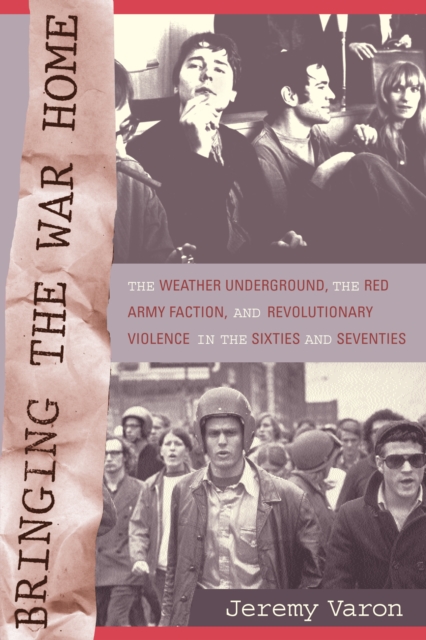
Bringing the War Home
In this first comprehensive comparison of left-wing violence in the United States and West Germany, Jeremy Varon focuses on America's Weather Underground and Germany's Red Army Faction to consider how and why young, middle-class radicals in prosperous democratic societies turned to armed struggle in efforts to overthrow their states. Based on a wealth of primary material, ranging from interviews to FBI reports, this book reconstructs the motivation and ideology of violent organizations active during the 1960s and 1970s. Varon conveys the intense passions of the era--the heat of moral purpose, the depth of Utopian longing, the sense of danger and despair, and the exhilaration over temporary triumphs. Varon's compelling interpretation of the logic and limits of dissent in democratic societies provides striking insights into the role of militancy in contemporary protest movements and has wide implications for the United States' current \"war on terrorism.\" Varon explores Weatherman and RAF's strong similarities and the reasons why radicals in different settings developed a shared set of values, languages, and strategies. Addressing the relationship of historical memory to political action, Varon demonstrates how Germany's fascist past influenced the brutal and escalating nature of the West German conflict in the 60s and 70s, as well as the reasons why left-wing violence dropped sharply in the United States during the 1970s. Bringing the War Home is a fascinating account of why violence develops within social movements, how states can respond to radical dissent and forms of terror, how the rational and irrational can combine in political movements, and finally how moral outrage and militancy can play both constructive and destructive roles in efforts at social change.
eBook

1968 : today's authors explore a year of rebellion, revolution, and change
\"Welcome to 1968--a revolution in a book. Essays, memoirs, and more by fourteen award-winning authors offer unique perspectives on one of the world's most tumultuous years\"--Provided by publisher.
Book

Represent and Destroy
In the global convulsions in the aftermath of World War II, one dominant world racial order broke apart and a new one emerged. In Represent and Destroy, Jodi Melamed portrays the postwar racial break as a transition from white supremacist modernity to a formally antiracist liberal capitalist modernity in which racial violence works normatively by policing representations of difference.
eBook

American whitelash : a changing nation and the cost of progress
\"In 2008, Barack Obama's historic victory was heralded as a turning point for the country. And so it would be--just not in the way that most Americans hoped. The election of the nation's first Black president fanned long-burning embers of white supremacy, igniting a new and frightening phase in a uniquely American cycle of racial progress and white backlash. In American Whitelash...Wesley Lowery charts the return of this bloodstained trend, showing how the forces of white power retaliated against Obama's victory--and both profited from and helped to propel the rise of Donald Trump. Interweaving deep historical analysis with...firsthand reporting on victims and perpetrators of violence, Lowery uncovers how this vicious cycle is carrying us into ever more perilous territory, how the federal government has failed to intervene, and how we still might find a route of escape\"--Dust jacket flap.
Book

Island X
Island X delves into the compelling political lives of
Taiwanese migrants who came to the United States as students from
the 1960s through the 1980s. Often depicted as compliant model
minorities, many were in fact deeply political, shaped by Taiwan's
colonial history and influenced by the global social movements of
their times. As activists, they fought to make Taiwanese people
visible as subjects of injustice and deserving of
self-determination. Under the distorting shadows of Cold War
geopolitics, the Kuomintang regime and collaborators across US
campuses attempted to control Taiwanese in the diaspora through
extralegal surveillance and violence, including harassment,
blacklisting, imprisonment, and even murder. Drawing on interviews
with student activists and extensive archival research, Wendy Cheng
documents how Taiwanese Americans developed tight-knit social
networks as infrastructures for identity formation, consciousness
development, and anticolonial activism. They fought for Taiwanese
independence, opposed state persecution and oppression, and
participated in global political movements. Raising questions about
historical memory and Cold War circuits of power, Island X
is a testament to the lives and advocacy of a generation of
Taiwanese American activists.
eBook

From the Land of Shadows : War, Revolution, and the Making of the Cambodian Diaspora
\"In a century of mass atrocities, the Khmer Rouge regime marked Cambodia with one of the most extreme genocidal instances in human history. What emerged in the aftermath of the regime's collapse in 1979 was a nation fractured by death and dispersal. It is estimated nearly one-fourth of the country's population perished from hard labor, disease, starvation, and executions. Another half million fled their ancestral homeland, with over one hundred thousand people finding refuge in America. From The Land of Shadows surveys the Cambodian diaspora and the struggle to understand and make meaning of this historical trauma. Drawing on over 250 interviews with survivors across the United States as well as in France and Cambodia, Khatharya Um places these accounts in conversation with studies of comparative revolutions, totalitarianism, transnationalism, and memory works to illuminate the pathology of power as well as the impact of auto-genocide on individual and collective healing. Exploring the interstices of home and exile, forgetting and remembering, From the Land of Shadows follows the ways in which Cambodian individuals and communities seek to rebuild connections frayed by time, distance, and politics in the face of this injurious history\"--From publisher's website.
Book

Mourning in America
Recent years have brought public mourning to the heart of American politics, as exemplified by the spread and power of the Black Lives Matter movement, which has gained force through its identification of pervasive social injustices with individual losses. The deaths of Sandra Bland, Michael Brown, Freddie Gray, Trayvon Martin, Tamir Rice, Walter Scott, and so many others have brought private grief into the public sphere. The rhetoric and iconography of mourning has been noteworthy in Black Lives Matter protests, but David W. McIvor believes that we have paid too little attention to the nature of social mourning-its relationship to private grief, its practices, and its pathologies and democratic possibilities.
InMourning in America, McIvor addresses significant and urgent questions about how citizens can mourn traumatic events and enduring injustices in their communities. McIvor offers a framework for analyzing the politics of mourning, drawing from psychoanalysis, Greek tragedy, and scholarly discourses on truth and reconciliation.Mourning in Americaconnects these literatures to ongoing activism surrounding racial injustice, and it contextualizes Black Lives Matter in the broader politics of grief and recognition. McIvor also examines recent, grassroots-organized truth and reconciliation processes such as the Greensboro Truth and Reconciliation Commission (2004-2006), which provided a public examination of the Greensboro Massacre of 1979-a deadly incident involving local members of the Communist Workers Party and the Ku Klux Klan.
eBook