
Catalogue Search | MBRL


Are you sure you want to remove the book from the shelf?

{{itemTitle}}
50
result(s) for
"Politicians Israel Biography"
Sort by:


Crisis and Development: Menachem Begin's Leadership Throughout the 1960s
The article discusses the connection between crisis and legitimacy in Menachem Begin's political career and traces the process, which led to a farreaching change in the identity of the Herut movement during the 1960s. Begin played a crucial role in removing barriers to this advancement, managing a number of issues by virtue of his leadership and special standing in his party. He succumbed to a number of deep crises and, to a large extent, also led his party into an equally deep abyss. At the same time, he learned the lessons from these crises and, from their depths to initiate the changes required to bring about political advancement. He uprooted old operative patterns that had worked against Herut's political progression in the political system and introduced new ones that transformed its place in the party system and the public arena.
Journal Article
The Sharett Legacy
There are leaders who despite their negligible contributions are well remembered and appreciated, and there are leaders who despite their significant contributions to their nations and states are forgotten or intentionally brushed aside. Moshe Sharett (1894-1965), Israel's first foreign minister and second prime minister, belongs to the second category of forgotten leaders. One of the main reasons for this situation is that he remains in the giant shadow of his well-known and remembered, more senior, charismatic, and activist colleague -- David Ben-Gurion. Here, Sheffer provides Sharett's political biography and his legacy.
Journal Article

Israeli Disraeli: Benjamin Disraeli's Afterlives in Israeli Culture
Building on the work of scholars who have examined how Benjamin Disraeli's Jewish roots affected his life, career, and public reception in Britain, the present article considers how these Jewish elements were understood and represented in the Hebrew culture emerging in Eretz Yisrael—from early Zionist settlement in the 1880s, through the Mandate period, to the founding of Israel in 1948 and beyond. Exploring a broad range of cultural arenas, the article traces intricate responses to Disraeli's political style and imperial vision, to his conversion and myth of Jewish racial superiority, and to his art, both as novelist and political performer. While Disraeli's proto-Zionism was celebrated in Israel, at least up to the 1950s, other elements of Disraeli's persona and thought were suppressed or treated ambivalently—often the result of ideological fault-lines. Attempting to explain these reactions, the article concludes by demonstrating how performances of \"Dizzy\" still echo in contemporary Israeli political culture.
Journal Article

Menachem Begin
Menachem Begin, father of Israel's right wing and sixth prime minister of the nation, was known for his unflinchingly hawkish ideology. And yet, in 1979 he signed a groundbreaking peace treaty with Egypt for which he and Egyptian president Anwar Sadat received the Nobel Prize for Peace. Such a contradiction was typical in Begin's life: no other Israeli played as many different, sometimes conflicting, roles as Begin, and no other figure inspired such sharply opposing responses. Begin was belittled and beloved, revered and despised, and his career was punctuated by exhilarating highs on the one hand, despair and ostracism on the other.
This riveting biography is the first to provide a satisfactory answer to the question, Who was Begin? Based on wide-ranging research among archival documents and on testimonials and interviews with Begin's closest advisers, the book presents a detailed new portrait of the founding leader. Among the many topics the book holds up to new light are Begin's antagonistic relationship with David Ben-Gurion, his controversial role in the 1982 Lebanon War, his unique leadership style, the changes in his ideology over the years, and the mystery behind the total silence he maintained at the end of his career. Through Begin's remarkable life, the book also recounts the history of the right-wing segment of Israeli society, a story essential to understanding the Israel of today.
eBook
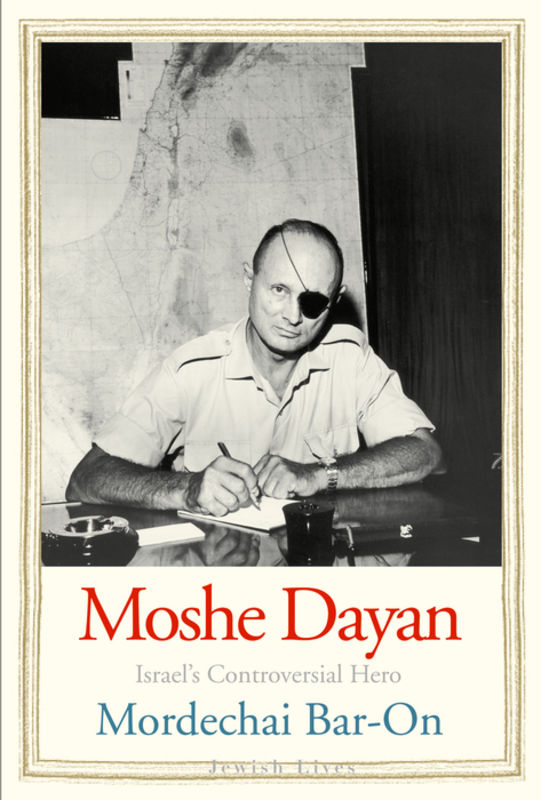
Moshe Dayan
Instantly recognizable with his iconic eye patch, Moshe Dayan (1915-1981) was one of Israel's most charismatic-and controversial-personalities. As a youth he earned the reputation of a fearless warrior, and in later years as a leading military tactician, admired by peers and enemies alike. As chief of staff during the 1956 Sinai Campaign and as minister of defense during the 1967 Six Day War, Dayan led the Israel Defense Forces to stunning military victories. But in the aftermath of the bungled 1973 Yom Kippur War, he shared the blame for operational mistakes and retired from the military. He later proved himself a principled and talented diplomat, playing an integral role in peace negotiations with Egypt.
In this arresting biography, Mordechai Bar-On, Dayan's IDF bureau chief, offers an intimate view of Dayan's private life, public career, and political controversies, set against an original analysis of Israel's political environment from pre-Mandate Palestine through the early1980s. Drawing on a wealth of Israeli archives, accounts by Dayan and members of his circle, and firsthand experiences, Bar-On reveals Dayan as a man unwavering in his devotion to Zionism and the Land of Israel.Moshe Dayanmakes a unique contribution to the history of Israel and the complexities of the Arab-Israeli conflict.
eBook

H V Evatt and the Establishment of Israel
The Minister for External Affairs, and the dominant force in the formation of Australian foreign policy for a crucial decade in the battle over Palestine (1941-1949), Herbert Vere Evatt played a central role in the Australian political response to Zionism and the conflict in Palestine. This book, which uses a variety of primary sources from Australia, Israel, the United Kingdom and the United States, provides a valuable study of Evatt the Zionist, as well as illuminating a fascinating political figure. This valuable book charts the debate in Australia over the creation of a Jewish state as well as providing a genuinely entertaining study of Evatt himself.
Daniel Mandel was born in Sydney in 1964 and educated in Australia and New Zealand, receiving his doctorate in history at the University of Melbourne. He is now a research fellow in the History Department of the University of Melbourne.
'If you're a history buff, this is one to pick up, and if you're not, the story is a fascinating play of political intrigue and balancing allegiances.' - Jewsweek
'A useful contribution to the history of Israel's founding - Middle East Quarterly
Introduction 1. A Wild Colonial Boy 2. A Rigorous System of Suppression 3. Questions of Colour and Groups of Nations 4. Explain the Whole Thing to Evatt 5. A Test of Our Powers, and Our Independence 6. A Narrow Line 7. Gravest Challenge Yet to Nations 8. What Would You Do About Palestine? 9. Naturally I Am Taking a Purely Objective View 10. Intrigues Directed Against the Jewish People 11. The Use of Force Would Not be Actively Opposed 12. Position is Being Watched Sympathetically 13. As Inevitable as it is Just 14. It is a Matter of Degree 15. More Pious than Pius. Conclusion. Epilogue
eBook

Yasir Arafat : a political biography
Yasir Arafat stands as one of the most resilient, recognizable and controversial political figures of modern times. The object of unrelenting suspicion, steady admiration and endless speculation, Arafat has occupied the center stage of Middle East politics for almost four decades. Yasir Arafat is the most comprehensive political biography of this remarkable man. Forged in a tumultuous era of competing traditionalism, radicalism, Arab nationalism, and Islamist forces, the Palestinian movement was almost entirely Arafat's creation, and he became its leader at an early age. Arafat took it through a dizzying series of crises and defeats, often of his own making, yet also ensured that it survived, grew, and gained influence. Disavowing terrorism repeatedly, he also practiced it constantly. Arafat's elusive behavior ensured that radical regimes saw in him a comrade in arms, while moderates backed him as a potential partner in peace. After years of devotion to armed struggle, Arafat made a dramatic agreement with Israel that let him return to his claimed homeland and transformed him into a legitimized ruler. Yet at the moment of decision at the Camp David summit and afterward, when he could have achieved peace and a Palestinian state, he sacrificed the prize he had supposedly sought for the struggle he could not live without. Richly populated with the main events and dominant leaders of the Middle East, this detailed and analytical account by Barry Rubin and Judith Colp Rubin follows Arafat as he moves to Kuwait, Syria, Jordan, Lebanon, Tunisia, and finally to Palestinian-ruled soil. It shows him as he rewrites his origins, experiments with guerrilla war, develops a doctrine of terrorism, fights endless diplomatic battles, and builds a movement, constantly juggling states, factions, and world leaders. Whole generations and a half-dozen U.S. presidents
have come and gone over the long course of Arafat's career. But Arafat has outlasted them all, spanning entire eras, with three constants always present: he has always survived, he has constantly seemed imperiled, and he has never achieved his goals. While there has been no substitute for Arafat, the authors conclude, Arafat has been no substitute for a leader who could make peace.
eBook