
Catalogue Search | MBRL


Are you sure you want to remove the book from the shelf?

{{itemTitle}}
22
result(s) for
"Politics and literature -- South Africa -- History -- 20th century"
Sort by:


Apartheid and Beyond
This book contributes to the study of South African literature, offering readings of writers such as Coetzee, Gordimer, Fugard, Tlali, and Mda. Focusing on the relationship between place, subjectivity, and literary form, the study examines our understanding of apartheid as a geographical form of control, and of its imagined and actual transformation.
eBook

Nelson Mandela and the end of apartheid
Examines \"how Nelson Mandela's personal struggles and great courage spurred the South African revolution that changed the way the world looked at Africa\"--Amazon.com.
Book
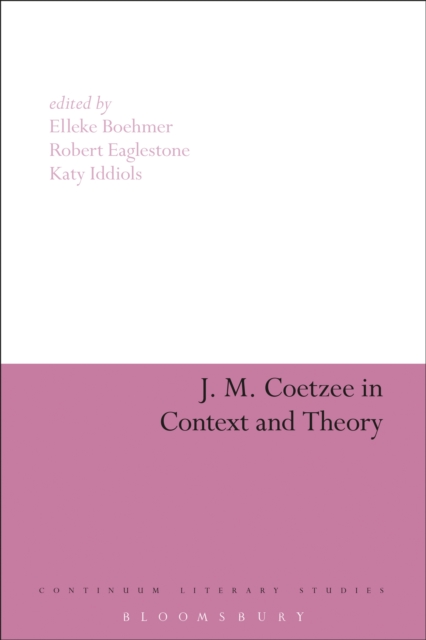
J. M. Coetzee in Context and Theory
Nobel Laureate and the first author to win the Booker Prize twice, J.M.Coetzee is perhaps the world's leading living novelist writing in English.Including an international roster of world leading critics and novelists, and drawing on new research, this innovative book analyses the whole range of Coetzee's work, from his most recent novels.
eBook


Rhetorics of Resistance
The period of apartheid was a perilous time in South Africa’s history. This book examines the tactics of resistance developed by those working for the Weekly Mail and New Nation, two opposition newspapers published in South Africa in the mid- and late 1980s. The government, in an attempt to crack down on the massive political resistance sweeping the country, had imposed martial law and imposed even greater restrictions on the press. Bryan Trabold examines the writing, legal, and political strategies developed by those working for these newspapers to challenge the censorship restrictions as much as possible—without getting banned. Despite the many steps taken by the government to silence them, including detaining the editor of New Nation for two years and temporarily closing both newspapers, the Weekly Mail and New Nation not only continued to publish but actually increased their circulations and obtained strong domestic and international support. New Nation ceased publication in 1994 after South Africa made the transition to democracy, but the Weekly Mail, now the Mail & Guardian, continues to publish and remains one of South Africa’s most respected newspapers.
eBook

On Latinx Globalities: the case of African cosmopolitanism in Elizabeth “Betita” Martínez and Víctor Hernández Cruz
This essay offers a literary history that corrects the notion that Latinx writers are exempt from cosmopolitan preoccupations. I address the undertheorized internationalism with Africa of two renowned Latinx writers: Víctor Hernández Cruz and Elizabeth “Betita” Martínez. Building from the critical analysis in Latinx studies that renders legible the liberationist pursuits of late twentieth-century Latinx writing, this intervention shows how African geopolitical tensions also become prominent spaces of engagement. For Cruz, I focus on the ways in which North Africa has featured prominently in his poetry since 1991. Internationalist activist Martínez, on the other hand, advocates for an international education, following Frantz Fanon’s pleas, implemented in her political autobiography
De Colores Means All of Us: Latina Views for a Multi-Colored Century
(1998). Her archival documents likewise speak to her immersion in African politics. The transatlantic links these authors make ultimately serve to challenge anti-black attitudes in the Latinx population. Both writers engage in a curiosity about and empathy for different African regions that reconceptualize south-south engagement while challenging normative idealizations of cosmopolitan theory.
Journal Article

Bulletproof
In 1856 and 1857, in response to a prophet’s command, the Xhosa people of southern Africa killed their cattle and ceased planting crops; the resulting famine cost tens of thousands of lives. Much like other millenarian, anticolonial movements—such as the Ghost Dance in North America and the Birsa Munda uprising in India—these actions were meant to transform the world and liberate the Xhosa from oppression. Despite the movement’s momentous failure to achieve that goal, the event has continued to exert a powerful pull on the South African imagination ever since. It is these afterlives of the prophecy that Jennifer Wenzel explores in Bulletproof. Wenzel examines literary and historical texts to show how writers have manipulated images and ideas associated with the cattle killing—harvest, sacrifice, rebirth, devastation—to speak to their contemporary predicaments. Widening her lens, Wenzel also looks at how past failure can both inspire and constrain movements for justice in the present, and her brilliant insights into the cultural implications of prophecy will fascinate readers across a wide variety of disciplines.
eBook