
Catalogue Search | MBRL


Are you sure you want to remove the book from the shelf?

{{itemTitle}}
61
result(s) for
"Politics and literature Great Britain History 16th century."
Sort by:

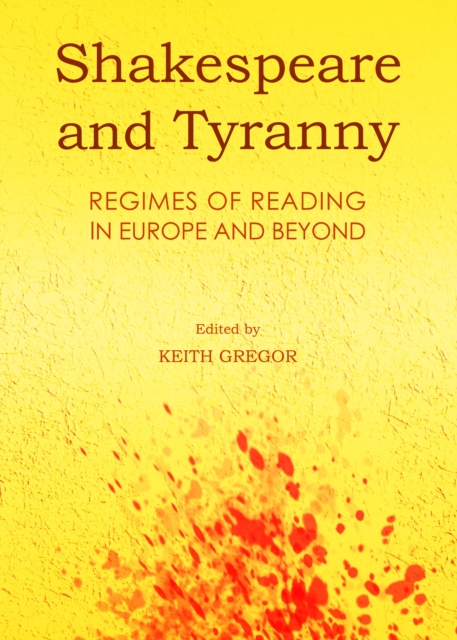
Shakespeare and Tyranny
This book brings together a selection of essays on the reception and dissemination of Shakespeare's plays in England and beyond from the 17th century to the present. Written from the perspective of a nation or cluster of nations in which Shakespeare has been used either to reflect, legitimize or challenge different versions of authoritarian rule, each of the chapters offers a picture of Shakespeare as unwitting commentator on some of the most significant and unsettling political events in Europe and elsewhere. Illustrating and analyzing changing attitudes to Shakespeare and his work in various tyrannical and post-tyrannical contexts in both Western and Eastern Europe, North Africa and South America, the volume provides insights into issues like the role of censorship and self-censorship in the revision and production of Shakespearean material; institutional controls on the dissemination and publication of Shakespeare's work; assumptions and techniques in the staging of his plays; state intervention in the elaboration of a Shakespeare \"canon\"; the role of Shakespeare in the construction of identity under tyranny; and the pertinence or otherwise of the subversion/containment paradigm following events such as the collapse of communism and the so-called \"Arab Spring\".
eBook

The last Plantagenet consorts : gender, genre, and historiography, 1440-1627
\"Most modern accounts of fifteenth-century queens understandably focus on separating what really happened from what was fabricated. What has not been considered in any detail, however, is the fabrications themselves as narratives, and as reflections of questions and anxieties that haunted their writers. By focusing on the relationship between gender and genre and the way embedded literary narratives echo across texts as disparate as chronicles, parliamentary proceedings, diplomatic correspondence, ballads, poetry, and drama, this study reveals hitherto unexplored tensions within these texts, generated by embedded narratives and their implications\"-- Provided by publisher.
Book

The third citizen : Shakespeare's theater and the early modern House of Commons
The new practices and theories of parliamentary representation that emerged during Elizabeth's and James' reigns shattered the unity of human agency, redefined the nature of power, transformed the image of the body politic, and unsettled constructs and concepts as fundamental as the relation between presence and absence. In The Third Citizen, Oliver Arnold argues that recovering the formation of political representation as an effective ideology should radically change our understanding of early modern political culture, Shakespeare's political art, and the way Anglo-American critics, for whom representative democracy is second nature, construe both. In magisterial readings of Titus Andronicus, Julius Caesar, Coriolanus, and the First Tetralogy, Arnold discovers a new Shakespeare who was neither a conservative apologist for monarchy nor a prescient, liberal champion of the House of Commons but instead a radical thinker and artist who demystified the ideology of political representation in the moment of its first flowering. Shakespeare believed that political representation produced (and required for its reproduction) a new kind of subject and a new kind of subjectivity, and he fashioned a new kind of tragedy to represent the loss of power, the fall from dignity, the false consciousness, and the grief peculiar to the experiences of representing and of being represented. Representationalism and its subject mark the beginning of political modernity; Shakespeare's tragedies greet political representationalism with skepticism, bleakness, and despair.
eBook


Utopia, Carnival, and Commonwealth in Renaissance England
With the emergence of utopia as a cultural genre in the sixteenth century, a dual understanding of alternative societies, as either political or literary, took shape. InUtopia, Carnival, and Commonwealth in Renaissance England, Christopher Kendrick argues that the chief cultural-discursive conditions of this development are to be found in the practice of carnivalesque satire and in the attempt to construct a valid commonwealth ideology. Meanwhile, the enabling social-political condition of the new utopian writing is the existence of a social class of smallholders whose unevenly developed character prevents it from attaining political power equivalent to its social weight.
In a detailed reading of Thomas More'sUtopia, Kendrick argues that the uncanny dislocations, the incongruities and blank spots often remarked upon in Book II's description of Utopian society, amount to a way of discovering uneven development, and that the appeal of Utopian communism stems from its answering the desire of the smallholding class (in which are to be numbered European humanists) for unity and power. Subsequent chapters on Rabelais, Nashe, Marlowe, Bacon, Shakespeare, and others show how the utopian form engages with its two chief discursive preconditions, carnival and commonwealth ideologies, while reflecting the history of uneven development and the smallholding class.Utopia, Carnival, and Commonwealth in Renaissance Englandmakes a novel case for the social and cultural significance of Renaissance utopian writing, and of the modern utopia in general.
eBook


Gender, culture and politics in England, 1560-1640 : turning the world upside down
\"Gender, Culture and Politics in England, 1560-1640 integrates social history, politics and literary culture as part of a groundbreaking study that provides revealing insights into the lives of men and women in early modern England. Susan D. Amussen and David E. Underdown examine familiar chaotic characters from the period, such as scolds, cuckolds, witches and scandalous women, and consider the significance of the disorder they create and how they turn the ordered world around them upside down in a very specific, gendered way. Using case studies from theatre, civic ritual and witchcraft, the book demonstrates how the idea of an upside down world, centered on gender inversion, repeatedly permeates the mental world of early modern England. Amussen and Underdown show both how gender was central to understanding society, and the ways in which both unruly women and failed patriarchs were disciplined. In doing so, they give a glimpse of how we can connect different dimensions of early modern society. This is a vital study for anyone keen to know more about the importance of gender in society, culture and politics in 16th- and 17th-century England\"--Provided by publisher.
Book
