
Catalogue Search | MBRL


Are you sure you want to remove the book from the shelf?

{{itemTitle}}
19
result(s) for
"Politique scientifique et technique États-Unis."
Sort by:
The brain development revolution : science, the media, and public policy
\"Today we perceive children and the influences on them with regard to their developing brains. This book documents how brain development became the dominant lens for understanding children's development, the benefits and missed opportunities for children that resulted, and why brain development compels our attention\"-- Provided by publisher.
Book
Scientists, business, and the state, 1890-1960
In the late nineteenth century, scientists began allying themselves with Americas corporate, political, and military elites. They did so not just to improve their professional standing and win more money for research, says Patrick McGrath, but for political reasons as well. They wanted to use their new institutional connections to effect a transformation of American political culture. They succeeded, but not in ways that all scientists envisioned or agreed upon. McGrath describes how, between 1890 and 1960, scientific, business, and political leaders together forged a new definition of American democracy in which science and technology were presented to the public as crucial ingredients of the nations progress, prosperity, and political stability. But as scientists became more prominent, they provoked conflicts among themselves as well as with their institutional patrons over exactly how their expertise should be used. McGrath examines the bitter battles that erupted over the role scientists should play during the Great Depression, World War II, the Cold War arms race, and the security and loyalty investigations of the 1950s. He finds that, by the end of the 1950s, scientists were regarded by the political and military elite not as partners but as subordinate technicians who were expected to supply weapons on demand for the Cold War state. Originally published 2001. A UNC Press Enduring Edition UNC Press Enduring Editions use the latest in digital technology to make available again books from our distinguished backlist that were previously out of print. These editions are published unaltered from the original, and are presented in affordable paperback formats, bringing readers both historical and cultural value.
eBook
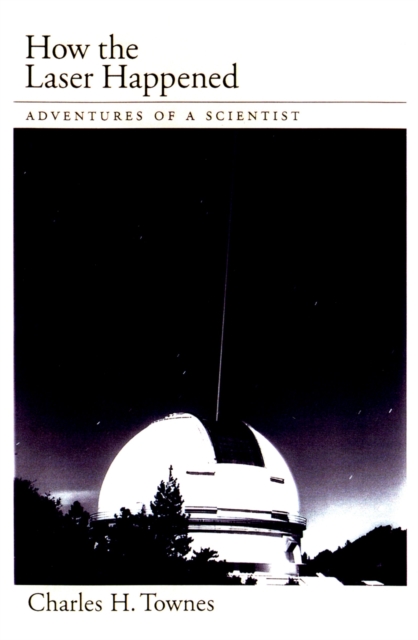
How the laser happened : adventures of a scientist
In How the Laser Happened, Nobel laureate Charles Townes provides a highly personal look at some of the leading events in twentieth-century physics. Townes was inventor of the maser, of which the laser is one example; an originator of spectroscopy using microwaves; and a pioneer in the study of gas clouds in galaxies and around stars. Throughout his career he has also been deeply engaged with issues outside of academic research. He worked on applied research projects for Bell Labs; served on the board of directors for General Motors; and devoted extensive effort to advising the government on science, policy, and defense. This memoir traces his multifaceted career from its beginnings on the family farm in South Carolina. Spanning decades of ground-breaking research, the book provides a hands-on description of how working scientists and inventors get their ideas. It also gives a behind-the-scenes look at the scientific community, showing how scientists respond to new ideas and how they approach a variety of issues, from priority and patents to the social and political implications of their work. In addition, Townes touches on the sociology of science, uncovering some of the traditions and values that are invisible to an outsider. A towering and energetic figure, Townes has explored or pioneered most of the roles available to the modern scientist. In addition to fundamental research, he was actively involved in the practical uses of the laser and in the court cases to defend the patent rights. He was a founding member of the Jasons, an influential group of scientists that independently advises the government on defense policy, and he played an active part in scientific decisions and policies from the Truman through the Reagan administration. This lively memoir, packed with first-hand accounts and historical anecdotes, is an invaluable resource for anyone interested in the history of science and an inspiring example for students considering scientific careers.
eBook

Re-Imagining the Museum
Re-Imagining the Museum presents new interpretations of museum history and contemporary museum practices.
Through a range of case studies from the UK, North America and Australia, Andrea Witcomb moves away from the idea that museums are always 'conservative' to suggest they have a long history of engaging with popular culture and addressing a variety of audiences. She argues that museums are key mediators between high and popular culture and between government, media practitioners, cultural policy-makers and museums professionals.
Analyzing links between museums and the media, looking at the role of museums in cities, and discussing the effects on museums of cultural policies, Re-Imagining the Museum presents a vital tool in the study of museum practice.
eBook
Saving Our Environment from Washington
Congress empowered the Environmental Protection Agency on the theory that only a national agency that is insulated from accountability to voters could produce the scientifically grounded pollution rules needed to save a careless public from its own filth. In this provocative book, David Schoenbrod explains how his experience as an environmental advocate brought him to this startling realization: letting EPA dictate to the nation is a mistake.
Through a series of gripping and illuminating anecdotes from his own career, the author reveals the EPA to be an agency that, under Democrats and Republicans alike, delays good rules, imposes bad ones, and is so big, muscle-bound, and remote that it does unnecessary damage to our society. EPA stays in power, he says, because it enables elected legislators to evade responsibility by hiding behind appointed bureaucrats. The best environmental rules-those that have done the most good-have come when Congress had to take responsibility or from states and localities rather than the EPA.
With the passion of an authentic environmentalist, Schoenbrod makes a sensible plea for \"bottom-up\" environmental protection now. The responsibility for pollution control belongs not in agencies but in legislatures, and usually not at the federal level but rather closer to home.
eBook
American science in an age of anxiety : scientists, anticommunism, and the cold war
No professional group in the United States benefitted more from World War II than the scientific community. After the atomic bombings of Hiroshima and Nagasaki, scientists enjoyed unprecedented public visibility and political influence as a new elite whose expertise now seemed critical to America's future. But as the United States grew committed to Cold War conflict with the Soviet Union and the ideology of anticommunism came to dominate American politics, scientists faced an increasingly vigorous regimen of security and loyalty clearances as well as the threat of intrusive investigations by the notorious House Committee on Un-American Activities and other government bodies. This book offers a major study of American scientists' encounters with Cold War anticommunism in the decade after World War II. By examining cases of individual scientists subjected to loyalty and security investigations, the organizational response of the scientific community to political attacks, and the relationships between Cold War ideology and postwar science policy, Jessica Wang demonstrates the stifling effects of anticommunist ideology on the politics of science. She exposes the deep divisions over the Cold War within the scientific community and provides a complex story of hard choices, a community in crisis, and roads not taken.
eBook
Anthropology At the Dawn of the Cold War
This book breaks new ground in the history of anthropology, opening up an explicit examination of anthropology in the Cold War era. With historical distance, Cold War anthropology has begun to emerge as a distinct field within the discipline. This book brings a number of different approaches to bear on the questions raised by anthropology's Cold War history.
The contributors show how anthropologists became both tools and victims of the Cold War state during the rise of the United States in the post-War period. Examining the intersection between science and power, this book is a compelling read for anthropologists, historians, sociologists, and anyone interested in the way in which colonial and neo-colonial knowledge is produced and constructed.
eBook

Redefining Science
The Cold War forced scientists to reconcile their values of internationalism and objectivity with the increasingly militaristic uses of scientific knowledge. For decades, antinuclear scientists pursued nuclear disarmament in a variety of ways, from grassroots activism to transnational diplomacy and government science advising. The U.S. government ultimately withstood these efforts, redefining science as a strictly technical endeavor that enhanced national security and deeming science that challenged nuclear weapons on moral grounds \"emotional\" and patently unscientific. In response, many activist scientists restricted themselves to purely technical arguments for arms control. When antinuclear protest erupted in the 1980s, grassroots activists had moved beyond scientific and technical arguments for disarmament. Grounding their stance in the idea that nuclear weapons were immoral, they used the \"emotional\" arguments that most scientists had abandoned.
Redefining Science shows that the government achieved its Cold War \"consensus\" only by active opposition to powerful dissenters and helps explain the current and uneasy relationship between scientists, the public, and government in debates over issues such as security, energy, and climate change.
eBook

fundamental role of science and technology in international development
In October 2003 the U.S. Agency for International Development (USAID) and the National Research Council (NRC) entered into a cooperative agreement. The agreement called for the NRC to examine selected aspects of U.S. foreign assistance activities-primarily the programs of the USAID-that have benefited or could benefit from access to strong science, technology, and medical capabilities in the United States or elsewhere. After considering the many aspects of the role of science and technology (S&T) in foreign assistance, the study led to the publication of The Fundamental Role of Science and Technology in International Development . In the book special attention is devoted to partnerships that involve the USAID together with international, regional, U.S. governmental, and private sector organizations in fields such as heath care, agriculture and nutrition, education and job creation, and energy and the environment. This book explores specific programmatic, organizational, and personnel reforms that would increase the effective use of S&T to meet the USAID's goals while supporting larger U.S. foreign policy objectives.
eBook

In Sputnik's Shadow
In today's world of rapid advancements in science and technology, we need to scrutinize more than ever the historical forces that shape our perceptions of what these new possibilities can and cannot do for social progress.In Sputnik's Shadowprovides a lens to do just that, by tracing the rise and fall of the President's Science Advisory Committee from its ascendance under Eisenhower in the wake of the Soviet launching of Sputnik to its demise during the Nixon years. Members of this committee shared a strong sense of technological skepticism; they were just as inclined to advise the president about what technologycouldn'tdo-for national security, space exploration, arms control, and environmental protection-as about what itcoulddo.Zuoyue Wang examines key turning points during the twentieth century, including the beginning of the Cold War, the debates over nuclear weapons, the Sputnik crisis in 1957, the struggle over the Vietnam War, and the eventual end of the Cold War, showing how the involvement of scientists in executive policymaking evolved over time. Bringing new insights to the intellectual, social, and cultural histories of the era, this book not only depicts the drama of Cold War American science, it gives perspective to how we think about technological advancements today.
eBook