
Catalogue Search | MBRL


Are you sure you want to remove the book from the shelf?

{{itemTitle}}
552
result(s) for
"Poor families United States."
Sort by:


Trapped in a Maze
Trapped in a Maze provides a window into families' lived experiences in poverty by looking at their complex interactions with institutions such as welfare, hospitals, courts, housing, and schools. Families are more intertwined with institutions than ever as they struggle to maintain their eligibility for services and face the possibility that involvement with one institution could trigger other types of institutional oversight. Many poor families find themselves trapped in a multi-institutional maze, stuck in between several systems with no clear path to resolution. Tracing the complex and often unpredictable journeys of families in this maze, this book reveals how the formal rationality by which these institutions ostensibly operate undercuts what they can actually achieve. And worse, it demonstrates how involvement with multiple institutions can perpetuate the conditions of poverty that these families are fighting to escape.
eBook

The financial diaries : how American families cope in a world of uncertainty
Deep within the American Dream lies the belief that hard work and steady saving will ensure a comfortable retirement and a better life for one's children. But in a nation experiencing unprecedented prosperity, even for many families who seem to be doing everything right, this ideal is still out of reach. Authors Jonathan Morduch and Rachel Schneider draw on the U.S. Financial Diaries, a project which follows the lives of 235 low- and middle-income families as they navigate through a year. Through the Diaries, Morduch and Schneider challenge popular assumptions about how Americans earn, spend, borrow, and save -- and they identify the true causes of distress and inequality for many working Americans. We meet real people, ranging from a casino dealer to a street vendor to a tax preparer, who open up their lives and illustrate a world of financial uncertainty in which even limited financial success requires imaginative -- and often costly -- coping strategies. Morduch and Schneider detail what families are doing to help themselves and describe new policies and technologies that will improve stability for those who need it most. Combining hard facts with personal stories, The Financial Diaries presents an inside look at the economic stresses of today's families and offers ideas for solving them.
Book

Jobs aren't enough
\"This unflinching examination of the obstacles to economic mobility for low-income families exposes the ugly reality that lies beneath the shining surface of the American Dream. The fact is that nearly 25% of employed adults have difficulty supporting their families today. In eye-opening interviews, twenty-five workers and nearly a thousand people who are linked to them-children, teachers, job trainers, and employers-tell wrenching stories about 'trying to get ahead.' Spanning five cities over five years, this study convincingly demonstrates that prevailing ideas about opportunity, merit, and 'bootstraps' are outdated. As the authors show, some workers who believe the myths end up destroying their health and families in the process of trying to 'move up.' Jobs Aren't Enough demonstrates that the social institutions of family, education, labor market, and policy all intersect to influence-and inhibit-employment mobility. It proposes a new mobility paradigm grounded in cooperation and collaboration across social institutions, along with revitalization of the 'public will.'\" (author's abstract, IAB-Doku). Contents: 1. Are Jobs Enough for Economic Mobility? 2. From the Old to the New Economic Mobility 3. The Parents: Their Backgrounds, Lives, and Locations 4. The Children: Their Lives and Worlds 5. Workforce Development: Systems and Networks 6. Yesterday's Firms and Today's Families: Connects and Disconnects / with Michele Belliveau 7. Children's Schools, Parents' Work, and Policy: Alignment and Misalignment 8. Jobs Aren't Enough: Toward an Agenda for Family Economic Mobility Afterword: What Lies Ahead for the New Orleans Families after Hurricane Katrina? Appendix A: Frequently Asked Questions about the Research in this Book: Research Design.
eBook


Trapped in a Maze
Trapped in a Maze provides a window into families' lived experiences in poverty by looking at their complex interactions with institutions such as welfare, hospitals, courts, housing, and schools. Families are more intertwined with institutions than ever as they struggle to maintain their eligibility for services and face the possibility that involvement with one institution could trigger other types of institutional oversight. Many poor families find themselves trapped in a multi-institutional maze, stuck in between several systems with no clear path to resolution. Tracing the complex and often unpredictable journeys of families in this maze, this book reveals how the formal rationality by which these institutions ostensibly operate undercuts what they can actually achieve. And worse, it demonstrates how involvement with multiple institutions can perpetuate the conditions of poverty that these families are fighting to escape.
Book


Good Parents or Good Workers?
Good Parents or Good Workers? draws upon new ethnographic studies and longitudinal interviews that are reporting on the daily lives of women and children under new welfare policy pressures. Contributors look at family policy in the context of daily demands and critique new social programs that are designed to strengthen families. The book is divided into three course-friendly sections that deal with the impact of welfare reform on caregiving, the lived experiences of low-income families, and family policy debates. Good Parents or Good Workers? is an important text on the impacts of welfare reform that will be essential reading in a variety of courses in education, sociology, and politics.
eBook

The war on welfare : family, poverty, and politics in modern America
Why did the War on Poverty give way to the war on welfare? Many in the United States saw the welfare reforms of 1996 as the inevitable result of twelve years of conservative retrenchment in American social policy, but there is evidence that the seeds of this change were sown long before the Reagan Revolution- and not necessarily by the Right. Historian Marisa Chappell provides a fresh look at the national debate about poverty, welfare, and economic rights from the 1960s through the mid-1990s. In Chappell's telling, we experience the debate over welfare from multiple perspectives, including those of conservatives of several types, liberal antipoverty experts, national liberal organizations, labor, government officials, feminists of various persuasions, and poor women themselves.
Book
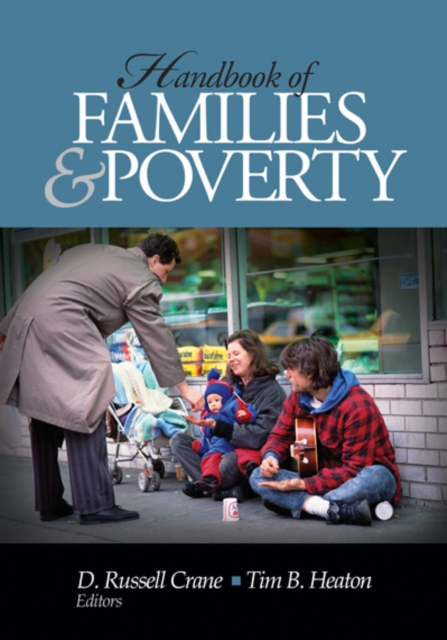
Handbook of families & poverty
Written by respected scholars from a variety of relevant disciplines, this handbook will cover hotly debated issues associated with public policy and funded research as they relate to families and poverty. Contributors, bringing multiple perspectives to bear, will aim to show alternatives to welfare in subgroups facing specific challenges that are currently not adequately addressed by the welfare system. (Several works have focused on welfare reform and poverty, but few have included as extensive a discussion.) Readers will also appreciate the insightful summaries of research involving poverty and its relationship to couple, marital, and family dynamics.
eBook