
Catalogue Search | MBRL


Are you sure you want to remove the book from the shelf?

{{itemTitle}}
2,906
result(s) for
"Pope, Alexander, 1688-1744"
Sort by:

Anniversary essays on Alexander Pope's The rape of the lock
\"Alexander Pope's heroi-comical, mock-epic poem, The Rape of the Lock, continues to sparkle after three hundred years as a peerless gem in the canon of English literature. In celebration of its tercentenary, this collection brings together ten eminent scholars with new perspectives on the poem. Their approaches reflect the vast range of interpretation of Pope's text, from discussions of religion, gender, and eighteenth-century biological science to an interview with Sophie Gee about her novelization of the poem in The Scandal of the Season. These stimulating analyses will be essential reading for students and teachers of The Rape of the Lock and a valuable resource for investigating eighteenth-century culture.\"-- From publisher's website.
BOOK
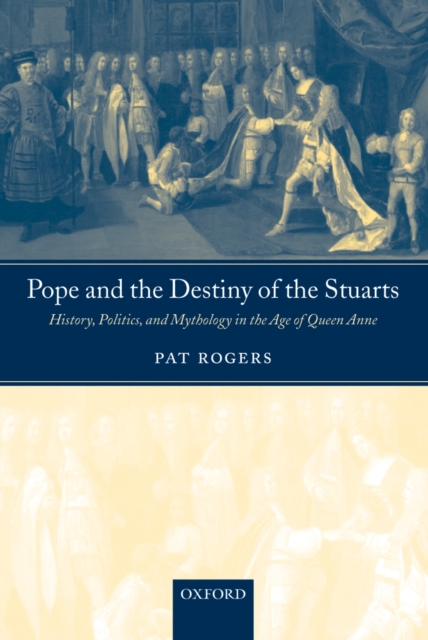
Pope and the Destiny of the Stuarts
This radical new look at the literary and political climate of England during the reign of Queen Anne examines the work of the greatest poet of the age, Alexander Pope. Pope and the Destiny of the Stuarts provides the fullest contextual account to date of Windsor-Forest (1713), widely seen as a key text in the evolution of early eighteenth-century poetry. It examines the poem's topical and political aspects and offers a reconfiguration of Pope's early career, demonstrating that this was a pivotal period, marking a critical watershed in both his personal and literary development. The book gives a complete account of Pope‘s life and work in his early twenties, and supplies a new political interpretation, including a careful analysis of possible Jacobite colourings. Attention is directed towards a range of literary, historical, ideological, and artistic issues. The book draws on classical studies (the role of Virgil and Ovid especially), Renaissance scholarship, literary history, political history, and artistic contexts. The key ideas and techniques of Windsor-Forest are related to Pope‘s other early works, including the Pastorals and, centrally, The Rape of the Lock. Rogers goes on to reassess the poet's dealings with the Scriblerus group. He shows previously unnoted textual connections with the work of Swift, Gay, Parnell, and also Prior, and casts fresh light on the tortuous process of composition and revision of Windsor-Forest, with a description of the manuscript and an account of the publishing and textual history, while numerous allusions are traced for the first time. Pope and the Destiny of the Stuarts will be of interest to scholars and students of eighteenth-century literature, history, and politics.
eBook


Literary Authority
This book is the cultural history of an idea which now seems so
self-evident as barely to be worth stating: through writing
imaginative literature, an author can accrue significant and
lasting economic and cultural power. We take for granted, now, that
authority dwells in literature and in being its author. This state
of affairs was not naturally occurring, but deliberately invented.
This book tells the story of that invention.
The story's central figures are Alexander Pope and Samuel
Johnson. But its narrative begins in the 1680s, with the last gasp
of the bond linking literary to political authority. While Jacobite
poets celebrated (and mourned) the Stuart dynasty, Whig writers
traced the philosophical and aesthetic consequences of the
accession of William of Orange. Both groups left behind sets of
literary devices ready-made to confer and validate authority.
Claude Willan challenges the continued reign of the \"Scriblerian\"
model of the period and shows how that reign was engineered. In so
doing he historicizes the relationship between \"good\" and \"bad\"
writing, and suggests how we might think about literature and
beauty had Pope and Johnson not taken literary authority for
themselves. What might literature have looked like, and what could
we use it like for, he provocatively asks.
eBook

اختطاف خصلة الشعر من مرتفعات شكسبير إلى سهول بوب
ضمن سلسلة الترجمة من إصدارات اتحاد الكتاب العرب صدر كتاب مترجم جديد لإسماعيل ركاب حمل عنوان \"اختطاف خصلة الشعر-من مرتفعات شكسبير إلى سهول بوب\". يتضمن الكتاب ترجمة لقصيدتين، وملحمة شعرية كوميدية ساخرة، من أجمل وأشهر الإنتاج الأدبي في عصر درايدن وبوب. القصيدة الأولى هي : عيد الإسكندر أو قوة تأثير الموسيقا، القصيدة الثانية هي : أغنية في يوم القديسة سيسيليا، والقصيدتان للشاعر جون درايدن. أما الملحمة الشعرية فهي : اختطاف خصلة الشعر للشاعر ألكسندر بوب.
Book
The Cambridge Companion to Alexander Pope
Alexander Pope was the greatest poet of his age and the dominant influence on eighteenth-century British poetry. His large oeuvre, written over a thirty-year period, encompasses satires, odes and political verse and reflects the sexual, moral and cultural issues of the world around him, often in brilliant lines and phrases which have become part of our language today. This is the first overview to analyse the full range of Pope's work and to set it in its historical and cultural context. Specially commissioned essays by leading scholars explore all of Pope's major works, including the sexual politics of The Rape of the Lock, the philosophical enquiries of An Essay on Man and the Moral Essays, and the mock-heroic of The Dunciad in its various forms. This volume will be indispensable not only for students and scholars of Pope's work, but also for all those interested in the Augustan age.
eBook

The Skeptical Sublime
This book argues that philosophical skepticism helps define the aesthetic experience of the sublime in late seventeenth- and eighteenth-century British literature, especially the poetry of Alexander Pope. Skeptical doubt appears in the period as an astonishing force in discourse that cannot be controlled—“doubt’s boundless Sea,” in Rochester’s words—and as such is consistently seen as affiliated with the sublime, itself emerging as an important way to conceive of excessive power in rhetoric, nature, psychology, religion, and politics. This view of skepticism as a force affecting discourse beyond its practitioners’ control links Noggle’s discussion to other theoretical accounts of sublimity, especially psychoanalytic and ideological ones, that emphasize the sublime’s activation of unconscious personal and cultural anxieties and contradictions. But because The Skeptical Sublime demonstrates the sublime’s roots in the epistemological obsessions of Pope and his age, it also grounds such theories in what is historically evident in the period’s writing. The skeptical sublime is a concrete, primary instance of the transformation of modernity’s main epistemological liability, its loss of certainty, into an aesthetic asset—retaining, however, much of the unsettling irony of its origins in radical doubt. By examining the cultural function of such persistent instability, this book seeks to clarify the aesthetic ideology of major writers like Pope, Swift, Dryden, and Rochester, among others, who have been seen, sometimes confusingly, as both reactionary and supportive of the liberal-Whig model of taste and civil society increasingly dominant in the period. While they participate in the construction of proto-aesthetic categories like the sublime to stabilize British culture after decades of civil war and revolution, their appreciation of the skepticism maintained by these means of stabilization helps them express ambivalence about the emerging social order and distinguishes their views from the more providentially assured appeals to the sublime of their ideological opponents.
eBook

Edmund Curll, Bookseller
Edmund Curll was a notorious figure among the publishers of the early eighteenth century: for his boldness, his lack of scruple, his publication of work without authors' consent, and his taste for erotic and scandalous publications. He was in legal trouble on several occasions for piracy and copyright infringement, unauthorised publication of the works of peers, and for seditious, blasphemous, and obscene publications. He stood in the pillory in 1728 for seditious libel. Above all, he was the constant target of the greatest poet and satirist of his age, Alexander Pope, whose work he pirated whenever he could and who responded with direct physical revenge (an emetic slipped into a drink) and persistent malign caricature. The war between Pope and Curll typifies some of the main cultural battles being waged between creativity and business. The story has normally been told from the poet's point of view, though more recently Curll has been celebrated as a kind of literary freedom-fighter. This book seeks to give a balanced and thoroughly-researched account of Curll's career in publishing between 1706 and 1747, untangling the mistakes and misrepresentations that have accrued over the years and restoring a clear sense of perspective to Curll's dealings in the literary marketplace. It examines the full range of Curll's output, including his notable antiquarian series, and uses extensive archive material to detail Curll's legal and other troubles, telling what is known about this strange and awkward figure.
eBook