
Catalogue Search | MBRL


Are you sure you want to remove the book from the shelf?

{{itemTitle}}
410
result(s) for
"Popular Science and Nature."
Sort by:
Ten tantalising truths : why the sky is blue, and other big answers to simple questions
John Gribbin is known for giving us simple explanations of big concepts in science. But there is another way to probe the mysteries of the Universe and our place in it. Faced with persistent enquiries from his grandchildren, Gribbin realised that simple questions, such as 'Why is the sky blue?', sometimes require big answers, understandable in straightforward language. In answering those simple questions, he discovered that he was telling the story of our place in the Universe, from the Big Bang to the evolutionary reasons why men are, on average, bigger than women. In this book, Gribbin invites the reader to join him on this voyage of discovery, where you may think you already know the answers but should be prepared to be surprised - or at least, tantalised by the truth.
Book
Life in Space
A little-known yet critical part of NASA
history
Life in Space explores the many aspects and outcomes of
NASA's research in life sciences, a little-understood endeavor that
has often been overlooked in histories of the space agency. Maura
Mackowski details NASA's work in this field from spectacular
promises made during the Reagan era to the major new directions set
by George W. Bush's Vision for Space Exploration in the early
twenty-first century.
At the first flight of NASA's space shuttle in 1981, hopes ran
high for the shuttle program to achieve its potential of regularly
transporting humans, cargo, and scientific experiments between
Earth and the International Space Station. Mackowski describes
different programs, projects, and policies initiated across NASA
centers and headquarters in the following decades to advance
research into human safety and habitation, plant and animal
biology, and commercial biomaterials. Mackowski illuminates these
ventures in fascinating detail by drawing on rare archival sources,
oral histories, interviews, and site visits.
While highlighting significant achievements and innovations such as
space radiation research and the Neurolab Spacelab Mission,
Mackowski reveals frustrations-lost opportunities, stagnation, and
dead ends-stemming from frequent changes in presidential
administrations and policies. For today's dreams of lunar outposts
or long-term spaceflight to become reality, Mackowski argues, a
robust program in space life sciences is essential, and the history
in this book offers lessons to help prevent leaving more
expectations unfulfilled.
eBook

A little history of everything : from the Big Bang down to you
Have you ever wondered why you exist? What had to happen for you - and all life on Earth - to come into being? What is the true answer to the ultimate question of life, the universe and everything? In 'A Little History of Everything', Tim Coulson - Professor of Zoology at Oxford - takes us back to the beginning of everything: the Big Bang 13.8 billion years ago. From there, he leads us step by step along the path to the most astonishing thing we have yet encountered - the staggering complexity of the modern human mind. Covering physics, astronomy, chemistry, geology, the emergence of life, evolution, consciousness and the rise of humankind, yet written to be understood by anyone with a child's curiosity, this book takes the biggest story of all and tells it simply, grippingly and, above all, entertainingly.
BOOK

The Complex Lives of British Freshwater Fishes
This book is an excellent read and opens your eyes to the secretive world of freshwater fish. Even as someone who has been involved with fish and fisheries for all of their professional life, I still found out lots of things I didn't know. I particularly liked the chapter on what have freshwater fishes ever done for us, and who doesn't like to dig a bit deeper into the weird and wonderful sex lives of fish? This book would make a great addition to the bookshelves of anyone who works with, or is interested in, fish and their biology. You cannot fail to pick it up and learn something new, even if you think you know all there is to know about fish.
eBook

Beautiful bacteria : encounters in the microuniverse
A leading bacteria scientist combines unique photographic techniques and accessible text to reveal the microbial world within and around us.
Book

Dictionary of Chemistry
This Dictionary provides an explanation of the main ideas of and concepts central to chemistry.Each entry in this A-Z resource begins with a clear, one-sentence definition that explains why the term is important.These sentences are followed by a fuller explanation and, where appropriate, examples, diagrams, tables and equations.
eBook

Shape : the hidden geometry of absolutely everything
How should a democracy choose its representatives? How does disease spread? How do computers teach themselves chess, and why is chess easier for them than analyzing a sentence? What should your kids study in school if they really want to learn to think? All of these are questions about geometry. Jordan Ellenberg reveals the mathematics behind some of the most important scientific, political, and philosophical conundrums we face. The word 'geometry', from the Greek, means 'measuring the world'. If anything, geometry doesn't just measure the world - it explains it. Shape shows us how.
Book

Mapmakers' Quest
In 1400 Europe was behind large parts of the world in its understanding of the use of maps. For instance, the people gf China and of Japan were considerably more advanced in this respect. And yet, by 1600 the Europeans had come to use maps for a huge variety of tasks, and were far ahead of the rest of the world in their appreciation of the power and use of cartography. The Mapmakers' Quest seeks to understand this development - not only to tease out the strands of thoughtand practice which led to the use of maps, but also to assess the ways in which such use affected European societies and economies.Taking as a starting point the question of why there were so few maps in Europe in 1400 and so many by 1650, the book explores the reasons for this and its implications for European history. It examines, inter al, how mapping and military technology advanced in tandem, how modern states' territories were mapped and borders drawn up, the role of maps in shaping the urban environment, and cartography's links to the new sciences.
eBook

100 maths ideas in 100 words : a whistle-stop tour of science's key concepts
Offering essential facts at your fingertips, satisfying your mathematical curiosity and helping you to understand the biggest concepts in maths in concise, 100-word summaries, this book introduces key areas of maths such as geometry, algebra, probability and pure maths, and explains each topic in just 100 words.
BOOK
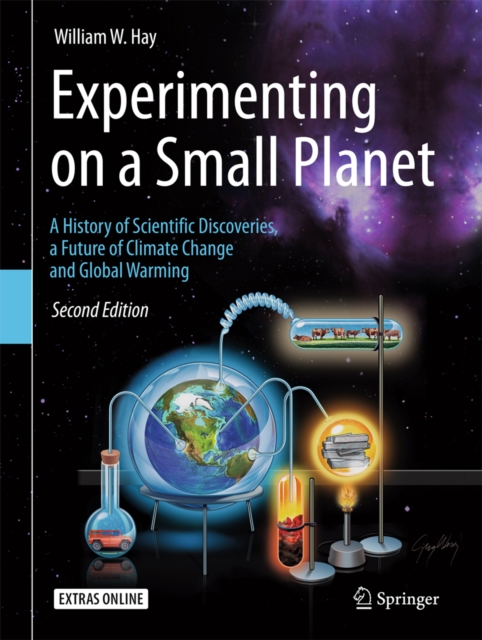
Experimenting on a Small Planet
This book is a thorough introduction to climate science and global change.The author is a geologist who has spent much of his life investigating the climate of Earth from a time when it was warm and dinosaurs roamed the land, to today's changing climate.Bill Hay takes you on a journey to understand how the climate system works.
eBook