
Catalogue Search | MBRL


Are you sure you want to remove the book from the shelf?

{{itemTitle}}
33
result(s) for
"Popular culture -- California -- Los Angeles -- History"
Sort by:


Land of Smoke and Mirrors
Unlike the more forthrightly mythic origins of other urban centers-think Rome via Romulus and Remus or Mexico City via the god Huitzilopochtli-Los Angeles emerged from a smoke-and-mirrors process that is simultaneously literal and figurative, real and imagined, material and metaphorical, physical and textual. Through penetrating analysis and personal engagement, Vincent Brook uncovers the many portraits of this ever-enticing, ever-ambivalent, and increasingly multicultural megalopolis. Divided into sections that probe Los Angeles's checkered history and reflect on Hollywood's own self-reflections, the book shows how the city, despite considerable remaining challenges, is finally blowing away some of the smoke of its not always proud past and rhetorically adjusting its rear-view mirrors.
Part I is a review of the city's history through the early 1900s, focusing on the seminal 1884 novelRamonaand its immediate effect, but also exploring its ongoing impact through interviews with present-day Tongva Indians, attendance at the 88th annualRamonapageant, and analysis of its feature film adaptations.
Brook deals with Hollywood as geographical site, film production center, and frame of mind in Part II. He charts the events leading up to Hollywood's emergence as the world's movie capital and explores subsequent developments of the film industry from its golden age through the so-called New Hollywood, citing such self-reflexive films asSunset Blvd.,
Singin' in the Rain, andThe Truman Show.
Part III considers LA noir, a subset of film noir that emerged alongside the classical noir cycle in the 1940s and 1950s and continues today. The city's status as a privileged noir site is analyzed in relation to its history and through discussions of such key LA noir novels and films asDouble Indemnity,Chinatown, andCrash.
In Part IV, Brook examines multicultural Los Angeles. Using media texts as signposts, he maps the history and contemporary situation of the city's major ethno-racial and other minority groups, looking at such films asMi Familia(Latinos),Boyz N the Hood(African Americans),Charlotte Sometimes(Asians),Falling Down(Whites), andThe Kids Are All Right(LGBT).
eBook

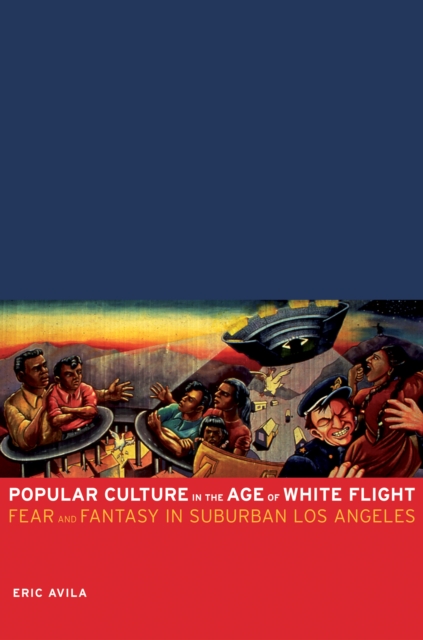
Popular culture in the age of white flight
Los Angeles pulsed with economic vitality and demographic growth in the decades following World War II. This vividly detailed cultural history of L.A. from 1940 to 1970 traces the rise of a new suburban consciousness adopted by a generation of migrants who abandoned older American cities for Southern California's booming urban region. Eric Avila explores expressions of this new \"white identity\" in popular culture with provocative discussions of Hollywood and film noir, Dodger Stadium, Disneyland, and L.A.'s renowned freeways. These institutions not only mirrored this new culture of suburban whiteness and helped shape it, but also, as Avila argues, reveal the profound relationship between the increasingly fragmented urban landscape of Los Angeles and the rise of a new political outlook that rejected the tenets of New Deal liberalism and anticipated the emergence of the New Right. Avila examines disparate manifestations of popular culture in architecture, art, music, and more to illustrate the unfolding urban dynamics of postwar Los Angeles. He also synthesizes important currents of new research in urban history, cultural studies, and critical race theory, weaving a textured narrative about the interplay of space, cultural representation, and identity amid the westward shift of capital and culture in postwar America.
eBook

Concrete and Dust
Concrete and Dust focuses on the performative nature of sexualized identity in Hollywood, the people that live in its underbelly and surrounding valleys, the sexual geographies of the place, and the ways in which sexual agency is mapped on the body and in consciousness.
eBook
Concrete and Dust
Concrete and Dust focuses on the performative nature of sexualized identity in Hollywood, the people that live in its underbelly and surrounding valleys, the sexual geographies of the place, and the ways in which sexual agency is mapped on the body and in consciousness. The cultural turn in ethnography has expanded the scope of ethnographic research methods, which now include innovative techniques that recognize and value sensuous scholarship (ethnographic works that incorporate visual, aural, and sensory texts). Hollywood has often been a focus in critical cultural theory; absent from the field is a holistic methodological perspective that collages visual image, arts-based ethnographic and autoethnographic narratives, experimental sound, poetry, and performative writing, in order to juxtapose the conflicting and complex performative nature of Hollywood, celebrity, glamour, and sexual agency.
eBook

Stardust monuments : the saving and selling of Hollywood
Hollywood is placeless, timeless, and iconic, a key fabricator and forger of American cultural myths and stories. How, then, will the history of Hollywood be written?
Stardust Monuments spotlights the enduring efforts to memorialize and canonize the history and meaning of Hollywood and American film culture. In this engaging analysis, Alison Trope explores the tensions between art and commerce as they intersect in a range of nonprofit and for-profit institutions and products.
An insightful tour of Hollywood’s past, present, and future, Stardust Monuments examines the establishment of film libraries and museums beginning in the mid 1930s, the many failed attempts to open a Hollywood museum ranging from the 1960s to today, and the more successful recent corporate efforts to use Hollywood’s past in theme restaurants and parks, classic movie channels, and DVD boxed sets.
This fascinating narrative details the ongoing struggle to champion and codify Hollywood’s legacy, a struggle engaged in by Hollywood stars and corporate executives, as well as memorabilia collectors and users of IMDb.
eBook

Spaces of conflict, sounds of solidarity
In Spaces of Conflict, Sounds of Solidarity, Gaye Theresa Johnson examines interracial anti-racist alliances, divisions among aggrieved minority communities, and the cultural expressions and spatial politics that emerge from the mutual struggles of Blacks and Chicanos in Los Angeles from the 1940s to the present. Johnson argues that struggles waged in response to institutional and social repression have created both moments and movements in which Blacks and Chicanos have unmasked power imbalances, sought recognition, and forged solidarities by embracing the strategies, cultures, and politics of each others' experiences. At the center of this study is the theory of spatial entitlement: the spatial strategies and vernaculars utilized by working class youth to resist the demarcations of race and class that emerged in the postwar era. In this important new book, Johnson reveals how racial alliances and antagonisms between Blacks and Chicanos in L.A. had spatial as well as racial dimensions.
eBook

Razabilly
Vocals tinged with pain and desperation. The deep thuds of an upright bass. Women with short bangs and men in cuffed jeans. These elements and others are the unmistakable signatures of rockabilly, a musical genre normally associated with white male musicians of the 1950s. But in Los Angeles today, rockabilly's primary producers and consumers are Latinos and Latinas. Why are these Razabillies partaking in a visibly un-Latino subculture that's thought of as a white person's fixation everywhere else?As a Los Angeles Rockabilly insider, Nicholas F. Centino is the right person to answer this question. Pairing a decade of participant observation with interviews and historical research, Centino explores the reasons behind a Rockabilly renaissance in 1990s Los Angeles and demonstrates how, as a form of working-class leisure, this scene provides Razabillies with spaces of respite and conviviality within the alienating landscape of the urban metropolis. A nuanced account revealing how and why Los Angeles Latinas/os have turned to and transformed the music and aesthetic style of 1950s rockabilly, Razabilly offers rare insight into this musical subculture, its place in rock and roll history, and its passionate practitioners.
eBook

L.A. rebellion
L.A. Rebellion: Creating a New Black Cinemais the first book dedicated to the films and filmmakers of the L.A. Rebellion, a group of African, Caribbean, and African American independent film and video artists that formed at the University of California, Los Angeles, in the 1970s and 1980s. The group-including Charles Burnett, Julie Dash, Haile Gerima, Billy Woodberry, Jamaa Fanaka, and Zeinabu irene Davis-shared a desire to create alternatives to the dominant modes of narrative, style, and practice in American cinema, works that reflected the full complexity of Black experiences. This landmark collection of essays and oral histories examines the creative output of the L.A. Rebellion, contextualizing the group's film practices and offering sustained analyses of the wide range of works, with particular attention to newly discovered films and lesser-known filmmakers. Based on extensive archival work and preservation, this collection includes a complete filmography of the movement, over 100 illustrations (most of which are previously unpublished), and a bibliography of primary and secondary materials. This is an indispensible sourcebook for scholars and enthusiasts, establishing the key role played by the L.A. Rebellion within the histories of cinema, Black visual culture, and postwar art in Los Angeles.
eBook