
Catalogue Search | MBRL


Are you sure you want to remove the book from the shelf?

{{itemTitle}}
102
result(s) for
"Populism History 21st century."
Sort by:

The populist explosion : how the great recession transformed American and European politics
\"Is the West witnessing a huge political upheaval? As if overnight, many Democrats revolted and passionately backed a socialist named Bernie Sanders; the United Kingdom voted to leave the European Union, in a stunning rebuke; the ... billionaire Donald Trump became the presidential nominee of the Republican Party; and a slew of rebellious parties continued to win election after election in countries like Switzerland, Norway, Italy, Austria, and Greece. John B. Judis ... tells us why we need to learn about the populist movement that began in the United States in the 1890s, the politics of which have recurred on both sides of the Atlantic ever since\"--Page 4 of cover.
Book
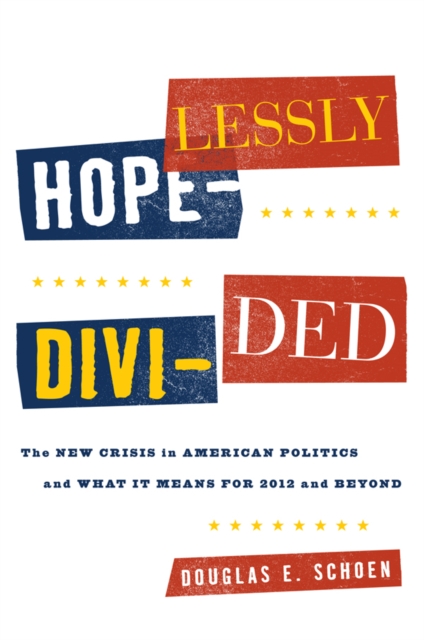
Hopelessly divided
Just in time for the 2012 election, Douglas E. Schoen, one of America’s preeminent political pundits, analyzes the growing chasm between the political class—politicians, lobbyists, fundraisers, consultants—and the American Mainstream, frustrated with government’s inability to address the major issues affecting their lives. This gap has given rise to populist movements on the right and the left and driven our two-party system to the brink of possible collapse—in ways that have never been fully discussed or articulated.
eBook


Promises of the Political
The possibility of a new emancipatory and democratizing politics, explored through the lens of recent urban insurgencies.
In Promises of the Political, Erik Swyngedouw explores whether progressive and emancipatory politics is still possible in a post-political era. Activists and scholars have developed the concept of post-politicization to describe the process by which “the political” is replaced by techno-managerial governance. If the political domain has been systematically narrowed into a managerial apparatus in which consensual governance prevails, where can we find any possibility of a new democratic politics? Swyngedouw examines this question through the lens of recent urban insurgencies. In Zuccotti Park, Paternoster Square, Taksim Square, Tahrir Square, Hong Kong, and elsewhere, he argues, insurgents have gathered to choreograph new configurations of the democratic.
Swyngedouw grounds his argument in urban and ecological processes, struggles, and conflicts through which post-politicization has become institutionally entrenched. He casts “the city” and “nature” as emblematic of the construction of post-democratic modes of governance. He describes the disappearance of the urban polis into the politics of neoliberal planetary urbanization; and he argues that the political-managerial framing of “nature” and the environment contributes to the formation of depoliticized governance—most notably in the impotent politics of climate change. Finally, he explores the possibilities for a reassertion of the political, considering whether—after the squares are cleared, the tents folded, and everyday life resumes—the urban uprisings of the last several years signal a return of the political.
eBook

Populist parties in Europe : agents of discontent?
\"Populism is a concept that is currently in vogue among political commentators and, more often than not, used pejoratively. The phenomenon of populism is typically seen as something adverse and, in the European context routinely related to xenophobic politics. What populism exactly is and who its main representatives are, however, often remains unclear. This text has two main aims: to identify populist parties in 21st century Europe and to explain their electoral performance. It argues that populist parties should not be dismissed as dangerous pariahs out of hand but rather that their rise tells us something about the state of representative democracy.The study has a broad scope, including populist parties of various ideological kinds - thus moving beyond examples of the 'right' - and covering long-established Western European countries as well as post-communist countries in Central and Eastern Europe. It presents the results of an innovative mixed-methods research project, combining a fuzzy set Qualitative Comparative Analysis (fsQCA) of populist parties in 31 European countries with three in-depth case studies of the Netherlands, Poland and the United Kingdom\"-- Provided by publisher.
Book

From Populist Politician to Sober Statesman
Abstract The surge of far-right populist leaders around the world has raised the question of whether they can be moderated through their participation in government—a matter of scholarly contention. This article examines the political arc of Naftali Bennett, a populist-nationalist politician who served as Israel's prime minister from June 2021 to June 2022. Until his unexpected ascension to the top political post, Bennett regularly employed populist Us vs. Them rhetoric while backing populist measures as a government minister that often put him at odds with the security establishment. Upon assuming the premiership, however, Bennett, following an instrumental logic, abandoned his polarizing rhetoric and embraced, instead, a statesmanlike approach to governing. The case of Bennett illustrates partial moderation undergone by a populist-nationalist politician's rise to power.
Journal Article


Thinking through Transition
Thinking through Transition is the first concentrated effort to explore the most recent chapter of East Central European past from the perspective of intellectual history. Post-socialism can be understood as a period of scarcity and preponderance of ideas, the dramatic eclipsing of the dissident legacy (as well as the older political traditions), and the rise of technocratic and post-political governance. This book, grounded in empirical research sensitive to local contexts, proposes instead a history of adaptations, entanglements, and unintended consequences. In order to enable and invite comparison, the volume is structured around major domains of political thought, some of them generic (liberalism, conservatism, the Left), others (populism and politics of history) deemed typical for post-socialism. However, as shown by the authors, the generic often turns out to be heavily dependent on its immediate setting, and the typical resonates with processes that are anything but vernacular.
eBook

American nightmare : Donald Trump, media spectacle, and authoritarian populism
Explaining the Donald Trump phenomenon is a challenge that will occupy critical theorists of U.S. politics for years to come. Firstly, Donald Trump won the Republican primary contest and is now a contender in the U.S. Presidential Election because he is the master of media spectacle, which he has deployed to create resonant images of himself in his business career, in his effort to become a celebrity and reality-TV superstar, and now his political campaign. More disturbingly, Trump embodies Authoritarian Populism and has used racism, nationalism, xenophobia, Islamophobia, and the disturbing underside of American politics to mobilize his supporters in his successful Republican primary campaign and in the hotly contested 2016 general election. The Trump phenomenon is a teachable moment that helps us understand the changes and contour of U.S. politics in the contemporary moment and the role of broadcast media, new media and social networking, and the politics of the spectacle.
Book

Change they can't believe in
Are Tea Party supporters merely a group of conservative citizens concerned about government spending? Or are they racists who refuse to accept Barack Obama as their president because he's not white?Change They Can't Believe Inoffers an alternative argument--that the Tea Party is driven by the reemergence of a reactionary movement in American politics that is fueled by a fear that America has changed for the worse. Providing a range of original evidence and rich portraits of party sympathizers as well as activists, Christopher Parker and Matt Barreto show that what actually pushes Tea Party supporters is not simple ideology or racism, but fear that the country is being stolen from \"real Americans\"--a belief triggered by Obama's election. From civil liberties and policy issues, to participation in the political process, the perception that America is in danger directly informs how Tea Party supporters think and act.
The authors argue that this isn't the first time a segment of American society has perceived the American way of life as under siege. In fact, movements of this kind often appear when some individuals believe that \"American\" values are under threat by rapid social changes. Drawing connections between the Tea Party and right-wing reactionary movements of the past, including the Know Nothing Party, the Ku Klux Klan of the 1920s, and the John Birch Society, Parker and Barreto develop a framework that transcends the Tea Party to shed light on its current and future consequences.
Linking past and present reactionary movements,Change They Can't Believe Inrigorously examines the motivations and political implications associated with today's Tea Party.
eBook