
Catalogue Search | MBRL


Are you sure you want to remove the book from the shelf?

{{itemTitle}}
19
result(s) for
"Portraits, French -- 18th century"
Sort by:

Portraiture and politics in Revolutionary France
\"Examines the genre of portraiture and the political and cultural role of images in Revolutionary France. Focuses on portraiture as a privileged site for the elaboration of modern notions of selfhood and political agency\"--Provided by publisher.
Book

Portraiture and politics in Revolutionary France
Portraiture and Politics in Revolutionary France challenges widely held assumptions about both the genre of portraiture and the political and cultural role of images in France at the beginning of the nineteenth century. After 1789, portraiture came to dominate French visual culture because it addressed the central challenge of the Revolution: how to turn subjects into citizens. Revolutionary portraits allowed sitters and artists to appropriate the means of representation, both aesthetic and political, and articulate new forms of selfhood and citizenship, often in astonishingly creative ways. The triumph of revolutionary portraiture also marks a turning point in the history of art, when seriousness of purpose and aesthetic ambition passed from the formulation of historical narratives to the depiction of contemporary individuals. This shift had major consequences for the course of modern art production and its engagement with the political and the contingent.
eBook
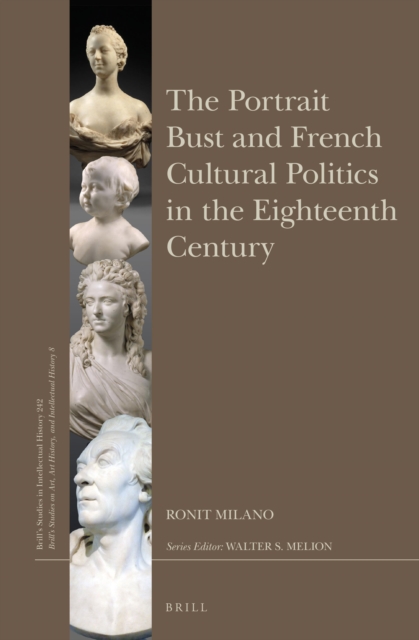
The Portrait Bust and French Cultural Politics in the Eighteenth Century
In The Portrait Bust and French Cultural Politics in the Eighteenth Century, Ronit Milano probes the aesthetic and intellectual charge of a remarkably concise art form, and its role in the construction of modern identity, during a seismic moment in French history.
eBook

Portraiture and Friendship in Enlightenment France
Portraiture and Friendship in Enlightenment France
examines how new and often contradictory ideas about friendship
were enacted in the lives of artists in the eighteenth century. It
demonstrates that portraits resulted from and generated new ideas
about friendship by analyzing the creation, exchange, and display
of portraits alongside discussions of friendship in philosophical
and academic discourse, exhibition criticism, personal diaries, and
correspondence. This study provides a deeper understanding of how
artists took advantage of changing conceptions of social
relationships and used portraiture to make visible new ideas about
friendship that were driven by Enlightenment thought.
Studies in Seventeenth- and Eighteenth-Century Art and
Culture
Distributed for the University of Delaware Press
eBook

Portraiture and Politics in Revolutionary France
Portraiture and Politics in Revolutionary France
challenges widely held assumptions about both the genre of
portraiture and the political and cultural role of images in France
at the beginning of the nineteenth century. After 1789, portraiture
came to dominate French visual culture because it addressed the
central challenge of the Revolution: how to turn subjects into
citizens. Revolutionary portraits allowed sitters and artists to
appropriate the means of representation, both aesthetic and
political, and articulate new forms of selfhood and citizenship,
often in astonishingly creative ways. The triumph of revolutionary
portraiture also marks a turning point in the history of art, when
seriousness of purpose and aesthetic ambition passed from the
formulation of historical narratives to the depiction of
contemporary individuals. This shift had major consequences for the
course of modern art production and its engagement with the
political and the contingent.
eBook

Touching Watelet: L'art de peindre and the Performance of Philosophical Materialism
This article examines the 1760 treatise L'art de peindre by amateur Claude-Henri Watelet in relation to eighteenth-century conceptions of the artist's touch, \"original\" prints, and genius. The work's illustrations and poems, as well as Jean-Baptiste Greuze's Portrait of Monsieur Watelet (1765), represent a performance of contemporaneous theories of combinatory imagination and sensory knowledge, particularly those by Étienne Bonnot de Condillac. Watelet's treatise, as a material object, exemplifies Condillac's theory of sensorial knowledge—most notably, the double experience of touch—through its representation of both self and external world, Watelet, and the art of painting.
Journal Article

Anglophilia and Sensibility in Late Eighteenth-Century Vienna: Prince Charles Antoine de Ligne's Testament and the Indissolubles
Prince Charles Antoine de Ligne, son of Prince Charles Joseph de Ligne, died fighting French revolutionary forces at Croix-au-Bois in the Argonne region on 14 September 1792. He left behind a last will and testament (a copy is held in the Kriegsarchiv in Vienna) that evoked the memory of his small circle of aristocratic Viennese friends called “les Indissolubles.” Each member received a personal legacy, and Charles directed that a “temple of friendship” be established in his rooms at Beloeil featuring portraits of group members and a bust of himself. This poignant document, in combination with Charles's correspondence with close friend and group member Prince Joseph Poniatowski (preserved in the Polish Academy library in Cracow), confirms in striking manner the group's affinity for two popular European trends: Anglophilia and sensibility. Although Charles's will was not published at the time of his death he could assume that, as with any final testament, his statements would become known to, and honored by, a limited “public” of their own.
Journal Article

NAPOLEONIC FREEDOM OF WORSHIP IN LAW AND ART
Napoleon's most famous innovation in his legendary military career was the use of the daunting Grande Armée with an emphasis on speed, maneuverability, and maintaining the offensive. Yet Napoleon understood that while skirmishes were won or lost on the battlefield, the real war lay in public perception. To that end, Napoleon used art and cultural treasures as part of his arsenal in order to create the perception of victory, regardless of the outcome of any particular campaign. Examining contemporary French artistic representations of Napoleon granting freedom of worship to religious groups, this article analyzes artwork as a tool for fashioning and communicating legal narrative. Popular visual arts are mined for meaning, painting a portrait of the legal and cultural setting of these creative works. The partisan artwork demonstrates how Napoleon's artists depicted freedom of worship as the freedom—granted to all faiths—to worship Napoleon. It is noted that Jews feature disproportionately in the Empire period's depictions of freedom of worship. This is surprising, as the Jewish community was numerically insignificant and hardly influential in Napoleon's realm. This article argues that in addition to broadcasting religious tolerance, Napoleonic artwork used Jews and symbols like Moses and tablets of law to fashion a narrative of law that foregrounded the legal legitimacy of Napoleon's rule: Napoleon's regime is legally just; the enlightened ruler affords rights and liberties to all his subjects; divine Napoleon is the new lawgiver.
Journal Article

Recentring Peripheral Queerness and Marginal Art in Portrait of a Lady on Fire (2019)
This essay examines the ways in which Céline Sciamma’s 2019 film Portrait de la Jeune Fille en Feu (Portrait of a Lady on Fire) looks to centralise onscreen homosexual experience through engagement with, and queering of, eighteenth-century art practices and the discourse surrounding them. From its reception of Ovid’s Metamorphoses to ideas espoused by the eighteenth-century art critic and philosopher Denis Diderot, Portrait looks to traditionally peripheral spaces, or edgelands, and the visual and embodied consequences of transcending them. Engaging closely with eighteenth-century processes of artmaking, the film transforms sketches on paper, paint applied to canvas and wood, miniatures held close to the body and erotica annotated in the margins into queer-coded sites used to reflect and document the developing relationship at its heart.
Journal Article
