
Catalogue Search | MBRL


Are you sure you want to remove the book from the shelf?

{{itemTitle}}
294
result(s) for
"Portugal/Portuguese"
Sort by:

Emigration
Discussing issues of emigration, the following articles are presented: (1) Maria Helena Carvalho dos Santos, Emigracao e niveis de cultura: a Uniao Portuguesa do Estado de California, 1880-1980 (Emigration and Levels of Culture: The Portuguese Union of the State of California, 1890-1980); (2) Roselyne de Villanova, A segunda geracao de imigrantes -- potencial ou 'handicap'? (The Second Generation of Immigrants -- Potential or 'Handicap'?); (3) Patricia Goldey, Migracao e relacoes de producao: a terra e o trabalho numa aldeia do Minho, 1876-1976 (Migration and Relations of Production: Land and Work in Minha Village, 1876-1976); (4) Anthony Leeds, Agricultura, politica nacional, subdesenvolvimento, e migracao em tres regioes de Portugal (Agriculture, National Policy, Underdevelopment, and Migration in Three Portuguese Regions); & (5) Elizabeth Leeds, Industrializacao e emigracao em Portugal: sintomas inevitaveis de uma doenca estrutural (Industrialization and Emigration in Portugal: Inevitable Symptoms of a Structural Malady). S. Karganovic.
Journal Article
The Replacement of Generations in Portugal: A Regional Analysis 1930-1975
Between 1977 & 1981, Portugal was an exception to the general trend of European countries toward a slightly higher fertility rate. The fertility rate in Portugal declined from 2.45 children per woman in 1977 to 2.0 in 1981, ie, to a level lower than 2.1, the commonly established minimum for the maintenance of zero population growth. An examination of demographic data from 1930 to 1975 shows wide variations in the overall decline in the fertility rate in 26 different regions of Portugal, from -51% in Castelo Branco to -13% in Ponta Delgada. 5 Tables, 6 Maps, 24 References. Modified HA.
Journal Article
Forms of Production and Work Statutes in Portuguese Agriculture
A theoretical discussion of the subordination of the agricultural sector of the Portuguese economy to the Ur-industrial sector; in many respects, agricultural development is lagging behind industrial & commercial development. A large part of the problem stems from misunderstandings about the nature of agricultural labor, which have been incorporated into national economic policy. A very high proportion of Ru workers are engaged in several different types of paid employment (work on the family farm, work as a tenant farmer, part-time employment, seasonal activities, etc). Thus, Portuguese farm workers may be viewed as semiproletarians. 7 Tables. Modified HA.
Journal Article
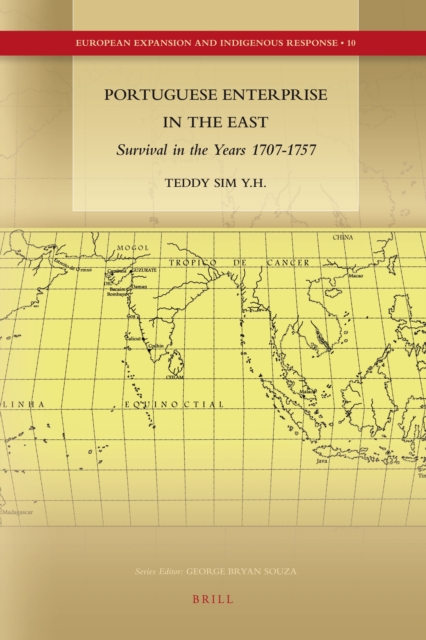
Portuguese Enterprise in the East
Drawing on unpublished materials from the Overseas Historical Archive, and other libraries in Portugal, this book considers Portuguese leadership and organization at home, where it pertained to the governance of the eastern colonies; as well as the formal and 'soft' instruments of state applied on the ground in these colonies in first half of the eighteenth century.
eBook


\Lusitanian Integralism\ in the Origins of Salazarism
The ideological & political history of the so-called \"Lusitanian integralism\" in Portugal is reviewed, focusing on its role in shaping the political space of the estado nova (new state). The origins of integralism as a doctrinal & political movement in the nineteenth century are outlined, tracing its links with the U of Coimbra & its publications; its role of opposition to the First Republic is extensively detailed. The legacy of integralism to the Salazarist new state is then discussed, noting: (1) that the coup d'etat represented a negation of a particular regime rather than a clearly defined political alternative; & (2) that this ideological void was filled by a Christian Democratic matrix supplemented by other ideologies, of which the most developed was in fact integralism. The continuing oppositional role represented by this perspective is emphasized. Modified HA.
Journal Article
TWENTY YEARS OF PORTUGUESE EMIGRATION: SOME DATA AND COMMENTS
A systematic presentation of statistical data on the quantitative evolution of Portuguese emigration in the period 1950-1969. Estimates of clandestine (illegal) emigration are included. An analysis of certain fundamental characteristics of the global emigratory movement is undertaken & a detailed examination of Portuguese emigration toward France is offered. France absorbed 43.5% of the emigrants during 1950-1969, followed by Brazil which took 27.6%. The effect of emigration on Portugual's balance of payment is considered. 60% of the emigrants are below 30 yrs of age & 60% are M vs 40% F. The incidence of fam over individual emigration is increasing. Some comments on Portuguese statistical sources are presented & themes for further res are suggested. More official data on the problems & adaptation of the Portuguese in France are needed. Systematic coordination & classification of existing data & their interpretation in the light of various proposed theories & hyp's are suggested. It is concluded that the process of emigration should be seen in the context of the transformation of Portugal from a traditional to an industr society. 32 Tables, 7 Figures. Modified HA.
Journal Article
THE ACTIVE POPULATION IN PORTUGAL: 1959-1969
Statistics on the LF in Portugal for the period 1959-1969 are presented as based on the LF Statistics issued by the Org for Econ Cooperation & Development, 1968 Ed. It is indicated that, while the OECD established an internat'l classificatory system in 1958, this does not mean that data for the cliff member countries of OECD are comparable. 5 Tables. M. Maxfield.
Journal Article
