
Catalogue Search | MBRL


Are you sure you want to remove the book from the shelf?

{{itemTitle}}
191
result(s) for
"Portugal -- Relations -- Brazil"
Sort by:

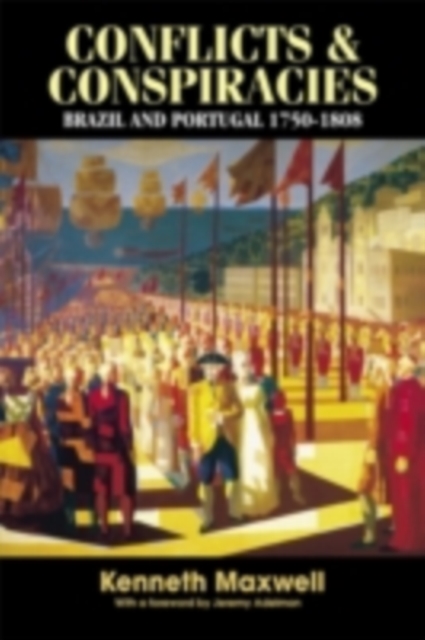
Conflicts & Conspiracies
First Published in 2004. Routledge is an imprint of Taylor & Francis, an informa company.
Kenneth Maxwell holds the Nelson and David Rockefeller Chair in Inter-American Studies at the Council of Foriegn Relations. He has taught at Yale, Princeton and Columbia Universities and the University of Kansas. Dr. Maxwell's recent books include Naked Tropics: Essays on Empire and Other Rogues (2003), The Making of Portuguese Democracy (1995) and Pombal: Paradox of the Enlightenment (1995).
eBook

Luso-tropicalism and its discontents : the making and unmaking of racial exceptionalism
\"Modern perceptions of race across much of the Global South are indebted to the Brazilian social scientist Gilberto Freyre, who in works such as The Masters and the Slaves claimed that Portuguese colonialism produced exceptionally benign and tolerant race relations. This volume radically reinterprets Freyre's Luso-tropicalist arguments and critically engages with the historical complexity of racial concepts and practices in the Portuguese-speaking world. Encompassing Brazil as well as Portuguese-speaking societies in Africa, Asia, and even Portugal itself, it places an interdisciplinary group of scholars in conversation to challenge the conventional understanding of twentieth-century racialization, proffering new insights into such controversial topics as human plasticity, racial amalgamation, and the tropes and proxies of whiteness\"-- Provided by publisher.
Book

Imperial Portugal in the age of Atlantic revolutions : the Luso-Brazilian world, c. 1770-1850
Portugal made great efforts to tie its territories together, but the Luso-Brazilian empire eventually succumbed to revolution like its British, French and Spanish counterparts. This book reveals the links and relationships between Portugal and Brazil that survived the demise of empire and shaped the trajectories of the two countries.
eBook

Imperial Portugal in the Age of Atlantic Revolutions
As the British, French and Spanish Atlantic empires were torn apart in the Age of Revolutions, Portugal steadily pursued reforms to tie its American, African and European territories more closely together. Eventually, after a period of revival and prosperity, the Luso-Brazilian world also succumbed to revolution, which ultimately resulted in Brazil's independence from Portugal. The first of its kind in the English language to examine the Portuguese Atlantic World in the period from 1750 to 1850, this book reveals that despite formal separation, the links and relationships that survived the demise of empire entwined the historical trajectories of Portugal and Brazil even more tightly than before. From constitutionalism to economic policy to the problem of slavery, Portuguese and Brazilian statesmen and political writers laboured under the long shadow of empire as they sought to begin anew and forge stable post-imperial orders on both sides of the Atlantic.
eBook

Lisbon Journal; From the Pure of Tongue, Catcalls in Portuguese
Now, with Portugal benefiting from its new membership in the European Community and Brazil's economy throttled by recession, not only are many Portuguese migrants returning home, but many Brazilians are also moving to Portugal. And for the first time since independence in 1822, Brazil's influence is being felt here. 'Tremendous Cultural Shock' Almost overnight, Brazil seems to be supplying Portugal's top soccer players, its most popular television soap operas and stars, even its best dentists. Brazilian musicians, artists, journalists and publicists are finding work here, while Brazilian tourists are discovering Portugal. Brazilians hoping to escape their country's economic troubles, though, are no longer finding the welcome mat out for them. Portuguese and Brazilian citizens enjoy equal rights in each other's country once they have become residents. But Portugal is holding back on giving Brazilians residence permits.
Newspaper Article

The Drivers and Outcomes of Global Health Diplomacy
This book investigates the Brazilian health cooperation in Mozambique looking at the interests of both actors and different power relations within this initiative. It counts with a case study looking at the implementation of SociedadeMocambicana de Medicamentos - a pharmaceutical factory that was implemented in Maputo as a result of the cooperation between the countries.
eBook

Parenting Styles, Internalization of Values and Self-Esteem: A Cross-Cultural Study in Spain, Portugal and Brazil
The present study analyzes the impact of parenting styles on adolescents’ self-esteem and internalization of social values in three countries, Spain, Portugal and Brazil. The sample of the study was comprised of 2091 adolescents from Spain (n = 793), Portugal (n = 675), and Brazil (n = 623) from 12–18 years old (52.1% females). The four types of parenting styles, authoritative, indulgent, authoritarian and neglectful, were measured through the warmth and strictness dimensions of the Scale of Parental Socialization ESPA29. The two criteria variables were captured with the five dimensions of the AF5, Five-Factor Self-Concept Questionnaire, and with self-transcendence and conservation Schwartz values. Results confirm emergent research in parenting socialization: the use of parental warmth is evidenced as key for adolescent self-esteem and internalization of social values in the three countries analyzed. Indulgent and authoritative parenting (both characterized by parental warmth) are associated with the highest value internalization in the three countries. Furthermore, indulgent parenting (use of warmth) is associated with the highest adolescent self-esteem, overcoming authoritative parenting (use of warmth and strictness). The influence of parenting over adolescent self-esteem and values internalization is maintained independent of the differences in self-esteem and value priorities observed in the cultural context, the sex and age of the participants.
Journal Article

Feeding Difficulties in Children with Hepatic Glycogen Storage Diseases Identified by a Brazilian Portuguese Validated Screening Tool
Background/Objectives: Hepatic glycogen storage diseases (GSDs) are inherited metabolic disorders that affect glycogen synthesis or breakdown, primarily involving the liver and muscles. Treatment typically consists of strict dietary management, including the consumption of uncooked cornstarch. However, there is limited research on feeding challenges and the associated stress experienced by parents of children with GSDs. This study aims to assess feeding difficulties in children with GSDs and the level of parental stress. Methods: A total of 29 caregivers of children aged 6 months to <7 years participated. Feeding difficulties were evaluated using the Brazilian Infant Feeding Scale (Escala Brasileira de Alimentação Infantil—EBAI), while parental stress was measured using the Parental Stress Scale (Escala de Estresse Parental—EEPa). Data were collected in 2020, and the study was approved by the ethics committee. Results: The majority of the children were male (19/10), with a mean age of 47.75 months and an average age of diagnosis of 8.39 months. GSD type Ia (n = 15) and type Ib (n = 5) were the most prevalent, followed by types III and IX (n = 2). Among the participants, 22 out of 29 (76%) reported feeding difficulties, categorized as mild (n = 7, 24%), moderate (n = 7, 24%), and severe (n = 8, 28%). EBAI scores were higher in female patients and in those who did not eat meals with their family. Only one caregiver exhibited high levels of parental stress, as measured by the EEPA scale. No significant correlation was found between feeding difficulties and parental stress. Conclusions: The findings confirm a high prevalence of feeding issues in children with GSDs, which significantly affects caregivers’ quality of life. Although no significant link between feeding difficulties and parental stress was identified, further research is needed to improve GSD management and provide better support for caregivers.
Journal Article

Organizational and Individual Factors Influencing the Quality of Working Life Among Brazilian University Professors during COVID-19
The COVID-19 pandemic suddenly impacted professors’ work demands and their adaptation to new technologies and work organization, namely, working from home. These changes urged us to know its impact on their quality of working life (QWL). This study aimed at characterizing the main determinants of the quality of working life in Brazilian university professors during the COVID-19 pandemic. It integrated two cross-sectional analyses, through a questionnaire applied in 2020–2021 and 2021–2022, at universities in central-western Brazil. The sample included 220 professors at the first moment and 180 at the second. The main tool used was the Quality of Working Life Questionnaire. Multiple linear regression analyses were performed to identify the significant predictors of the QWL. In 2020–2021, “Sleep quality” was the main predictor with a 15.8% contribution to explaining the QWL variability, followed by “Satisfaction with supervisors”, “Depression”, “Work–family conflict” and “Difficulties with materials or physical resources”. In 2021–2022, the predictors that contributed most to explain the QWL variability were “Work–family conflict” and “Sleep quality” with contributions of 13.9% and 12.2%, respectively, to the coefficient of determination. “Satisfaction with students”, “Difficulties in interpersonal relationships with supervisors”, “Noise”, “Smoking habits” and “Biological sex” had lower contributions. The knowledge of the predictors of QWL among university professors is essential to defining strategies to prevent occupational risks and promoting workers’ health and sustainable quality of working life.
Journal Article