
Catalogue Search | MBRL


Are you sure you want to remove the book from the shelf?

{{itemTitle}}
68
result(s) for
"Portuguese prose literature"
Sort by:


Luso-Brazilian encounters of the sixteenth century
As it happens with other early-Modern corpora, the descriptive texts from 16th-century encounters of the Portuguese colonizers in Brazil are well-known for their strangeness. In them we find references to entities like monsters and demons, bizarre descriptions, and odd classification systems of plants and animals. For the most part, these elements are dismissed as mere eccentricities by modern scholars studying these texts. Instead, this book takes these elements seriously. They are focused on and tackled with a theoretical tool_styles of thinking_not yet used in Luso-Brazilian studies, and coming from another field of inquiry: philosophy and history of science. By doing so the book aims to unveil epistemological and ontological issues in which colonial and post-colonial studies are entangled, and which have a relevance that goes beyond debates concerning, for instance, the formation of Brazil's cultural identity. This book contributes to Luso-Brazilian studies, science studies, and the history of the early-modern period. The notion of 'styles of thinking' as presented and used in it benefitted from the many discussions about philosophy and history of science that emerged since the 1980s, with authors such as Ian Hacking, Lorraine Daston, and Peter Galison, who have already done much reassessing critically what is best in the work of previous authors such as Paul Feyerabend, Thomas Kuhn, and Michel Foucault. This book considers that the well-known puzzling passages of the corpus of the Portuguese have a fictional and figurative character that acquires full intelligibility in view of literary and mystical traditions typical of the late Renaissance, and influential over the Portuguese. Nature is understood as emerging from an excessive source which permanently overflows it and which is impossible to refer and depict literally. The book points to the fact that such an idea would connect the Portuguese with other peculiar pre-Modern and post-Modern authors with similar ontological insights: from the neo-Platonists to Boccaccio, Nietzsche, and more recently, Derrida.
eBook

Race, caste, and indigeneity in Medieval Spanish travel literature
\"The origins of present-day Ibero-American racialization, and of associated caste hierarchies in various Latin American regions and societies, are in many ways traceable to the medieval Iberian Peninsula during the era of the so-called Reconquest (eleventh through fifteenth centuries). Focusing on themes of race, caste, and indigeneity during a period straddling the boundary between the Middle Ages and the era of New World exploration, conquest, and colonization (early-thirteenth through mid-sixteenth centuries), this study explores the already highly internationalized world of late-medieval and early-modern Europe as revealed in various kinds of travel narrative. The works surveyed include conquest narratives, touristic and diplomatic diaries, gazetteers, chivalric romances and biographies, pilgrimage accounts, and political essays. Despite their stylistic and thematic variety, the works are linked by a shared compulsion to go forth among alien folk, and by a Eurocentric obsession with ethnicity, status, native identity, and what we would call globalization\"-- Provided by publisher.
Book

Documents in Crisis
Winner of the 2012 Best Book in the Humanities presented by
the Mexico Section of the Latin American Studies
Association In the turbulent twentieth century, large
numbers of Mexicans of all social classes faced crisis and
catastrophe on a seemingly continuous basis. Revolution,
earthquakes, industrial disasters, political and labor unrest, as
well as indigenous insurgency placed extraordinary pressures on
collective and individual identity. In contemporary literary
studies, nonfiction literatures have received scant attention
compared to the more supposedly \"creative\" practices of fictional
narrative, poetry, and drama. In Documents in Crisis , Beth
E. Jörgensen examines a selection of both canonical and
lesser-known examples of narrative nonfiction that were written in
response to these crises, including the autobiography, memoir,
historical essay, testimony, chronicle, and ethnographic life
narrative. She addresses the relative neglect of Mexican nonfiction
in criticism and theory and demonstrates its continuing relevance
for writers and readers who, in spite of the contemporary blurring
of boundaries between fiction and nonfiction, remain fascinated by
literatures of fact.
eBook

Bilingual Legacies
Bilingual Legacies examines fatherhood in the work of four canonical Spanish authors born in Barcelona and raised during the dictatorship of Francisco Franco. Drawing on the autobiographical texts of Juan Goytisolo, Carlos Barral, Terenci Moix, and Clara Janes, the book explores how these authors understood gender roles and paternal figures as well as how they positioned themselves in relation to Spanish and Catalan literary traditions.Anna Casas Aguilar contends that through their presentation of father figures, these authors subvert static ideas surrounding fatherhood. She argues that this diversity was crucial in opening the door to revised gender models in Spain during the democratic period. Moving beyond the shadow of the dictator, Casas Aguilar shows how these writers distinguished between the patriarchal \"father of the nation\" and their own paternal figures. In doing so, Bilingual Legacies sheds light on the complexity of Spanish conceptions of gender, language, and family and illustrates how notions of masculinity, authorship, and canon are interrelated.
eBook

Writing Pancho Villa's Revolution
No detailed description available for \"Writing Pancho Villa's Revolution\".
eBook
Metafizyka i literatura w epoce nieprawdy. O Księdze niepokoju Fernanda Pessoi
The article is concerned with one of the most fascinating prose texts of the 20th cen- tury – Livro do desassossego (The Book of Disquiet) by Fernando Pessoa, one of the most prominent poets of the Portuguese language. The uniqueness of the Book, among others, is illustrated by the fact that it can be freely composed from 30,000 fragments Pessoa did not publish, but whose authorship he did not ascribe to himself, but to his half-heteronym (porte-parole), Bernardo Soares. The article explores the philosophical sources of the phenomenon of heteronymy characteristic for Pessoa’s work and the ob- sessive thread of the Book – the narrator’s inability to grasp the sense of his life and his own identity. In this context, the issue of relations between literature and philosophy is considered, with regard to the modernist undermining of philosophy’s claims to truth, and equating both of these areas of their creativity in terms of possibility of accessing the truth and expressing it.
Journal Article

Drawing the Curtain
Miguel de Cervantes’s experimentation with theatricality is frequently tied to the notion of revelation and disclosure of hidden truths. Drawing the Curtain showcases the elements of theatricality that characterize Cervantes’s prose and analyses the ways in which he uses theatricality in his own literary production.
Bringing together the works of well-known scholars, who draw from a variety of disciplines and theoretical approaches, this collection demonstrates how Cervantes exploits revelation and disclosure to create dynamic dramatic moments that surprise and engage observers and readers. Hewing closely to Peter Brook’s notion of the bare or empty stage, Esther Fernández and Adrienne L. Martín argue that Cervantes’s omnipresent concern with theatricality manifests not only in his drama but also in the myriad metatheatrical instances dispersed throughout his prose works. In doing so, Drawing the Curtain sheds light on the ways in which Cervantes forces his readers to engage with themes that are central to his life and works, including love, freedom, truth, confinement, and otherness.
eBook

Urban Chroniclers in Modern Latin America
An unstructured genre that blends high aesthetic standards with nonfiction commentary, the journalistic crónica, or chronicle, has played a vital role in Latin American urban life since the nineteenth century. Drawing on extensive archival research, Viviane Mahieux delivers new testimony on how chroniclers engaged with modernity in Mexico City, Buenos Aires, and São Paulo during the 1920s and 1930s, a time when avant-garde movements transformed writers' and readers' conceptions of literature. Urban Chroniclers in Modern Latin America: The Shared Intimacy of Everyday Life examines the work of extraordinary raconteurs Salvador Novo, Cube Bonifant, Roberto Arlt, Alfonsina Storni, and Mário de Andrade, restoring the original newspaper contexts in which their articles first emerged. Each of these writers guided their readers through a constantly changing cityscape and advised them on matters of cultural taste, using their ties to journalism and their participation in urban practice to share accessible wisdom and establish their role as intellectual arbiters. The intimate ties they developed with their audience fostered a permeable concept of literature that would pave the way for overtly politically engaged chroniclers of the 1960s and 1970s. Providing comparative analysis as well as reflection on the evolution of this important genre, Urban Chroniclers in Modern Latin America is the first systematic study of the Latin American writers who forged a new reading public in the early twentieth century.
eBook
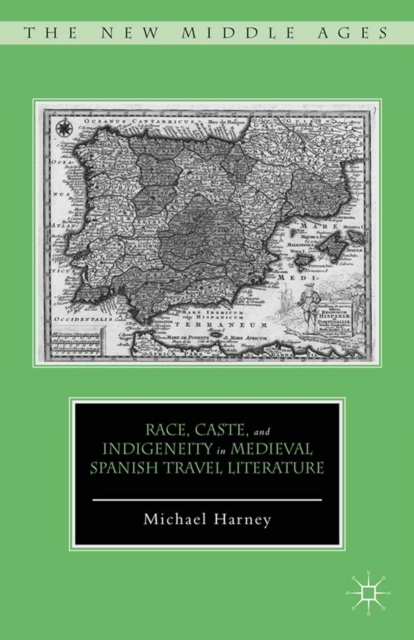
Race, caste, and indigeneity in medieval Spanish travel literature
The origins of present-day Ibero-American racialization can be traced to the period when Europe straddled the boundary between the Middle Ages and the era of New World exploration. Focusing on themes of race, caste, and indigeneity in travel narratives, Harney explores this already internationalized world of late-medieval and early-modern Europe.
eBook