
Catalogue Search | MBRL


Are you sure you want to remove the book from the shelf?

{{itemTitle}}
11
result(s) for
"Post-Habsburg"
Sort by:

Food Shortages during the Post-Habsburg Transition in the Bohemian Lands and Slovenia
This article introduces the forum on food shortages during the post-Habsburg transition in the Bohemian Lands and Slovenia. Using examples from these regions, it first outlines the food crisis that developed during World War I and contributed to the internal disintegration of the Habsburg Empire. The article then turns to Czechoslovakia and Yugoslavia, successor states which, despite their victorious status and optimistic prospects for the future, had to contend with food shortages that lasted well beyond 1918. Shortages remained one of the main challenges to the consolidation of these newly formed states. Finally, and most importantly, the article provides an overview of the state of the art in Czech, Slovene, and international historiography, identifies gaps in knowledge, and presents our approach to the topic.
Journal Article
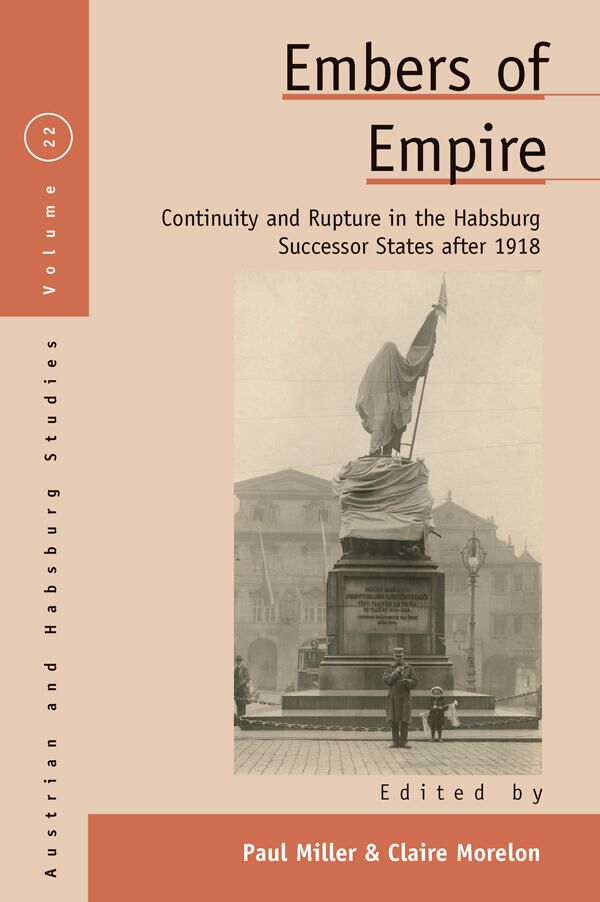
Embers of empire : continuity and rupture in the Habsburg successor states after 1918
The collapse of the Habsburg Monarchy at the end of World War I ushered in a period of radical change for East-Central European political structures and national identities. Yet this transformed landscape inevitably still bore the traces of its imperial past. Breaking with traditional histories that take 1918 as a strict line of demarcation, this collection focuses on the complexities that attended the transition from the Habsburg Empire to its successor states. In so doing, it produces new and more nuanced insights into the persistence and effectiveness of imperial institutions, as well as the sources of instability in the newly formed nation-states.
eBook
A Hungarian Old China Hand and the End of Empire: Loyalty Struggles in Interwar Shanghai's Migrant Community
This article explores the consequences of the Austro-Hungarian Empire's end through the tumultuous biography of a philanthropic entrepreneur and quasi-consul community leader known today for assisting thousands of Jewish refugees during World War II. Focusing on Paul Komor (1886–1973) and the migrant community of Shanghai Hungarians, the article contends that postimperial diasporas preserved a piece of empire in their commitment to Jewish emancipation, imperialist nationalism, multiple loyalties, and political nostalgia. It also argues that diasporic networks and charitable actions communicated political and national loyalties while creating and defining the boundaries of the community. Presenting original research involving sources in multiple languages from China, Hungary, the U.S., the U.K., and the Netherlands, the article traces the fortunes of a Jewish Hungarian family in colonial Shanghai, shows the limits of its son's charity-rooted advancement in community leadership, sheds light on the seemingly contradictory political ideas of a postimperial expatriate to explain his complicated relationship with his kinstate, and analyzes the institutionalization of communal charity and the competing prerequisite definitions of postimperial national belonging.
Journal Article
“Yugoslavia is worthless . . . you can get neither sugar nor kerosene.” Food Supply and Political Legitimacy in the Slovene Part of Yugoslavia, 1918–1924
The new states that were established in the autumn of 1918 presented themselves as something new and better. Not only were they supposed to be the embodiment of the “national yearnings” of the formerly “oppressed nations” of the Habsburg Empire, but they were also meant to be more democratic and it was promised that their administrations would work better and their economies would flourish. In short, they were to be a decisive break with the imperial past. However, the new nation-states often could not deliver on these lofty promises, and, as a result, their legitimacy began to erode rather rapidly. In this context, the inability to quickly improve the food supply played an important role. In the Slovene part of Yugoslavia, the inadequate supply of basic foodstuffs, rationing, and increasing prices made the already volatile situation worse, as parts of the population began to grumble, protest, and yearn for the Habsburgs, looking across their northern and western borders. Police and court files, district captains’ reports, and various other sources indicate that after the proclamation of independence the mood of the population quickly soured, and that the legitimacy of the new state was often questioned.
Journal Article
The Battle for Post-Habsburg Trieste/Trst: State Transition, Social Unrest, and Political Radicalism (1918–23)
In spite of the recent transnational turn, there continues to be a considerable gap between Fascist studies and the new approaches to the transitions, imperial collapses, and legacies of post–World War I Europe. This article posits itself at the crossroads between fascist studies, Habsburg studies, and scholarship on post-1918 violence. In this regard, the difficulties of the state transition, the subsequent social unrest, and the ascent of new forms of political radicalism in post-Habsburg Trieste are a case in point. Rather than focusing on the “national strife” between “Italians” and “Slavs,” this article will concentrate on the unstable local relations between state and civil society, which led to multiple cycles of conflict and crisis. One of the arguments it makes is that in post-1918 Trieste, where the different nationalist groups contended for a space characterized by multiple loyalties and allegiances, Fascists claimed to be the movement of the “true Italians,” identified with the Fascists and their sympathizers. Accordingly, while targeting the alleged enemies of the “Italian nation” (defined as “Bolsheviks,” “Austrophiles,” and “Slavs”), they aimed to polarize the Italian-speaking community along different political fault lines to reconfigure relations between the state and civil society.
Journal Article
“Who Could Be Strong When Hungry?”: Food Supply and Nutrition of the Civilian Population in Maribor at the End of and after World War I
The end of World War I brought not only the end of a great slaughter but also the creation of new countries, great expectations of better living conditions, and the promise of an end of scarcity. In Maribor, a contested border town occupied by Slovenian troops and annexed to the newly established State of Slovenes, Croats, and Serbs, expectations were even higher. A part of the population opposed the town's annexation to the newly established state and compared the living conditions at home with those in Austria. As early as November 1918, the Slovene City Food Council was established in Maribor to feed the city's population. It introduced measures similar to those introduced during the war, such as food ration cards. Despite these measures, food shortages and hunger were part of everyday life, especially in the winter of 1918–19. This article discusses civilians' survival strategies, as well as continuities and discontinuities between wartime and postwar measures to improve the food supply. It shows that despite the efforts of the new Yugoslav authorities, they often continued wartime practices and food remained of poor quality and difficult to access for most of the population throughout 1919.
Journal Article
Food Profiteering, Paper Laws, and Criminal Justice in the Bohemian Lands after 1918
The article deals with food profiteering in the Bohemian Lands after the declaration of Czechoslovakia in 1918. The new state faced a disintegrated society in which various units continued to fight each other for an advantage in the food market. While food shortages persisted, the Czechoslovak authorities had to deal with a situation in which food rationing laws had lost some of their power to distinguish between the legal and the criminal. Moreover, collective ideas about what was right and wrong, about the victims and perpetrators of food profiteering, and of whom to punish and how, varied according to the different social and ethnic affiliations of the population. Political instrumentalization of such ideas jeopardized the postwar consolidation based on the promise of a better future. Thus, the introduction of food profiteering courts with lay judges was an attempt to institutionalize conflicts over food profiteering and to reduce the impacts of the atomization of society until the economic situation improved.
Journal Article
Planting the Republic: State Regulation of the Discourse on Food Shortages in Public Communication in Early Czechoslovakia (1918–21)
Czechoslovakia as a victorious, yet still fragile post-imperial state, considered censorship and state propaganda to be a necessary tool to secure its legitimacy at home and abroad. From the very beginning, Czechoslovakia defined itself as a democracy with freedom of speech as its basic principle, yet at the same time, it had to deal with inner fragility and outer vulnerabilities. The strategic agenda of people's nutrition, which was closely associated with the perceived competence of state institutions, serves as a litmus test for the state's regulation of press and public speech and the implementation of republican practices and acceptable limits on public discourse. This study analyzes how the new republican state regulated information on food supply shortcomings in the press and at public gatherings. It argues that Czechoslovakia maintained the prewar Habsburg practices of censorship; however, instead of the vaguely defined public interest of the multinational monarchy, it was now used to protect the public interest of “the national state of the Czechoslovaks.” This study analyzes how the government thought about the consistency of its communication during the postwar (supply) crisis, and thus also options of how to shape a clear and positive brand of the state.
Journal Article
“Yugoslavia has Nothing. Yugoslavia has No Bread. But Hungary Gives Us Bread”: Access to Food and (Dis)loyalty in a “Redeemed” Yugoslav Borderland
This article illustrates the socioeconomic background of rural political discontent in the post-imperial Yugoslav border region Prekmurje. The author argues that during the post-Habsburg political transition and ensuing social transformation, the fundamental lack of loyalty to the Yugoslav state among an important segment of the rural population of Prekmurje was rooted in insufficient access to food. Documents of court proceedings, official state reports, and findings of individuals with deep understandings of the situation on the ground reveal that this rural political mobilization was not so much a reflection of Hungarian propaganda or a “lack of appropriate national identification” among the local population—although, of course, these two factors cannot be ignored in a contested and linguistically and ethnically diverse region—but rather an outcome of the impoverishment of large sections of the peasant population.
Journal Article
Embers of Empire
The collapse of the Habsburg Monarchy at the end of World War I ushered in a period of radical change for East-Central European political structures and national identities. Yet this transformed landscape inevitably still bore the traces of its imperial past. Breaking with traditional histories that take 1918 as a strict line of demarcation, this collection focuses on the complexities that attended the transition from the Habsburg Empire to its successor states. In so doing, it produces new and more nuanced insights into the persistence and effectiveness of imperial institutions, as well as the sources of instability in the newly formed nation-states.
eBook