
Catalogue Search | MBRL


Are you sure you want to remove the book from the shelf?

{{itemTitle}}
6
result(s) for
"Post-transitional South Africa"
Sort by:


Ivan Vladislavić's Aesthetics of Detritus in \Autopsy\ and \Propaganda by Monuments\
In this article, I examine detritus as a central trope for post-transitional South African society, an idea that, I argue, has particular relevance for Ivan Vladislavić's second short story collection, Propaganda by Monuments. As a point of departure, I use Leon de Kock's idea of the \"democratic moment\" – the moment of radical globalization coinciding with the fall of the Berlin Wall and the crumbling of apartheid bureaucracy. In this new \"democratic\" age, cultural detritus - remnants, fragments and addenda - begins to circulate and litter transnational contexts, finding its way into the unlikeliest of spaces, producing cultural resonances, echoes and cross-talk. In Propaganda by Monuments, detritus carries exotic charges of meaning, and allows for alternative ways of seeing the urban landscape in the new democratic era, in which the nation state has begun its process of dissipation. As such, Propaganda by Monuments can perhaps be read as a prelude to Vladislavić's third collection of stories, 101 Detectives, in which the detritus has been swept away, and polished surfaces are angled towards the protagonists, and the reader, narrowing their margins for subjectivity and self-styling.
Journal Article

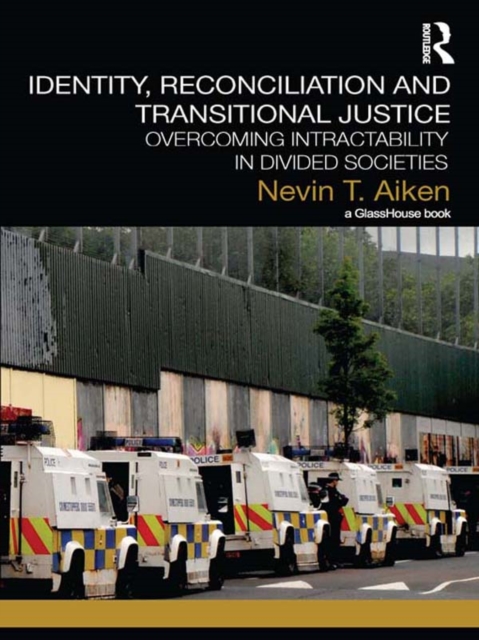
Identity, Reconciliation and Transitional Justice
Building upon an interdisciplinary synthesis of recent literature from the fields of transitional justice and conflict transformation, this book introduces a groundbreaking theoretical framework that highlights the critical importance of identity in the relationship between transitional justice and reconciliation in deeply divided societies. Using this framework, Aiken argues that transitional justice interventions will be successful in promoting reconciliation and sustainable peace to the extent that they can help to catalyze those crucial processes of 'social learning' needed to transform the antagonistic relationships and identifications that divide post-conflict societies even after the signing of formal peace agreements. Combining original field research and an extensive series of expert interviews, Aiken wlies this social learning model in a comprehensive examination of both the South African Truth and Reconciliation Commission and the uniquely 'decentralized' approach to transitional justice that has emerged in Northern Ireland. By offering new insight into the experiences of these countries, Aiken provides compelling firsthand evidence to suggest that transitional justice interventions can best contribute to post-conflict reconciliation if they not only provide truth and justice for past human rights abuses, but also help to promote contact, dialogue and the amelioration of structural and material inequalities between former antagonists.
Identity, Reconciliation and Transitional Justice makes a timely contribution to debates about how to best understand and address past human rights violations in post-conflict societies, and it offers a valuable resource to students, scholars, practitioners and policymakers dealing with these difficult issues.
eBook

Post-TRC Prosecutions in South Africa
This book offers the first comprehensive analysis and evaluation of criminal prosecutions required after the Truth and Reconciliation Commission's amnesty process, putting the issue into a normative and practical perspective of transitional justice in South Africa.
eBook