Catalogue Search | MBRL


Are you sure you want to remove the book from the shelf?

{{itemTitle}}
384,669
result(s) for
"Postal "
Sort by:

Post offices
\"Vivid photographs and easy-to-read text introduce readers to the purpose, people, and layout of post offices. Young readers will get to dive into their community's oldest form of communication. Features include a table of contents, an infographic, fun facts, Making Connections questions, a glossary, and an index. QR Codes in the book give readers access to book-specific resources to further their learning. Aligned to Common Core Standards and correlated to state standards.\" -- Amazon.com.
Book
Financial access and stability : a road map for the Middle East and North Africa
This report contributes to the effort to improve Middle East and North Africa's (MENA's) growth and employment performance by providing a diagnostic of MENA's financial systems and proposing a roadmap for more diversified, competitive, and inclusive financial systems. The report recognizes the need to complement the financial development agenda by a financial stability agenda, to ensure that financial systems remain resilient as access is expanded and new risks emerge. The report starts by briefly reviewing the main causes of MENA's unsatisfactory growth and employment performance, identifying the region's broader growth agenda and the role of financial development in this agenda. It proceeds by reviewing the size and structure of MENA's financial systems, showing that most of these systems are excessively bank based and undiversified. The chapter provides a battery of access indicators showing that access outcomes have been very poor relative to those in other regions. It discusses the main causes of these poor outcomes and proposes a comprehensive agenda for financial development and financial stability. The report emphasizes the many common challenges faced by MENA countries, but it also recognizes the differences and tailors policy recommendations to the initial conditions in each of the main sub regions.
eBook

Our post office
\"The post office is an important place in our community. Many community helpers work at the post office. Readers will learn about who works at a post office, what the workers do, and what makes a post office special. Simple, at-level text and vibrant photos help readers learn all about the post office\"-- Provided by publisher.
Book
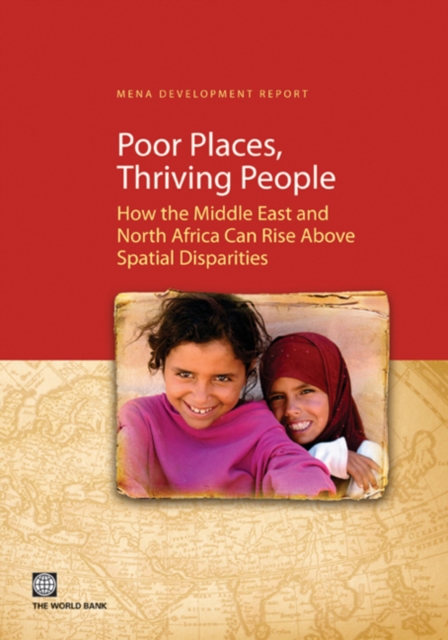
Poor places, thriving people : how the Middle East and North Africa can rise above spatial disparities
The main messages of poor places, thriving people: how the Middle East and North Africa can rise above spatial disparities can be summarized in four words: people, connections, clusters, and institutions. This report shows how smart investments and policies in transport can connect poor places to the dynamic economies of their rich neighbors. There is also a wide open field of opportunity for telecommunications to bring electronic proximity to lagging areas. Many countries have spent huge sums on subsidies to entice investors to lagging areas-usually without any sustainable impact. This report recommends that governments turn their efforts toward the new approach to local economic development, which is gaining ground around the world, and is based on economic clusters, local competitive advantage, private initiative, and public-private dialogue. The report describes the state-of-play in territorial planning, public financial management, targeted programs, deconcentration, and decentralization, and it sketches some emerging lessons. This report combines the insights of specialists in the majority of the World Bank's key sectors: agriculture, development economics, education, health, poverty analysis, social protection, and transport. It is the report's modest aim, if not to offer a single formula for reducing spatial disparities, at least to propose a range of policy options that the region's leaders can reflect on in the light of their national objectives.
eBook


‘It’s as if I’m Worth Nothing’—Cost-Driven Restructuring and the Dignity of Long-Term Workers in Finland’s State-Owned Postal Service Company
Organisational restructuring involving cost-cutting, downsizing, and the acquisition and divestment of different functions is an increasingly normalised aspect of employment in both the private and public sectors. This article takes up the question of the effects of restructuring on workers through a study based on in-depth, semi-structured interviews of long-term workers in Finland’s state-owned postal service, using the concept of dignity as an analytical lens. The article distinguishes between everyday, organisational, and social dignity, using this distinction to capture how workers strove to sustain dignity in a process of organisational restructuring that generated dignity threats related to occupational devaluation. The study shows how dignity in postal work has been dependent on a particular historical configuration of public service work involving the employer organisation, employment relations, and occupational values. Cost-driven restructuring has destabilised this configuration, producing a stark separation between dignity in everyday work and the organisational indignities of restructuring in postal workers’ experiences. Feeling unable to affect organisational changes in their work, postal workers have been left to sustain dignity through everyday relationality, and by drawing intra-organisational boundaries to temporary workers and upper managers based on an occupational hierarchy of commitment and competence. The study highlights the significance of organisational support for dignity at work, particularly in relation to the dignity threats generated by prolonged processes of restructuring.
Journal Article

There's Always Work at the Post Office
This book brings to life the important but neglected story of African American postal workers and the critical role they played in the U.S. labor and black freedom movements. Historian Philip Rubio, a former postal worker, integrates civil rights, labor, and left movement histories that too often are written as if they happened separately. Centered on New York City and Washington, D.C., the book chronicles a struggle of national significance through its examination of the post office, a workplace with facilities and unions serving every city and town in the United States.Black postal workers--often college-educated military veterans--fought their way into postal positions and unions and became a critical force for social change. They combined black labor protest and civic traditions to construct a civil rights unionism at the post office. They were a major factor in the 1970 nationwide postal wildcat strike, which resulted in full collective bargaining rights for the major postal unions under the newly established U.S. Postal Service in 1971. In making the fight for equality primary, African American postal workers were influential in shaping today's post office and postal unions.
eBook