
Catalogue Search | MBRL


Are you sure you want to remove the book from the shelf?

{{itemTitle}}
216
result(s) for
"Posters 20th century."
Sort by:


Posters for Peace
By the spring of 1970, Americans were frustrated by continuing war in Vietnam and turmoil in the inner cities. Students on American college campuses opposed the war in growing numbers and joined with other citizens in ever-larger public demonstrations against the war. Some politicians—including Ronald Reagan, Spiro Agnew, and Richard Nixon—exploited the situation to cultivate anger against students. At the University of California at Berkeley, student leaders devoted themselves, along with many sympathetic faculty, to studying the war and working for peace. A group of art students designed, produced, and freely distributed thousands of antiwar posters. Posters for Peace tells the story of those posters, bringing to life their rhetorical iconography and restoring them to their place in the history of poster art and political street art. The posters are vivid, simple, direct, ironic, and often graphically beautiful. Thomas Benson shows that the student posters from Berkeley appealed to core patriotic values and to the legitimacy of democratic deliberation in a democracy—even in a time of war.
eBook

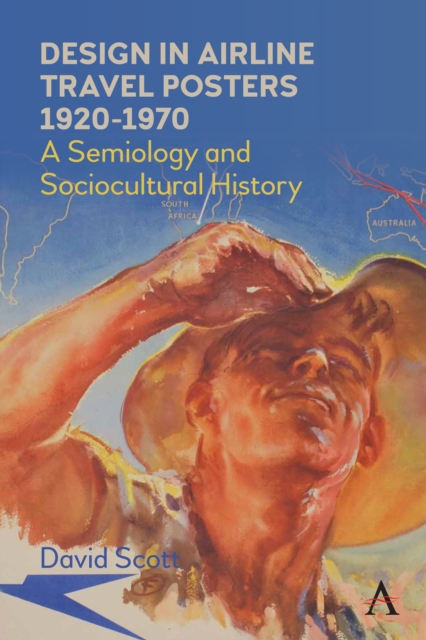
Design in Airline Travel Posters 1920-1970
This book studies design in airline travel posters of the 1920–1970: period. It is both a semiology and a sociocultural cultural history that explores the way advertising posters combine information and fantasy to create seductive images/texts. The book is lavishly illustrated in colour, the images constituting part of the overall argument. The field of poster studies is vast, but it is surprising how little work has been done till date on the fundamental structures – semiotic and semantic – that underpin the visual messages posters produce. Most studies of posters focus either on their history; on specific themes – politics, travel, sport, cinema; or on their status as collectable items. Though such approaches are valid, they hardly account for the specificity of the poster’s appeal or for the complex semiotic and cultural issues poster art raises. This book sets out to tackle these latter issues since they are fundamental both to the deeper significance and to the wider appeal of the poster as a cultural form. In doing so it focuses on the field of airline travel posters which developed precisely in the period of the twentieth century (1920–1970) that coincided with the onset of mass travel.
eBook

Milton Glaser posters
Milton Glaser has designed more than 500 posters. Some, like his 1967 Bob Dylan poster for Columbia Records, are icons; others, like the series celebrating \"I [heart] New York,\" evoke his best-known works. Milton Glaser Posters includes more than 400 of them, with Glaser's own commentary describing his intentions and inspiration. It is a delight for the art lover, an education in visual storytelling, and a journey through the cultural life of half a century, all rolled into one compact, intense book.
BOOK

WPA Posters in an Aesthetic, Social, and Political Context
This book examines posters produced by the Works Progress Administration (WPA), a federal relief program designed to create jobs in the United States during the Great Depression.
Cory Pillen focuses on several issues addressed repeatedly in the roughly 2,200 extant WPA posters created between 1935 and 1943: recreation and leisure, conservation, health and disease, and public housing. As the book shows, the posters promote specific forms of knowledge and literacy as solutions to contemporary social concerns. The varied issues these works engage and the ideals they endorse, however, would have resonated in complex ways with the posters' diverse viewing public, working both for and against the rhetoric of consensus employed by New Deal agencies in defining and managing the relationship between self and society in modern America.
This book will be of interest to scholars in design history, art history, and American studies.
Cover image: Don (Chester) C. Powell. Washington D.C. WPA, Department of the Interior, National Park Service, c. 1938. Silkscreen Print. Digital Image courtesy of Library of Congress, Prints & Photographs Division, WPA Poster Collection, LC-DIG-ppmsca-13397.
eBook


Dole queues and demons : British election posters from the Conservative Party Archive
A blend of graphic design, bold art or photography & psychology, election posters are an unsung art form, stretching back to the dawn of the 20th century. Exploiting the Conservative Party Archive held at the Bodleian Library which contains over 700 posters, this text charts the evolution of the Conservatives' election posters.
Book

Paraphrenia revisited: psychotic states arising later in life. Why do psychiatrists tend to overlook it?
IntroductionIn spite of the progress observed in the last decade particularly in the field of the neurosciences, areas of controversy and incomplete concepts still remain in psychiatry. One relates to the study the heterogeneous group of schizophrenic spectrum functional psychosis that arise along the neurophysiological aging process. Kraepelin first used the term paraphrenia in 1912, to describe a psychotic disorder with much lighter impairment of emotion and volition, minimal to no cognitive deterioration (dementia) and personality preservation compared to dementia praecox. However, since its first descriptions, late-onset psychoses have received different descriptions and definitions.ObjectivesBrief review of the evolution of paraphrenia concept, focusing not only on pioneering currents, but also articulating it with recent conclusions on late-onset psychoses.MethodsSystematic revision of literature.ResultsAfter Kreapelin pioneerism, Bleuler and Mayer-Gross would contribute to the weakening and disruption of the Kraepelinian concept of paraphrenia. In the first half of the 20th century, psychiatry was moving towards the dissolution of this concept. British psychiatrists would later rehabilitate the concept of paraphrenia but to designate a very late-onset variant of schizophrenia - late paraphrenia. This influenced the International Diseases Classifications (ICD), and the 8th edition was the first to consider paraphrenia as a subtype of paranoid schizophrenia.By the end of the 20th century, both ICD-10 and various editions of DSM since DSM-III-TR (inclusive) omitted the category of paraphrenia, allowing the super-inclusiveness of the schizophrenia category and discouraging research on the theme.In the late 20th century, late paraphrenia was conceived as a group of heterogeneous disorders that included paranoid and organic psychosis. To date, the term very late onset schizophrenia-like psychosis is the term used to replace late paraphrenia.ConclusionsThe nosological consecration of paraphrenia suffered several misfortunes over the last century. The schizophrenic psychosis “black-hole” conceived at the same time contributed to this concealment. In addition, modern pharmacology also allowed the neuroleptization and homogenization of disorders with psychotic symptoms which led to the devaluation of some diagnostic possibilities in the “neighborhood” of schizophrenia.We propose a nosological frame composed of two distinct entities: one based on a neurodevelopment disorder - schizophrenia - with insidious onset at a younger age, with a hereditary background and greater global deterioration, an the other, with a neurodegenerative basis - paraphrenia - with an abrupt and later onset, less contribution of genetic factors, greater preservation and lower probability of dementia development.Disclosure of InterestNone Declared
Journal Article