
Catalogue Search | MBRL


Are you sure you want to remove the book from the shelf?

{{itemTitle}}
796
result(s) for
"Potatoes History."
Sort by:

Potato : a history of the propitious esculent
Photojournalist Reader (Africa: A Biography of the Continent) traces the humble potato from its roots in the Peruvian Andes to J.R. Simplot's multibillion-dollar-a-year French fry business. Despite its predilection to disease, the potato is a highly adaptable, high-yield, and nutrient-packed foodstuff. While this title focuses primarily on the potato's presence in South America and Europe, it also touches on Papua New Guinea, New Zealand, and China-currently the world's largest producer and consumer of potatoes. Verdict: Curiously little attention is paid to the tuber's contributions to the culinary and beverage landscape; the UK subtitle of this work, \"The Potato in World History,\" provides a more accurate description of the focus of the text.
Book

Potato
Object Lessons is a series of short, beautifully designed books about the hidden lives of ordinary things.Baked potatoes, Bombay potatoes, pommes frites...everyone eats potatoes, but what do they mean?To the United Nations they mean global food security (potatoes are the world's fourth most important food crop).
eBook
Potato
The potatohumble, lumpy, bland, familiaris a decidedly unglamorous staple of the dinner table. Or is it? John Readers narrative on the role of the potato in world history suggests we may be underestimating this remarkable tuber. From domestication in Peru 8,000 years ago to its status today as the worlds fourth largest food crop, the potato has played a starringor at least supportingrole in many chapters of human history. In this witty and engaging book, Reader opens our eyes to the power of the potato.Whether embraced as the solution to hunger or wielded as a weapon of exploitation, blamed for famine and death or recognized for spurring progress, the potato has often changed the course of human events. Reader focuses on sixteenth-century South America, where the indigenous potato enabled Spanish conquerors to feed thousands of conscripted native people; eighteenth-century Europe, where the nutrition-packed potato brought about a population explosion; and todays global world, where the potato is an essential food source but also the worlds most chemically-dependent crop. Where potatoes have been adopted as a staple food, social change has always followed. It may be just a humble vegetable, John Reader shows, yet the history of the potato has been anything but dull.
eBook
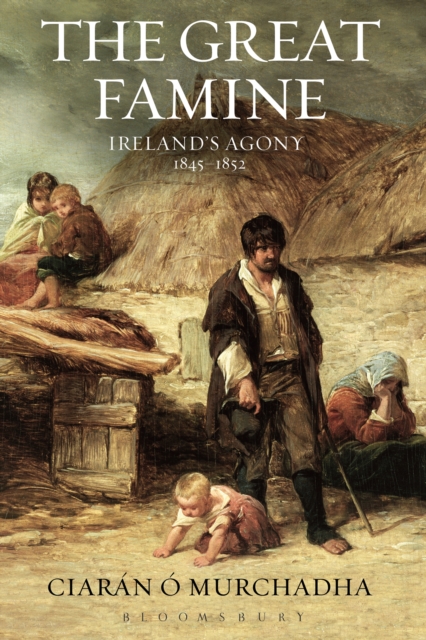
The great famine : Ireland's agony 1845-1852
Over one million people died in the Great Famine, and more than one million more emigrated on the coffin ships to America and beyond.Drawing on contemporary eyewitness accounts and diaries, the book charts the arrival of the potato blight in 1845 and the total destruction of the harvests in 1846 which brought a sense of numbing shock.
eBook

Crunch
The potato chip has been one of America's favorite snacks since its accidental origin in a nineteenth-century kitchen.
Crunch! A History of the Great American Potato Chip tells the story of this crispy, salty treat, from the early sales of locally made chips at corner groceries, county fairs, and cafes to the mass marketing and corporate consolidation of the modern snack food industry.
Crunch! also uncovers a dark side of potato chip history, including a federal investigation of the snack food industry in the 1990s following widespread allegations of antitrust activity, illegal buyouts, and predatory pricing. In the wake of these \"Great Potato Chip Wars,\" corporate snack divisions closed and dozens of family-owned companies went bankrupt. Yet, despite consolidation, many small chippers persist into the twenty-first century, as mom-and-pop companies and upstart \"boutique\" businesses serve both new consumers and markets with strong regional loyalties. Illustrated with images of early snack food paraphernalia and clever packaging from the glory days of American advertising art,
Crunch! is an informative tour of large and small business in America and the vicissitudes of popular tastes.
eBook

Potatoes: Food tourism and beyond
Food tourism includes various activities and attractions linked to food. Potatoes can also be also linked to tourism, or food tourism as testified by special Victorian Potato Industry Tour organized in and around Melbourne, Australia or Rural Community Tourism in the Potato Park; a tour around Cusco, Peru; various culinary events dedicated to potatoes in Slovenia and many others. This paper contributes to the knowledge on tourism and specifically food tourism by proposing to \"open\" a new niche of research based on specific foods or their ingredients, which up to now seems to have touched only a very few specific foods (or drinks) and associated ingredients-for instance, the case of grape/wine is exemplar. However, many other specific foods or ingredients could be singularly one-by-one) researched to examine their role in tourism. This paper discusses the role in tourism/food tourism of a \"humble tuber\", the potato. This is a desktop research which draws on previous literature, organizational and institutional documents and information and data, such as the list of museums around the world. The aim is to analyse the knowledge from various disciplines linking the potato to tourism to understand the various ways in which it can directly or indirectly have a role in tourism. The article presents the potato including its (social) history, gastronomy in relation to tourism/food tourism. The article argues that the potato should be promoted given its various uses and universality of application as a food and as an ingredient.
Journal Article

Historical collections reveal patterns of diffusion of sweet potato in Oceania obscured by modern plant movements and recombination
The history of sweet potato in the Pacific has long been an enigma. Archaeological, linguistic, and ethnobotanical data suggest that prehistoric human-mediated dispersal events contributed to the distribution in Oceania of this American domesticate. According to the \"tripartite hypothesis,\" sweet potato was introduced into Oceania from South America in pre-Columbian times and was then later newly introduced, and diffused widely across the Pacific, by Europeans via two historically documented routes from Mexico and the Caribbean. Although sweet potato is the most convincing example of putative pre-Columbian connections between human occupants of Polynesia and South America, the search for genetic evidence of pre-Columbian dispersal of sweet potato into Oceania has been inconclusive. Our study attempts to fill this gap. Using complementary sets of markers (chloroplast and nuclear microsatellites) and both modern and herbarium samples, we test the tripartite hypothesis. Our results provide strong support for prehistoric transfer(s) of sweet potato from South America (Peru-Ecuador region) into Polynesia. Our results also document a temporal shift in the pattern of distribution of genetic variation in sweet potato in Oceania. Later ^ introductions, accompanied by recombination between distinct sweet potato gene pools, have reshuffled the crop's initial genetic base, obscuring primary patterns of diffusion and, at the same time, giving rise to an impressive number of local variants. Moreover, our study shows that phenotypes, names, and neutral genes do not necessarily share completely parallel evolutionary histories. Multidisciplinary approaches, thus, appear necessary for accurate reconstruction of the intertwined histories of plants and humans.
Journal Article

THE POTATO'S CONTRIBUTION TO POPULATION AND URBANIZATION: EVIDENCE FROM A HISTORICAL EXPERIMENT
We exploit regional variation in suitability for cultivating potatoes, together with time variation arising from their introduction to the Old World from the Americas, to estimate the impact of potatoes on Old World population and urbanization. Our results show that the introduction of the potato was responsible for a significant portion of the increase in population and urbanization observed during the eighteenth and nineteenth centuries. According to our most conservative estimates, the introduction of the potato accounts for approximately one-quarter of the growth in Old World population and urbanization between 1700 and 1900. Additional evidence from within-country comparisons of city populations and adult heights also confirms the cross-country findings.
Journal Article