
Catalogue Search | MBRL


Are you sure you want to remove the book from the shelf?

{{itemTitle}}
1,432
result(s) for
"Potawatomi Indians"
Sort by:

Braiding sweetgrass
\"As a leading researcher in the field of biology, Robin Wall Kimmerer understands the delicate state of our world. But as an active member of the Potawatomi nation, she senses and relates to the world through a way of knowing far older than any science. In Braiding Sweetgrass, she intertwines these two modes of awareness--the analytic and the emotional, the scientific and the cultural--to ultimately reveal a path toward healing the rift that grows between people and nature. The woven essays that construct this book bring people back into conversation with all that is green and growing; a universe that never stopped speaking to us, even when we forgot how to listen\"-- Provided by publisher.
Book

Imprints
The Pokagon Band of Potawatomi Indians has been a part of Chicago since its founding. In very public expressions of indigeneity, they have refused to hide in plain sight or assimilate. Instead, throughout the city's history, the Pokagon Potawatomi Indians have openly and aggressively expressed their refusal to be marginalized or forgotten-and in doing so, they have contributed to the fabric and history of the city.Imprints: The Pokagon Band of Potawatomi Indians and the City of Chicagoexamines the ways some Pokagon Potawatomi tribal members have maintained a distinct Native identity, their rejection of assimilation into the mainstream, and their desire for inclusion in the larger contemporary society without forfeiting their \"Indianness.\" Mindful that contact is never a one-way street, Low also examines the ways in which experiences in Chicago have influenced the Pokagon Potawatomi.Imprintscontinues the recent scholarship on the urban Indian experience before as well as after World War II.
eBook

Three Fires Unity
The Lake Huron area of the Upper Great Lakes region, an area spreading across vast parts of the United States and Canada, has been inhabited by the Anishnaabeg for millennia. Since their first contact with Europeans around 1600, the Anishnaabeg have interacted with-and struggled against-changing and shifting European empires and the emerging nation-states that have replaced them. Through their cultural strength, diplomatic acumen, and a remarkable knack for adapting to change, the Anishnaabeg of the Lake Huron Borderlands have reemerged as a strong and vital people, fully in charge of their destiny in the twenty-first century.
Winner of the North American Indian Prose Award, this first comprehensive cross-border history of the Anishnaabeg provides an engaging account of four hundred years of their life in the Lake Huron area, showing how they have been affected by European contact and trade.Three Fires Unity examines how shifting European politics and, later, the imposition of the Canada-United States border running through their homeland, affected them and continue to do so today. In looking at the cultural, social, and political aspects of this borderland contact, Phil Bellfy sheds light on how the Anishnaabeg were able to survive and even thrive over the centuries in this intensely contested region.
eBook

The Borderland of Fear
The Ohio River Valley was a place of violence in the nineteenth century, something witnessed on multiple stages ranging from local conflicts between indigenous and Euro-American communities to the Battle of Tippecanoe and the War of 1812. To describe these events as simply the result of American expansion versus Indigenous nativism disregards the complexities of the people and their motivations. Patrick Bottiger explores the diversity between and among the communities that were the source of this violence.As new settlers invaded their land, the Shawnee brothers Tenskwatawa and Tecumseh pushed for a unified Indigenous front. However, the multiethnic Miamis, Kickapoos, Potawatomis, and Delawares, who also lived in the region, favored local interests over a single tribal entity. The Miami-French trade and political network was extensive, and the Miamis staunchly defended their hegemony in the region from challenges by other Native groups. Additionally, William Henry Harrison, governor of the Indiana Territory, lobbied for the introduction of slavery in the territory. In its own turn, this move sparked heated arguments in newspapers and on the street. Harrisonians deflected criticism by blaming tensions on indigenous groups and then claiming that antislavery settlers were Indian allies.Bottiger demonstrates that violence, rather than being imposed on the region's inhabitants by outside forces, instead stemmed from the factionalism that was already present.The Borderland of Fearexplores how these conflicts were not between nations and races but rather between cultures and factions.
eBook

Seeing Red
Against long odds, the Anishinaabeg resisted removal, retaining
thousands of acres of their homeland in what is now Michigan,
Wisconsin, and Minnesota. Their success rested partly on their
roles as sellers of natural resources and buyers of trade goods,
which made them key players in the political economy of plunder
that drove white settlement and U.S. development in the Old
Northwest. But, as Michael Witgen demonstrates, the credit for
Native persistence rested with the Anishinaabeg themselves.
Outnumbering white settlers well into the nineteenth century, they
leveraged their political savvy to advance a dual citizenship that
enabled mixed-race tribal members to lay claim to a place in U.S.
civil society. Telling the stories of mixed-race traders and
missionaries, tribal leaders and territorial governors, Witgen
challenges our assumptions about the inevitability of U.S.
expansion. Deeply researched and passionately written, Seeing
Red will command attention from readers who are invested in
the enduring issues of equality, equity, and national belonging at
its core.
eBook
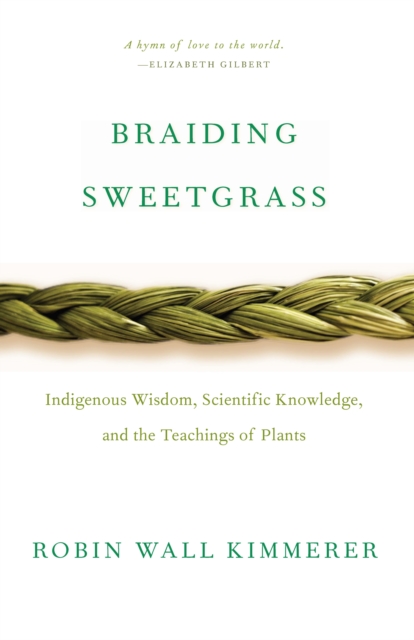
Braiding Sweetgrass
A New York Times BestsellerA Washington Post BestsellerNamed a \"Best Essay Collection of the Decade\" by Literary HubAs a botanist, Robin Wall Kimmerer has been trained to ask questions of nature with the tools of science. As a member of the Citizen Potawatomi Nation, she embraces the notion that plants and animals are our oldest teachers. In Braiding Sweetgrass, Kimmerer brings these two lenses of knowledge together to take us on \"a journey that is every bit as mythic as it is scientific, as sacred as it is historical, as clever as it is wise\" (Elizabeth Gilbert).Drawing on her life as an indigenous scientist, and as a woman, Kimmerer shows how other living beings-asters and goldenrod, strawberries and squash, salamanders, algae, and sweetgrass-offer us gifts and lessons, even if we've forgotten how to hear their voices. In reflections that range from the creation of Turtle Island to the forces that threaten its flourishing today, she circles toward a central argument: that the awakening of ecological consciousness requires the acknowledgment and celebration of our reciprocal relationship with the rest of the living world. For only when we can hear the languages of other beings will we be capable of understanding the generosity of the earth, and learn to give our own gifts in return.
eBook


Kenekuk, the Kickapoo Prophet
Most of the Indians whose names we remember were warriors-Tecumseh, Black Hawk, Sitting Bull, Crazy Horse, Geronimo-men who led their people in a desperate defense of their lands and their way of life. But as Alvin Josephy has written, \"Some of the Indians' greatest patriots died unsung by white men, and because their peoples were also obliterated, or almost so, their names are forgotten.\" Kenekuk was one of those unsung patriots. Leader of the Vermillion Band Kickapoos and Potawatomis from the 1820s to 1852, Kenekuk is today little known, even in the Midwest where his people settled. His achievements as the political and religious leader of a small band of peaceful Indians have been largely overlooked. Yet his leadership, which transcended one of the most difficult periods in Native American history-that of removal-was no less astute and courageous than that of the most warlike chief, and his teachings continued to guide his people long after his death. In his policies as well as his influence he was unique among American Indians. In this sensitive and revealing biography, Joseph Herring and explores Kenekuk's rise to power and astute leadership, as well as tracing the evolution of his policy of acculturation. This strategy proved highly effective in protecting Kenekuk's people against the increasingly complex, intrusive, and hostile white world. In helping his people adjust to white society and retain their lands without resorting to warfare or losing their identity as Indians, the Kickapoo Prophet displayed exceptional leadership, both secular and religious. Unlike the Shawnee Prophet and his brother Tecumseh, whose warlike actions proved disastrous for their people, Kenekuk always stressed peace and outward cooperation with whites. Thus, by the time of his death in 1852, Kenekuk had prepared his people for the challenge of maintaining a separate and unique Indian way of life within a dominant white culture. While other bands disintegrated because they either resisted cultural innovations or assimilated under stress, the Vermillion Kickapoos and Potawatomis prospered.
eBook