
Catalogue Search | MBRL


Are you sure you want to remove the book from the shelf?

{{itemTitle}}
8
result(s) for
"Pottery, Italian."
Sort by:

The collection of antiquities of the American Academy in Rome
The foundation of the American Academy in Rome dates back more than one hundred years to the early decades of the last century. Over the years, the Academy has acquired a study collection of material goods from antiquity, including coins, statues and figurines, lamps, stucco and other architectural fragments, jewelry, and inscriptions. While most are Roman in origin, some pieces are Greek or Etruscan. Some were gifts, others come from long-ago excavations, a few were bought. The Collection of Antiquities of the American Academy in Rome, the latest addition to the Supplements to the Memoirs of the American Academy in Rome series, focuses on highlights of the collection.
Book

Antonella Cimatti: Between Art Research and Technology
Antonella Cimatti's ceramic work is characterised by combining aspects of creativity with those of technological research of materials and processes. She uses photorealistic transfers (ceramic litho) of images taken from the natural world and has created a series of double-face objects painted with the brush's tip. Antonella Cimatti trained in Faenza at the Istituto Statale d'Arte per la Ceramica (State Art Institute for Ceramics) and was a pupil of Carlo Zauli and of l'Accademia di Belle Arti (Academy of Arts) in Bologna.
Magazine Article
Bloom Result is Clara Garesio's
On the occasion of the 80th birthday of the artist Clara Garesio her work Rebirth Mandala (2012) will be exhibited for a year in her \"place of the heart\", the National Museum of Ceramics Duca di Martina in Naples (Italy). At the same museum a great retrospective exhibition dedicated to Clara Garesio and supervised by Franco Bertoni took place last year. The exhibition, inaugurated on Oct 22, 2016 and lasted until the end of February 2017, was entitled Bloom is Result (a line by Emily Dickinson), because -- as Antonella Cilento wrote -- \"the sole and real aim of working on oneself is growing as a plant, feeding on, playing, enjoying oneself even when the going gets tough\" and Clara has never stopped enjoying herself: her work shows an infinite joyfulness, an absolute quality, an unprecedented variety, liveliness and beauty. Today Garesio lives and works in Naples and teaches at the Humaniter.
Trade Publication Article
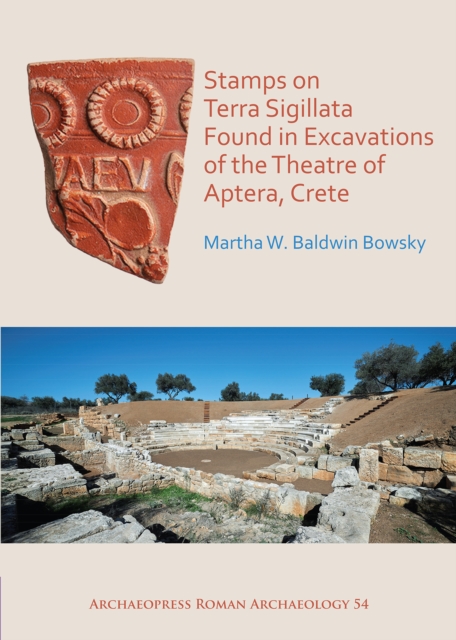
Stamps on Terra Sigillata Found in Excavations of the Theatre of Aptera, Crete
Stamps on Terra Sigillata Found in Excavations of the Theatre of Aptera, Crete presents a group of stamped fragments of Italian and eastern sigillata found in excavations of the theatre of Aptera (Crete). A total of 258 stamped sherds have been discovered and identified: 28 already published by the author and another 230 included here. Aptera now yields more stamped fragments of terra sigillata than any other Cretan city to date, including Knossos.
The sigillata stamps from the theatre of Aptera can be analysed so as to address a series of fundamental questions. Three of these constitute traditional uses of the evidence available from an analysis of terra sigillata: which potters supplied the theatre of Aptera and its environs; where these potters were active; when these potters were active and therefore what production centres supplied the theatre and its area over time. Two questions go further, in an effort to take advantage of this kind of material's ability to testify to patterns of contact and exchange, as well as to details of life within the Roman imperial system: what distribution patterns might have brought terra sigillata to the theatre and its vicinity; and whether we can suggest how terra sigillata was consumed in Aptera's theatre and its environs.
Aptera's theatre was a venue not only for performances but also for drinking, eating, and serving by the theatre-goers, spectators, actors and other performers. These activities took place during a period of prosperity for Roman Aptera in the first and second centuries, a period that coincides nicely with the production and distribution of terra sigillata. The people of Aptera and the surrounding area took full advantage of Crete's strategic position amid crossroads of transit and exchange as well as integration into the Roman economy, to display their prosperity and status in public and in private.
eBook

Eine apenninische Schale in Kition. Anzeichen für einen süditalienisch-zyprischen Kontakt im 14. Jahrhundert v. u. Z
Zu den Keramikfunden aus Grabkomplex 4+5 in Kition an der Südküste Zyperns zählt das Randfragment eines handgemachten Gefäßes mit Kerbschnittverzierung, das als Tasse/Schale der apenninischen Kulturgruppe bestimmt werden kann. Es ist somit derzeit das einzige aus dem östlichen Mittelmeerraum bekannte apenninische Gefäß. Die Verbreitung, die die Parallelen für die Kombination von Gefäßform und Muster in Italien haben, belegt ein Hauptproduktionsgebiet solcher Gefäße in Kampanien. Die Datierung der Parallelen in die italienische Mittelbronzezeit 3 passt zur Datierung der ältesten mykenischen Keramikbeigaben im Grabkomplex 4+5, die größtenteils während SH IIIA2 produziert wurden. Vermutlich gelangte das apenninische Gefäß in dieser Zeit aus Süditalien – am ehesten aus Kampanien oder der Region von Tarent, wo jeweils auch mykenische Keramik gleicher Zeitstellung gefunden wurde, – nach Zypern.
A rim fragment of a handmade vessel with intaglio decoration is part of the ceramic finds from tomb complex 4+5 at Kition on the south coast of Cyprus. It can be identified as a cup/bowl of the Apennine culture group, which makes it the only Apennine vessel known from the Eastern Mediterranean so far. The distribution of the parallels for the combination of vessel shape and motif in Italy demonstrates that the main production area of such vessels was Campania. The date of the parallels in the Italian Middle Bronze Age 3 fits with the date of the earliest of the pottery grave goods in tomb complex 4+5, as most of those were produced in LH IIIA2. Presumably during this time the Apennine vessel came from southern Italy – most probably from Campania or the Tarato region, where Mycenaean pottery of the same age has also been found – to Cyprus.
Journal Article

Quando le mani non sanno: approssimazione e imperizia nella produzione Aretina Di Ateius
L’étude des fragments de vases trouvés dans la décharge du four de l’atelier d’ Ateius , découvert à Arezzo dans les années 1950, a offert l’occasion d’une analyse détaillée du processus de fabrication des sigillées italiques. Une observation attentive des imperfections et des défauts des vases fournit des détails révélateurs de la compétence des potiers employés dans l’atelier, de la gestion du travail et des différentes phases de production des sigillées arétines.
Journal Article
Petro-archaeometric characterization of potteries from a kiln in Adrano, Sicily
Background This work is part of a wide scientific project finalized to characterize the Sicilian pottery productions from Greek to Roman Age. In this prospective, local reference groups have been analysed in order to create a database of the circulation and production centres in Sicily during this period. In this framework, a set of 28 waste pottery fragments (III-II century B.C.) from a pit found during excavations at the fortification of Adrano (Sicily) have been studied. Characterization of the samples has been obtained by macroscopic, petrographic (OM), mineralogical (XRD) and chemical (XRF) analyses. Results Macroscopic analysis of the studied potteries has allowed to distinguish four groups on the basis of grain size, porosity and clay paste color. Petrographic and mineralogical analysis, carried out on a selection of representative samples have allowed us to obtain useful information on the production technology of the studied samples. Moreover, information about raw materials and provenance of clay sediments has been obtained by comparing chemical data of the analysed samples with locally outcropping clay sediments reference data. Finally, chemical results on Adrano potteries have been compared with kiln wastes from Siracusa and Gela. Conclusions The aim of the present work is to obtain fabric characterizations and technological information on a local reference group of ceramic specimens manufactured in Adrano (Sicily). Petrographic and mineralogical results allow us to esteem high firing temperature suggesting a good technological level of local production; in addition, chemical data suggest a local provenance of raw materials used in the production of the studied samples. The comparison with local production from Siracusa and Gela highlights several differences in the use of raw material and in the technological levels achieved in the different sites, over time. Therefore, this work provides a valuable contribution in defining the local scenario of ceramic production in South-Eastern Sicily during the Hellenistic Age and in producing local reference groups in the petro-archaeometric studies of archaeological potteries.
Journal Article

More Than Mere Playthings
This book is inspired by the 2015 Italian Art Society-sponsored conference sessions of the American Association of Italian Studies. Its seven chapters span the art of ancient Etruria to twentieth century Italy, and explore a variety of media, including mirrors, cameos, treasury objects, reliquaries, ceramics, and figurines. Contributors approach the topic of the minor arts from a variety of interdisciplinary perspectives, including reception, use, patronage, gender issues, propaganda, and iconography. The volume thus fills the lacuna in the scholarship of the minor arts, and reveals that the minor arts are unique and worthy of study for their size, preciosity, patronage, audience, function, portability, and material. Ultimately, in revealing the importance of these objects, the book shows that the division between the major and minor arts is no longer valid, and that these objects of the minor arts hold as much significance as those of the major arts.
eBook