
Catalogue Search | MBRL


Are you sure you want to remove the book from the shelf?

{{itemTitle}}
314
result(s) for
"Pottery, Roman."
Sort by:

Roman pottery in the archaeological record
Examining how the Romans used their pottery & the implications of these practices for the archaeological record, this text is organised around a flow model for the life cycle of Roman pottery that covers eight distinct practices: manufacture, distribution, prime use, reuse, maintenance, recycling, discard & reclamation.
Book

Pottery Production, Landscape and Economy of Roman Dalmatia
This book presents interdisciplinary research carried out on the Roman sites of pottery workshops active within the coastal area of the province of Dalmatia as well as on material recovered during the excavations.
eBook
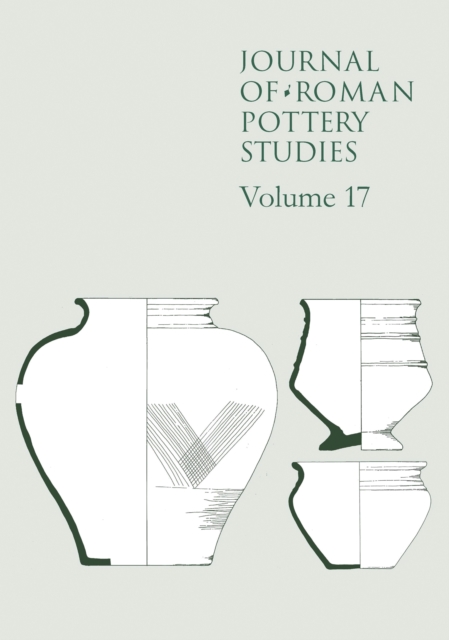
Journal of Roman Pottery Studies Volume 17
As a result of recent methodological and theoretical developments in approaches to the human body in archaeological contexts, the theme has recently become a particularly dynamic research area. This volume, building on the Neolithic Studies Group conference 2014, captures the variety of debates developing across research into the Neolithic bodies of the Near East and Europe. Papers are divided into three themes: living bodies, the body in death, and the representation of the body. In the first section, papers present new research assessing skeletal evidence alongside new interpretations of the body in the Southern British Neolithic to examine the lived experience of the body in the Neolithic. The second theme illustrates the variety of approaches arising from the study of death and burial, focusing on the many different ways the dead were treated during the Neolithic. The third theme examines the body as it is represented in Neolithic art, through artifacts and the stone stele found in Western and Mediterranean Europe. The volume begins with an introduction to the recent developments in the field and concludes with a discussion chapter from Julian Thomas, which sets an agenda for future studies on this theme. The approaches taken in the papers presented here bridge many different methodologies, ranging from theoretical treatises to methodological debates. Overall, the volume presents the study of the body in the Neolithic as a contested site, at which overlapping research themes meet, and addresses the insights provided by thinking about past bodies.
eBook

The collection of antiquities of the American Academy in Rome
The foundation of the American Academy in Rome dates back more than one hundred years to the early decades of the last century. Over the years, the Academy has acquired a study collection of material goods from antiquity, including coins, statues and figurines, lamps, stucco and other architectural fragments, jewelry, and inscriptions. While most are Roman in origin, some pieces are Greek or Etruscan. Some were gifts, others come from long-ago excavations, a few were bought. The Collection of Antiquities of the American Academy in Rome, the latest addition to the Supplements to the Memoirs of the American Academy in Rome series, focuses on highlights of the collection.
Book

The Ancient Mediterranean Trade in Ceramic Building Materials
This study addresses the level of interregional trade of ceramic building material (CBM), traditionally seen as a high bulk low value commodity, within the ancient Mediterranean between the third century BC and the seventh century AD.
eBook


La Céramique du Groupe épiscopal d'ARADI/Sidi Jdidi (Tunisie)
This study focuses on ceramic finds from the excavations (1996-2006) of the Episcopal Group of Sidi Jdidi, the ancient city of Aradi, in the hinterland of Hammamet in Tunisia.
eBook
Le commerce de céramiques fines à ammaia, une ville du sud de la Lusitanie (50 - 550 apr. J.-c.)
Ce livre présente l'ensemble de céramiques fines (sigillées, lampes et parois fines) d' Ammaia, une ville d'époque romaine et tardo-romaine, située dans l'hinterland de la région méridionale de la Lusitania (actuellement dans le territoire portugais). Malgré la distance de la côte atlantique, Ammaia a profité de sa proximité avec Augusta Emerita, la capitale de la provincia de la Lusitania. Cet aspect est particulièrement important entre c.50 et c.150 apr. J.-C., quand le marché local a importé de grandes quantités de céramiques fines de la capitale. La phase de l'Antiquité Tardive démontre une importation équilibrée à Ammaia, dont les céramiques fines, essentiellement formées par des sigillées, sont fournies par les productions du Nord de l' Hispania (les vallées du Douro et de l'Èbre) et l'Afrique du Nord. En plus, la recherche plus récente à Ammaia a livré d'excellents contextes datés entre c.50 et c.150 apr. J.-C., un aspect crucial pour la compréhension de l'évolution chronologique de la sigillée italique, sud-gallique et hispanique. Dans le dernier chapitre, l'auteur met en place une analyse à large spectre de la Lusitania méridionale, par rapport à la consommation de céramiques fines et d'amphores. Quelques phases chronologiques furent établies, basées sur l'évidence stratigraphique et typologique, pour la période entre c. 50 et c. 550 apr. J.-C., c'est-à-dire le Haut-Empire (à partir de la période claudio-néronienne) et sa transition vers la période romaine tardive et la phase post-romaine. Au cours des derniers sous-chapitres, cette analyse se concentre sur les problématiques du Ve siècle, jusqu'à la dernière évidence stratigraphique lusitanienne, au milieu du VIe siècle.
eBook