
Catalogue Search | MBRL


Are you sure you want to remove the book from the shelf?

{{itemTitle}}
753
result(s) for
"Pottery craft"
Sort by:

The beginner's guide to hand building : functional and sculptural projects for the home potter
\"Whether you have access to a communal studio or not, hand building projects can travel just about anywhere. Take your clay outside or work at the kitchen table, with instruction from best-selling ceramics author Sunshine Cobb. In this book, you'll find all the necessary fundamentals, including a thorough discussion of clay as well as helpful tips for keeping your body and mind in top shape. Then pick the path that's right for you in the chapters that follow\"-- Amazon.com.
Book

Woodland Potters and Archaeological Ceramics of the North Carolina Coast
The first comprehensive study of the meaning of pottery as a social activity in coastal North Carolina. Pottery types, composed of specific sets of attributes, have long been defined for various periods and areas of the Atlantic coast, but their relationships and meanings have not been explicitly examined. In exploring these relationships for the North Carolina coast, this work examines the manner in which pottery traits cross-cut taxonomic types, tests the proposition that communities of practice existed at several scales, and questions the fundamental notion of ceramic types as ethnic markers. Ethnoarchaeological case studies provide a means of assessing the mechanics of how social structure and gender roles may have affected the transmission of pottery-making techniques and how socio-cultural boundaries are reflected in the distribution of ceramic traditions. Another very valuable source of information about past practices is replication experimentation, which provides a means of understanding the practical techniques that lie behind the observable traits, thereby improving our understanding of how certain techniques may have influenced the transmission of traits from one potter to another. Both methods are employed in this study to interpret the meaning of pottery as an indicator of social activity on the North Carolina coast.
eBook

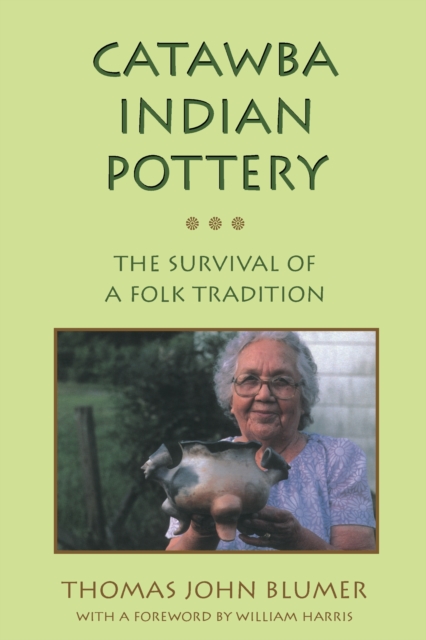
Catawba Indian Pottery
Traces the craft of pottery making among the Catawba
Indians of North Carolina from the late 18th century to the
present When Europeans encountered them, the
Catawba Indians were living along the river and throughout the
valley that carries their name near the present North
Carolina-South Carolina border. Archaeologists later collected
and identified categories of pottery types belonging to the
historic Catawba and extrapolated an association with their
protohistoric and prehistoric predecessors. In this volume,
Thomas Blumer traces the construction techniques of those
documented ceramics to the lineage of their probable
present-day master potters or, in other words, he traces the
Catawba pottery traditions. By mining data from archives and
the oral traditions of contemporary potters, Blumer
reconstructs sales circuits regularly traveled by Catawba
peddlers and thereby illuminates unresolved questions regarding
trade routes in the protohistoric period. In addition, the
author details particular techniques of the representative
potters—factors such as clay selection, tool use,
decoration, and firing techniques—which influence their
styles.
eBook

No kiln, handbuilding clay projects : 50 elegant projects to make for the home
\"Features information on setting up a workshop space, different tools and clays, common terms to know, clay making basics, and 50 clay projects for the home\"-- Provided by publisher.
BOOK

Technical traditions and individual variability in the Early Neolithic: Linear pottery culture flint knappers in the Aisne Valley (France)
For the Early Neolithic lithic industry in Western Europe (5500–4800 BCE), the study of technical behaviors, recognition of technical traditions, and even more so, idiosyncratic manifestations are not widespread. In this study, we propose an original approach to lithic industries based on the identification of \"communities of practice\" and individuals within housing units. The comparison of lithic series from the Meuse, Rhine and Seine basins allowed us to identify different technical traditions in the Early Neolithic. The study of three dwelling units at two sites in the Aisne Valley in France shows that it is possible to distinguish different flint blade debitages, which we interpreted as the work of different knappers. This novel study of hand-finding in the villages of the first agro-pastoralists populations proves stimulating for the renewal of perspectives on the interpretation of the organization of activities within villages.
Journal Article

Capturing technological crossovers between clay crafts: An archaeometric perspective on the emergence of workshop production in Late Iron Age northern Spain
In the Iberian Iron Age, the transition to workshop-based pottery production involved the use of innovative tools (the potter’s wheel and kiln) and dedicated workspace. This facilitated an intensification of production, with repercussions for consumption practices and the economy. Cross-craft comparison can contribute to understanding the transmission processes underpinning this transition, as well as its impact on local craft traditions. This paper discusses an archaeometric methodology to compare the technological procedures underpinning different clay crafts to reveal crossovers and divergences that are meaningful for understanding cross craft interaction and the spread of technological innovations. We use thin-section ceramic petrography, X-Ray Fluorescence, Inductively Coupled Plasma–Mass Spectrometry, and X-Ray Diffraction to analyse the mineralogical and geochemical compositions and levels of standardisation in hand-made pottery, wheel-made ceramics, and ceramic building materials from the Late Iron Age oppidum of Monte Bernorio (Aguilar de Campoo, Palencia) and the kiln site of El Cerrito (Cella, Teruel). The results demonstrate that wheel-made pottery was produced according to a highly uniform clay preparation and clay selection procedure, which spanned the northern Iberian Plateau and largely existed in isolation from local pottery traditions. At Monte Bernorio, wheel-made pottery was made on-site from non-local clays, suggesting that suitable clays were brought to the site, perhaps by itinerant potters working on a seasonal basis. Technological traditions were thus largely polarised, demonstrating that knowledge, skills, and markets relating to workshop-produced pottery were enacted by a segment of society operating as part of a closed technological system.
Journal Article

Ceramics and the Spanish Conquest
Focusing on the native ceramic technology of central Mexico during the early colonial period and the present-day, this book offers a refreshing view into the process of cultural continuity and change in the indigenous Mesoamerican world after the Spanish conquest.
eBook