
Catalogue Search | MBRL


Are you sure you want to remove the book from the shelf?

{{itemTitle}}
25,010
result(s) for
"Pottery."
Sort by:


Materiality, Techniques and Society in Pottery Production
Daniel Albero Santacreu presents a wide overview of certain aspects of the pottery analysis and summarizes most of the methodological and theoretical information currently applied in archaeology in order to develop wide and deep analysis of ceramic pastes. The book provides an adequate framework for understanding the way pottery production is organised and clarifies the meaning and role of the pottery in archaeological and traditional societies. The goal of this book is to encourage reflection, especially by those researchers who face the analysis of ceramics for the first time, by providing a background for the generation of their own research and to formulate their own questions depending on their concerns and interests. The three-part structure of the book allows readers to move easily from the analysis of the reality and ceramic material culture to the world of the ideas and theories and to develop a dialogue between data and their interpretation. Daniel Albero Santacreu is a Lecturer Assistant in the University of the Balearic Islands, member of the Research Group Arqueo UIB and the Ceramic Petrology Group. He has carried out the analysis of ceramics from several prehistoric societies placed in the Western Mediterranean, as well as the study of handmade pottery from contemporary ethnic groups in Northeast Ghana.
eBook

Materializing Colonial Identities in Clay
In Materializing Colonial Identities in Clay , Jon Bernard Marcoux, Corey A. H. Sattes, and contributors examine colonoware to explore the active roles that African Americans and Indigenous people played in constructing southern colonial culture and part of their shared history with Europeans.
Colonoware was most likely produced by African and Indigenous potters and used by all colonial groups for cooking, serving, and storing food. It formed the foundation of colonial foodways in many settlements across the southeastern United States. Even so, compared with other ceramics from this period, less has been understood about its production and use because of the lack of documentation. This collection of essays fills this gap with valuable, recent archaeological data from which much may be surmised about the interaction among Europeans, Indigenous, and Africans, especially within the contexts of the African and Indigenous slave trade and plantation systems.
The chapters represent the full range of colonoware research: from the beginning to the end of its production, from urban to rural contexts, and from its intraregional variation in the Lowcountry to the broad patterns of colonialism across the early American Southeast. The book summarizes current approaches in colonoware research and how these may bridge the gaps between broader colonial American studies, Indigenous studies, and African Diaspora studies.
A concluding discussion contextualizes the chapters through the perspectives of intersectionality and Black feminist theory, drawing attention to the gendered and racialized meanings embodied in colonoware, and considering how colonialism and slavery have shaped these cultural dimensions and archaeologists’ study of them.
eBook


Social Change and the Evolution of Ceramic Production and Distribution in a Maya Community
How and why do ceramics and their production change through time? Social Change and the Evolution of Ceramic Production and Distribution in a Maya Community is a unique ethno-archaeological study that attempts to answer these questions by tracing social change among potters and changes in the production and distribution of their pottery in a single Mexican community between 1965 and 1997. Dean E. Arnold made ten visits to Ticul, Yucatan, Mexico, witnessing the changes in transportation infrastructure, the use of piped water, and the development of tourist resorts. Even in this context of social change and changes in the demand for pottery, most of the potters in 1997 came from the families that had made pottery in 1965. This book traces changes and continuities in that population of potters, in the demand and distribution of pottery, and in the procurement of clay and temper, paste composition, forming, and firing. In this volume, Arnold bridges the gap between archaeology and ethnography, using his analysis of contemporary ceramic production and distribution to generate new theoretical explanations for archaeologists working with pottery from antiquity. When the descriptions and explanations of Arnold's findings in Ticul are placed in the context of the literature on craft specialization, a number of insights can be applied to the archaeological record that confirm, contradict, and nuance generalizations concerning the evolution of ceramic specialization. This book will be of special interest to anthropologists, archaeologists, and ethnographers.
eBook

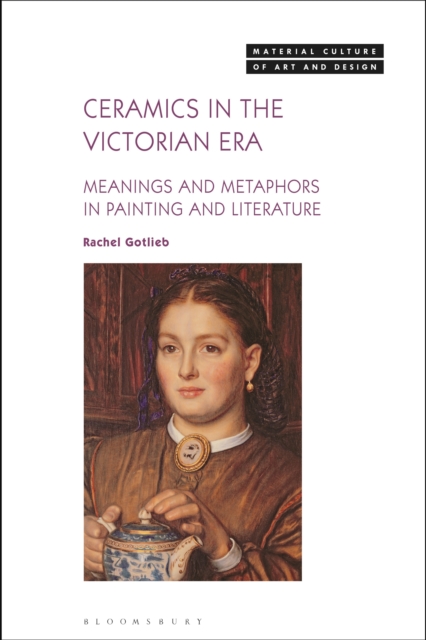
Ceramics in the Victorian Era
This book broadens the discussion of pottery and china in the Victorian era by situating them in the national, imperial, design reform, and domestic debates between 1840 and 1890. Largely ignored in recent scholarship, Ceramics in the Victorian Era: Meanings and Metaphors in Painting and Literature argues that the signification of a pot, a jug, or a tableware pattern can be more fully discerned in written and painted representations.Across five case studies, the book explores a rhetoric and set of conventions that developed within the representation of ceramics, emerging in the late-18th century, and continuing in the Victorian period. Each case study begins with a textual passage exemplifying the outlined theme and closes with an object analysis to demonstrate how the fusing of text, image, and object are critical to attaining the period eye in order to better understand the metaphorical meanings of ceramics.Essential reading not only for ceramics scholars, but also those of material culture, the book mines the rich and diverse archive of Victorian painting and literature, from the avant-garde to the sentimental, from the well-known to the more obscure, to shed light on the at once complex and simple implications of ceramics' agencies at this time.
eBook


Early pottery : technology, function, style, and interaction in the lower Southeast
A synthesis of research on earthenware technologies of the Late Archaic Period in the southeastern U.S. Information on social groups and boundaries, and on interaction between groups, burgeons when pottery appears on the social landscape of the Southeast in the Late Archaic period (ca. 5000-3000 years ago). This volume provides a broad, comparative review of current data from "first potteries" of the Atlantic and Gulf coastal plains and in the lower Mississippi River Valley, and it presents research that expands our understanding of how pottery functioned in its earliest manifestations in this region. Included are discussions of Orange pottery in peninsular Florida, Stallings pottery in Georgia, Elliot's Point fiber-tempered pottery in the Florida panhandle, and the various pottery types found in excavations over the years at the Poverty Point site in northeastern Louisiana. The data and discussions demonstrate that there was much more interaction, and at an earlier date, than is often credited to Late Archaic societies. Indeed, extensive trade in pottery throughout the region occurs as early as 1500 B.C. These and other findings make this book indispensable to those involved in research into the origin and development of pottery in general and its unique history in the Southeast in particular.
eBook