
Catalogue Search | MBRL


Are you sure you want to remove the book from the shelf?

{{itemTitle}}
256
result(s) for
"Practical idealism"
Sort by:

Racial Justice in the Age of Obama
With the election of Barack Obama as the first black president of the United States, the issue of racial justice in America occupies center stage. Have black Americans finally achieved racial justice? Is government intervention no longer required? Racial Justice in the Age of Obama considers contemporary civil rights questions and theories, and offers fresh insights and effective remedies for race issues in America today.
While there are now unprecedented opportunities for talented African Americans, Roy Brooks shows that lingering deficiencies remain within the black community. Exploring solutions to these social ills, Brooks identifies competing civil rights theories and perspectives, organizing them into four distinct categories--traditionalism, reformism, limited separation, and critical race theory. After examining each approach, Brooks constructs the best civil rights theory for the Obama phase of the post-civil rights era. Brooks supports his theoretical model with strong statistics that break down the major racial groups along such demographics as income and education. He factors in the cultural and structural explanations for the nation's racial divisions, and he addresses affirmative action, the failures of integration, the negative aspects of black urban culture, and the black community's limited access to resources. The book focuses on African Americans, but its lessons are relevant for other groups, including Latinos, Asians, women, and gays and lesbians.
Racial Justice in the Age of Obamamaps out today's civil rights questions so that all groups can achieve equality at a time of unprecedented historical change.
eBook
Post-Kantian Perfectionism. A Study in the Political Thought of German Idealism, from Leibniz to Marx
This paper summarizes the major themes of my current monograph project and my recent co-edited volume on post-Kantian perfectionism. The central thesis is that Kant’s critique of rational heteronomy in the Groundwork effectively ruled out certain types of perfectionist ethics and their corresponding political applications, notably the programmes of Christian Wolff and his school, which were dominant in the German territories in the mid- to late eighteenth century. Kant’s critiques did not, however, preclude the emergence of a new type of perfectionism, no longer based on the state-sponsored promotion of eudaimonia or material, intellectual, and spiritual thriving, but on the advancement of freedom and the conditions for its exercise. Predicated on the idea of right, post-Kantian perfectionism focuses on maintaining and enhancing the juridical, political, and economic conditions for rightful interaction among self-defining individuals. Humboldt, Schiller, Fichte, Hegel, and the Hegelian School exemplify this new approach in different ways. Marx’s problematic relation to this tradition is outlined.
Journal Article
Kant’ın Eleştirel Felsefesinde Teleolojiden Teolojiye Geçişliliğin İmkânı
In this study, teleological judgments were examined as having a part of the boundless relationship of reason with the universal and unconditional, based on Kant's critical philosophy. To do this, firstly, the distinction between telos and skopos has been pointed out. The cognitive faculties of the subject as the source of finality in nature and the concepts of purposeless purposefulness were discussed. We emphasized that according to Kant's critical philosophy, the introduction of the concept of God as an internal principle to natural science would be characterized as false belief. This trespassing, which causes a narrative that goes beyond the limits of our knowledge, was discussed in the context of the processes of acquiring knowledge in Kant's philosophy. In this regard, according to Kant the nature of the transition from teleological judgments to theological judgments was investigated. At the beginning of the study, the relation of telos with infinity was discussed. Afterward, the idea of purposefulness, which organizes itself in nature and eliminates blind randomness, was emphasized. The basis of the teleological principle as the inner principle of natural science was analyzed. The possibility of placing the concept of God on this very ground was discussed. It was pointed out that the characteristics of universality and necessity that Kant attributed to purposefulness were not only based on the grounds of experience. At this point, it was stated that to achieve universality, it is necessary to base on an a priori principle at the same time. The possibility that this principle could be an intention (Alm. Absicht) or a final end (Alm. Endzweck) was discussed. We focused on the request of the reason, which is applied to the conditioned and the finite, to reach the unconditional. It was stated that for Kant, the reason for the transition from teleological judgments to theological judgments was the effort to see purposeful regularity in phenomena. It was pointed out that it is a necessary step of the mind to lead this regularity to a higher telos and even to a creator, to the first being. We emphasized that concerning Kant’s critical philosophy if the concept of God was placed on the ground of natural science and the purposefulness in nature would be explained with this, and this method was used to prove the existence of God that would create an internal and non-permanent narrative. It was discussed whether this claim was an illusion. At this point, the task of the imagination performed with telos was examined. Evaluations about the concept of telos as the common ground of the subjective and the universal were included. As a result, it has been investigated how the search for the constant existing in the human mind can lead him to the existence of a God in the chain of causality.
Journal Article

Relational Realism and Practical Reason in Utpaladeva’s Sambandhasiddhi
One debate that occupied Pratyabhijñā philosophers and their Buddhist interlocutors was the question of the reality of sambandha, or relation. A central treatise on the topic is Utpaladeva’s (∼10th c.) Sambandhasiddhi [SS] (‘Proof of Relation’), a response to Dharmakīrti’s (∼7th c.) Sambandhaparīkṣā [SP] (‘Analysis of Relation’). As the contrasting titles suggest, Dharmakīrti held that relations are merely conceptual constructions (kalpanā), inferred post hoc from discrete perceptual cognitions (pratyakṣa)—and thus ultimately unreal. Utpaladeva, on the other hand, attempted to ‘prove’ (siddhi) the truth (satya) of relation as a genuine ‘division-non-division,’ or ‘unity-in-diversity’ (bhedābheda). In this article, I reconstruct Utpala’s ‘proof’ as a pragmatic argument to the effect that Dharmakīrti, in virtue of his nominalist metaphysics, mistakenly treats the general form of relation as an inferential concept, rather than the mode of ‘intentional’ action (śakti) manifest in reflexive judgment (vimarśa). In doing so, Utpala suggests that Dharmakīrti inadvertently renders the relational conditions for the recognition of determinate intentional content unintelligible.
Journal Article

How is the practical deduction possible?
In the Critique of Pure Reason , Immanuel Kant asserts the impossibility of the principles of practical reason, as “the objective reality of the moral law cannot be proved by any deduction” (KpV, АА 05: 47). This is the case if deduction is understood as the procedure Kant follows in the “Transcendental Analytic” of the first Critique. Yet, Kant himself points out that “deduction […] is the justification (Rechtfertigung) of its objective and universal validity” ( KpV , AA 5:46). This justification of the principles of practical reason can be found in Kant’s works and has a certain structure. Firstly, in the Critique of Pure Reason , he justifies the existence of an intelligible world where the determining ground of causality is freedom. In the intelligible domain, the principles of pure reason possess objective reality. Thus, in the first Critique , Kant justifies the existence of (i) an intelligible world, (ii) freedom as the ground of causality and (iii) the ought as a reason for practical action. Secondly, in the Groundwork of the Metaphysics of Morals , Kant demonstrates that freedom carries one to an intelligible world where the good will resides. The good will rests upon freedom and brings forth human autonomy. And it is the good will from which the categorical imperative and morality in general emanate. Thirdly, it is explicated in the second Critique that freedom is the keystone ( Schlußstein ) of practical reason. Here, the moral law (= “a fact of reason”) is instrumental in deducing transcendental freedom itself. This means that the reality of transcendental freedom manifests itself through the moral law. The moral law exists and is effective; therefore, there is transcendental freedom behind it. Thus, the structure of transcendental deduction of practical reason consists of the successive justification of (i) the intelligible world, (ii) freedom, (iii) the good will, (iv) duty (categorical imperative), (v) the moral law as a “fact of reason”. Consequently, the practical deduction is possible only through a synthetic union between the Copernican Revolution,transcendental idealism and criticism.
Journal Article
Good Will and Spontaneity in Communication
The article is based on the interpretation of Kant’s notion of good will with regard to its meaning for successful communication. It seeks to delineate its necessary relation to spontaneity as opposed to a strictly closed definition – the spontaneity in language as crucial for communication. Agambenian and Wittgensteinian musings on language and paradigm are employed for that purpose. The art of comedy is seen to illustrate the communication based on spontaneity and paradigm and the art of tragedy is seen to depict the condition of radical incommunicability. Alongside this linguistic and epistemological approach, the discussion of the issue also includes the ontological aspect, i.e. the Agambenian-Aristotelian notion of potentiality is described as akin to the Kantian good will (Ding an sich) and is seen as the necessary (and perhaps also sufficient) condition for (successful) communication.
Journal Article

The suspension of reason in Hegel and Schelling
Countering the common depiction of Hegel and Schelling as uncritical champions of reason's triumph in the modern world, I analyze the significance of their respective claims that reason must be “suspended” ( aufgehoben) in both its theoretical and practical employments. After tracing their uptake of the Kantian distinction between the endless categorizing of the understanding (Verstand) and the self-criticism of reason (Vernunft), I argue that Hegel and Schelling demonstrate the need for a form of cognition beyond reason. In particular, Hegel's Phenomenology of Spirit and Schelling's Freedom essay offer alternate spatial models for how reason's infinite striving can be suspended without annulling its advantages over the understanding. These spatial models set the stage for some of the most important debates in twentieth century continental ethics, and careful attention to their structures potentially offers a way around some dialectical impasses concerning the self and the other.
Dissertation

Hegel on Self-Consciousness
In the most influential chapter of his most important philosophical work, thePhenomenology of Spirit, Hegel makes the central and disarming assertions that \"self-consciousness is desire itself\" and that it attains its \"satisfaction\" only in another self-consciousness.Hegel on Self-Consciousnesspresents a groundbreaking new interpretation of these revolutionary claims, tracing their roots to Kant's philosophy and demonstrating their continued relevance for contemporary thought.
As Robert Pippin shows, Hegel argues that we must understand Kant's account of the self-conscious nature of consciousness as a claim in practical philosophy, and that therefore we need radically different views of human sentience, the conditions of our knowledge of the world, and the social nature of subjectivity and normativity. Pippin explains why this chapter of Hegel'sPhenomenologyshould be seen as the basis of much later continental philosophy and the Marxist, neo-Marxist, and critical-theory traditions. He also contrasts his own interpretation of Hegel's assertions with influential interpretations of the chapter put forward by philosophers John McDowell and Robert Brandom.
eBook
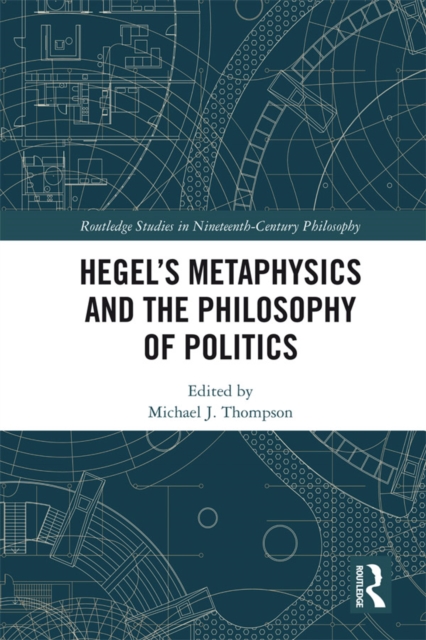
Hegel’s Metaphysics and the Philosophy of Politics
The renaissance in Hegel scholarship over the past two decades has largely ignored or marginalized the metaphysical dimension of his thought, perhaps most vigorously when considering his social and political philosophy. Many scholars have consistently maintained that Hegel’s political philosophy must be reconstructed without the metaphysical structure that Hegel saw as his crowning philosophical achievement. This book brings together twelve original essays that explore the relation between Hegel’s metaphysics and his political, social and practical philosophy. The essays seek to explore what normative insights and positions can be obtained from examining Hegel’s distinctive view of the metaphysical dimensions of political philosophy. His ideas about the good, the universal, freedom, rationality, objectivity, self-determination and self-development can be seen in a new context and with renewed understanding once their relation to his metaphysical project is considered. Hegel’s Metaphysics and the Philosophy of Politics will be of great interest to scholars of Hegelian philosophy, German Idealism, nineteenth-century philosophy, political philosophy and political theory.
eBook

Pursuits of Wisdom
This is a major reinterpretation of ancient philosophy that recovers the long Greek and Roman tradition of philosophy as a complete way of life--and not simply an intellectual discipline. Distinguished philosopher John Cooper traces how, for many ancient thinkers, philosophy was not just to be studied or even used to solve particular practical problems. Rather, philosophy--not just ethics but even logic and physical theory--was literally to be lived. Yet there was great disagreement about how to live philosophically: philosophy was not one but many, mutually opposed, ways of life. Examining this tradition from its establishment by Socrates in the fifth century BCE through Plotinus in the third century CE and the eclipse of pagan philosophy by Christianity,Pursuits of Wisdomexamines six central philosophies of living--Socratic, Aristotelian, Stoic, Epicurean, Skeptic, and the Platonist life of late antiquity.
The book describes the shared assumptions that allowed these thinkers to conceive of their philosophies as ways of life, as well as the distinctive ideas that led them to widely different conclusions about the best human life. Clearing up many common misperceptions and simplifications, Cooper explains in detail the Socratic devotion to philosophical discussion about human nature, human life, and human good; the Aristotelian focus on the true place of humans within the total system of the natural world; the Stoic commitment to dutifully accepting Zeus's plans; the Epicurean pursuit of pleasure through tranquil activities that exercise perception, thought, and feeling; the Skeptical eschewal of all critical reasoning in forming their beliefs; and, finally, the late Platonist emphasis on spiritual concerns and the eternal realm of Being.
Pursuits of Wisdomis essential reading for anyone interested in understanding what the great philosophers of antiquity thought was the true purpose of philosophy--and of life.
eBook