
Catalogue Search | MBRL


Are you sure you want to remove the book from the shelf?

{{itemTitle}}
174
result(s) for
"Pragmatismus"
Sort by:

Expressivism, Pragmatism and Representationalism
Pragmatists have traditionally been enemies of representationalism but friends of naturalism, when naturalism is understood to pertain to human subjects, in the sense of Hume and Nietzsche. In this volume Huw Price presents his distinctive version of this traditional combination, as delivered in his René Descartes Lectures at Tilburg University in 2008. Price contrasts his view with other contemporary forms of philosophical naturalism, comparing it with other pragmatist and neo-pragmatist views such as those of Robert Brandom and Simon Blackburn. Linking their different 'expressivist' programmes, Price argues for a radical global expressivism that combines key elements from both. With Paul Horwich and Michael Williams, Brandom and Blackburn respond to Price in new essays. Price replies in the closing essay, emphasising links between his views and those of Wilfrid Sellars. The volume will be of great interest to advanced students of philosophy of language and metaphysics.
eBook

Podcasting the Truth: Challenging Journalistic Knowledge and Building Epistemic Authority in Independent YouTube Podcasts
The legitimacy of journalism as a truth-teller has become contested during the era of digitalisation and newly emerging platforms. Recently, the epistemic authority of legacy journalism has been challenged by right-wing podcasting. This article explores metajournalistic discussions on the identity of legacy journalism as a truth-oriented practice and institution in six Finnish podcasts published independently outside legacy media on YouTube. This metajournalistic discourse of truth is identified through topic modelling in 229 podcast episodes, of which 119 are scrutinised using qualitative discourse analysis. The discursive articulations in the YouTube podcast episodes are assessed in the light of realist and antirealist philosophies as well as epistemic theories of journalistic truth structured by critical realist and pragmatist philosophies. The results show that the epistemic authority of legacy journalism is challenged through three interconnected themes through which legacy journalism is articulated as an antirealist practice and institution. By contrast, YouTube podcasting is framed as a platform for a balanced, authentic, and uncut talk that realises the epistemic ideals of journalism. The challenges to the epistemic authority of legacy journalism presented by the Finnish YouTube podcasts are also similar to those identified in previous research on right-wing podcasting and online counter-media. The findings point to the need for legacy journalists and podcasting practitioners to adopt more nuanced and context-bound understandings of journalistic knowledge and truth structured by critical realist and pragmatist philosophies.
Journal Article

Situational Analysis as a Traveling Concept: Mapping, Coding and the Role of Hermeneutics
Situational analysis mapping is widely appreciated as offering systematical empirical approaches to analyzing relationality. However, the role of grounded theory coding as a technique to analyze sequentially remains somewhat unclear in situational analysis method books. In my contribution, I regard situational analysis as a traveling concept rooted in pragmatism and taken up within research landscapes different from its origin. Scrutinizing how situational analysis is practiced in German-speaking social sciences, I find that grounded theory coding is commonly used in addition to mapping. I relate this to existing debates on social scientific hermeneutics. Relations between pragmatism and hermeneutics are clarified and possible implications for data analysis in situational analysis are pointed out.
Journal Article
Fall-Netzwerk-Analysen: eine exemplarische Methodenkombination von Fallrekonstruktion und Akteur-Netzwerk-Forschung
Im Beitrag diskutieren wir die methodische Kombination von Akteur-Netzwerk-Theorie (ANT) und objektiver Hermeneutik (OH) am Beispiel eines empirischen Forschungsprojekts zu sozio-ökologischen Transformationen von Wasserinfrastrukturen. Wir vergleichen zuerst die beiden Forschungszugänge, die zwar mit Bezügen auf den Pragmatismus methodologische Gemeinsamkeiten aufweisen, sich allerdings mit ihrer Netzwerkbeziehungsweise Fallperspektive im Hinblick auf Analyseziele und Forschungsweise unterscheiden. Wir nutzen deshalb die methodischen Mittel der ANT primär als Erhebungsstrategie (\"follow the actors\", LATOUR 2012 [2005], S.61) beim Erschließen relevanter Akteur-Netzwerke, ergänzt um ein Analysemodell. Demgegenüber erlaubt es die OH, die Sinnstrukturen der beteiligten Fälle zu rekonstruieren. Diese Rekonstruktionen liefern die sinnstrukturellen Antworten auf die Transformationsfragen, bei der ANT richtet sich die Aufmerksamkeit dagegen auf die Vernetzungsprozesse, um Transformationsoptionen in deren Zusammenspiel aufzufinden. Aus der Kombination, die wir Fall-Netzwerk-Analyse nennen und modellhaftzusammenführen, ergeben sich neue Einsichten. An einem empirischen Beispiel zeigen wir, wie sich Sinnstrukturen und Netzwerk wechselseitig stabilisieren können: eine stark technisch orientierte Problemperspektive im technisch orientierten Akteur-Netzwerk.
Journal Article

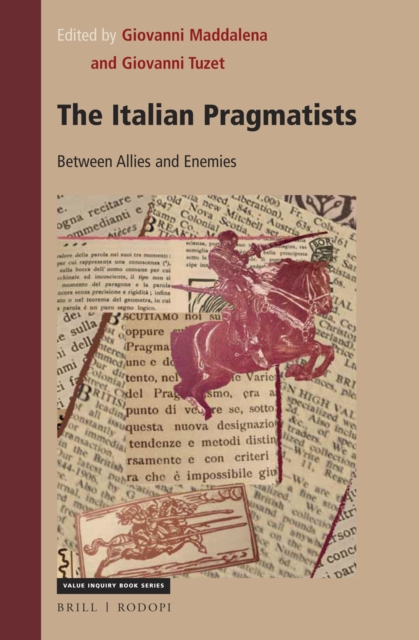
The Italian Pragmatists
The Italian Pragmatists were a group of philosophers in the early 20th century. They gathered around the journal Leonardo, which was published in Florence. This volume emphasizes what they all shared, as well as their value for philosophy and culture.
eBook
Lost in Translation? Openness, Reflexivity and Pragmatism as Guiding Principles for Cross-Language Qualitative Research
In zunehmend globalisierten und sprachlich vielfältigen Gesellschaften werden sprachübergreifende Konstellationen in der qualitativen Forschung immer wahrscheinlicher und notwendiger. Ausgehend von den Erfahrungen, die wir während unserer Forschung in fremdsprachlichen Kontexten gemacht haben, reflektieren wir drei Leitprinzipien qualitativer Forschung – Offenheit, Reflexivität und Pragmatismus – und wie wir sie im Umgang mit den vielfältigen Herausforderungen sprachlicher Verständigung angewendet haben. Anknüpfend an die laufenden Diskussionen zum Thema legen wir in diesem Artikel eine Darstellung einer reflexiven Methodologie vor, die sich ihrer Voraussetzungen und Grenzen bewusst ist. Wir plädieren für einen selbstbewussten Umgang mit sprachlichen Schwierigkeiten und weisen darauf hin, dass es in der qualitativen Forschung stets erforderlich war, dass die gewählten Methoden flexibel genug sind, um sie den Herausforderungen des Feldes anzupassen.
Journal Article
Grounded Theory Method and Symbolic Interactionism: Freedom of Conceptualization and the Importance of Context in Research
Der symbolische Interaktionismus (SI), eine Perspektive zum Verständnis menschlichen Verhaltens, wird gemeinhin als Grundlage für die Grounded-Theory-Methodologie (GTM) angesehen. Der Zweck der GTM besteht jedoch darin, aus Daten eine substanzielle, erklärende Sozialtheorie zu erstellen, ohne sich auf vorherige Annahmen zu stützen. Daher argumentieren einige, dass SI eine unnötige theoretische Einschränkung des Hauptziels der GTM – der freien Konzeptualisierung von Daten – darstelle. In diesem Artikel verwenden wir Beispiele aus einer laufenden konstruktivistischen Grounded-Theory-Studie über die Aushandlung der Rollen von Krankenschwestern in der Allgemeinmedizin in Neuseeland, um zu zeigen, was SI in Bezug auf die konzeptionelle Entwicklung und das Verständnis des Kontextes beitragen kann. Wir argumentieren, dass durch das Stellen von drei Fragen aus einer symbolisch-interaktionistischen Perspektive in jeder Phase des Forschungsprozesses die Freiheit der Konzeptualisierung erhöht und das Bewusstsein für kontextuelle Belange gefördert werden kann, um eine bessere Brücke zwischen den Weltsichten zu schlagen.
Journal Article
Pragmatist metaphysics : an essay on the ethical grounds of ontology
Pragmatist Metaphysics proposes a pragmatist re-articulation of the nature, aims and methods of metaphysics.Rather than regarding metaphysics as a 'first philosophy', an inquiry into the world independent of human perspectives, the pragmatist views metaphysics as an inquiry into categorizations of reality laden with human practices.
eBook
Mixed Methods and Their Pragmatic Approach: Is There a Risk of Being Entangled in a Positivist Epistemology and Methodology? Limits, Pitfalls and Consequences of a Bricolage Methodology
Since the early 2000s, the pragmatic approach has been proposed as a philosophical program for social research, regardless of whether qualitative, quantitative or mixed methods are used. In addition, current mixed methods have been presented as a third way between positivism and constructivism. However, can mixed methods be fully considered a third way? For instance, in their inquiries, will scholars oriented to pragmatism actually employ the traditional and standardized questionnaire, with forced choices and closed questions, which strongly limits any interpretative and interactional perspective? Hence, several theoretical and methodological difficulties of the pragmatist proposal emerge precisely (and paradoxically) at the level of research practice. The pragmatic approach is presented by its proponents as a model designed to dissolve differences and neutralize epistemological barriers; however, without problematizing and removing the positivist features of their methods, researchers oriented to pragmatism actually risk ending up reproducing positivism in disguise. Hence, despite their claims to innovation, proponents of pragmatism are often overly traditionalist in their use of methods.
Journal Article