
Catalogue Search | MBRL


Are you sure you want to remove the book from the shelf?

{{itemTitle}}
38
result(s) for
"Prehistoric peoples -- China"
Sort by:

China and East Africa : ancient ties, contemporary flows
'China and East Africa' marks the culmination of a new round of archaeological and historical research on the relations between China and Africa, from the origins to the present. Africa and Asia have always been in constant contact, through land and seas. The contributors to this volume debate and present the results of their research on the very complex and intricate networks of connections that crisscrossed the Indian Ocean and surrounding lands linking Africa to East Asia.
Book

The Archaeology of China
This book explores the roles of agricultural development and advancing social complexity in the processes of state formation in China. Over a period of about 10,000 years, it follows evolutionary trajectories of society from the last Palaeolithic hunting-gathering groups, through Neolithic farming villages and on to the Bronze Age Shang dynasty in the latter half of the second millennium BC. Li Liu and Xingcan Chen demonstrate that sociopolitical evolution was multicentric and shaped by inter-polity factionalism and competition, as well as by the many material technologies introduced from other parts of the world. The book illustrates how ancient Chinese societies were transformed during this period from simple to complex, tribal to urban, and preliterate to literate.
eBook

The archaeology of China : from the late paleolithic to the early bronze age
\"Past, present and future \"The archaeological materials recovered from the Anyang excavations ... in the period between 1928 and 1937...have laid a new foundation for the study of ancient China (Li, C. 1977: ix).\" When inscribed oracle bones and enormous material remains were found through scientific excavation in Anyang in 1928, the historicity of the Shang dynasty was confirmed beyond dispute for the first time (Li, C. 1977: ix-xi). This excavation thus marked the beginning of a modern Chinese archaeology endowed with great potential to reveal much of China's ancient history.. Half a century later, Chinese archaeology had made many unprecedented discoveries which surprised the world, leading Glyn Daniel to believe that \"a new awareness of the importance of China will be a key development in archaeology in the decades ahead (Daniel 1981: 211). This enthusiasm was soon shared by the Chinese archaeologists when Su Bingqi announced that \"the Golden Age of Chinese archaeology is arriving (Su, B. 1994: 139--140)\". In recent decades, archaeology has continuously prospered, becoming one of the most rapidly developing fields in social science in China\"-- Provided by publisher.
Book
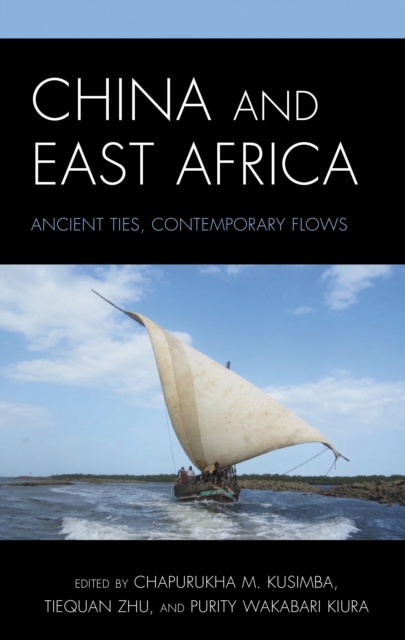
China and East Africa : ancient ties, contemporary flows
China and East Africa: Ancient Ties and Contemporary Flows marks the culmination of a new round of archaeological and historical research on the relations between China and Africa, from the origins to the present.Africa and Asia have always been in constant contact, through land and seas.
eBook


A Companion to Chinese Archaeology
A Companion to Chinese Archaeology is an unprecedented, new resource on the current state of archaeological research in one of the world's oldest civilizations. It presents a collection of readings from leading archaeologists in China and elsewhere that provide diverse interpretations about social and economic organization during the Neolithic period and early Bronze Age. * An unprecedented collection of original contributions from international scholars and collaborative archaeological teams conducting research on the Chinese mainland and Taiwan * Makes available for the first time in English the work of leading archaeologists in China * Provides a comprehensive view of research in key geographic regions of China * Offers diverse methodological and theoretical approaches to understanding China's past, beginning with the era of established agricultural villages from c. 7000 B.C. through to the end of the Shang dynastic period in c. 1045 B.C.
eBook


Paleolithic Cultures in China
This paper presents an overview of the Chinese Paleolithic industries between 300 ka and 40 ka, a time span now termed the “later Early Paleolithic” (LEP) in the Chinese chronological scheme. It describes the unique features of LEP remains in China compared with contemporaneous materials in Africa and western Eurasia as well as the internal diversity and complexity of these Chinese Paleolithic assemblages. Basic features of LEP remains in China include the persistent and conservative pebble-tool and simple flake-tool traditions, the use of poor-quality local raw materials, tool fabrication on pebbles and direct use of unretouched flakes, opportunistic flaking, simple and casual modification, and the lack of obvious temporal trends. The diversity and complexity of Chinese Paleolithic cultures as they are expressed in terms of the major difference between southern China’s pebble-tool tradition and northern China’s simple flake-tool tradition are also assessed. Based on such generalizations and analyses, a comprehensive behavioral model is proposed to explain the unique features of LEP cultures in China and the alternative pathway of human evolution and adaptation in China during that period of time.
Journal Article

The early modern human from Tianyuan Cave, China
For more than a century, scientists have returned time and again to the issue of modern human emergence-the when and where of the evolutionary process and the human behavioral and biological dynamics involved. The 2003 discovery of a human partial skeleton at Tianyuandong (Tianyuan Cave) excited worldwide interest. The first human skeleton from the region to be directly radiocarbon-dated (to 40,000 years before present), its geological age places it close to the time period during which modern humans became permanently established across the Old World (between 50,000 and 35,000 years ago).
eBook

Journey to the east: Diverse routes and variable flowering times for wheat and barley en route to prehistoric China
Today, farmers in many regions of eastern Asia sow their barley grains in the spring and harvest them in the autumn of the same year (spring barley). However, when it was first domesticated in southwest Asia, barley was grown between the autumn and subsequent spring (winter barley), to complete their life cycles before the summer drought. The question of when the eastern barley shifted from the original winter habit to flexible growing schedules is of significance in terms of understanding its spread. This article investigates when barley cultivation dispersed from southwest Asia to regions of eastern Asia and how the eastern spring barley evolved in this context. We report 70 new radiocarbon measurements obtained directly from barley grains recovered from archaeological sites in eastern Eurasia. Our results indicate that the eastern dispersals of wheat and barley were distinct in both space and time. We infer that barley had been cultivated in a range of markedly contrasting environments by the second millennium BC. In this context, we consider the distribution of known haplotypes of a flowering-time gene in barley, Ppd-H1, and infer that the distributions of those haplotypes may reflect the early dispersal of barley. These patterns of dispersal resonate with the second and first millennia BC textual records documenting sowing and harvesting times for barley in central/eastern China.
Journal Article