
Catalogue Search | MBRL


Are you sure you want to remove the book from the shelf?

{{itemTitle}}
678,952
result(s) for
"Presidential campaign"
Sort by:

George McGovern and the Democratic Insurgents : The Best Campaign and Political Posters of the Last Fifty Years
\"Compilation of political posters from the 1960s to the present\"-- Provided by publisher.
Book

Red state, blue state, rich state, poor state
On the night of the 2000 presidential election, Americans watched on television as polling results divided the nation's map into red and blue states. Since then the color divide has become symbolic of a culture war that thrives on stereotypes--pickup-driving red-state Republicans who vote based on God, guns, and gays; and elitist blue-state Democrats woefully out of touch with heartland values. With wit and prodigious number crunching, Andrew Gelman debunks these and other political myths.
This expanded edition includes new data and easy-to-read graphics explaining the 2008 election.Red State, Blue State, Rich State, Poor Stateis a must-read for anyone seeking to make sense of today's fractured political landscape.
eBook

Gustavo Petro vs. Rodolfo Hernández
La segunda vuelta de las elecciones presidenciales del 19 de junio de 2022 opuso a dos personalidades alejadas de las élites tradicionales del país y de los grandes partidos políticos. Por un lado, Gustavo Petro era líder de una izquierda que nunca había llegado a las más altas funciones en Colombia y parecía condenada al eterno ejercicio de la oposición, por el otro, Rodolfo Hernández era una figura nueva en la política nacional que saltó de la alcaldía de Bucaramanga a la candidatura presidencial con base en un discurso de rechazo a la clase política en general. El perfil inhabitual de los dos contrincantes suscitó muchos comentarios sobre el auge del populismo en el país sobre un trasfondo de crisis de la representación política y de fuerte conflictividad social. Este libro se propone discutir a través de contribuciones diversas qué puede enseñarnos el concepto de populismo sobre el nuevo escenario político que dibujaba este enfrentamiento electoral.
eBook

Deplorable
Political campaigns in the United States, especially those for
the presidency, can be nasty-very nasty. And while we would like to
believe that the 2020 election was an aberration, insults,
invective, and yes, even violence have characterized US electoral
politics since the republic's early days. By examining the
political discourse around nine particularly deplorable elections,
Mary E. Stuckey seeks to explain why.
From the contest that pitted Thomas Jefferson against John Adams
in 1800 through 2020's vicious, chaotic matchup between Donald
Trump and Joe Biden, Stuckey documents the cycle of despicable
discourse in presidential campaigns. Looking beyond the character
and the ideology of the candidates, Stuckey explores the broader
political, economic, and cultural milieus in which each took place.
In doing so, she reveals the conditions that exacerbate and enable
our worst political instincts, producing discourses that incite
factions, target members of the polity, encourage undemocratic
policy, and actively work against the national democratic
project.
Keenly analytical and compulsively readable, Deplorable
provides context for the 2016 and 2020 elections, revealing them as
part of a cyclical-and perhaps downward-spiraling-pattern in
American politics. Deplorable offers more than a
comparison of the worst of our elections. It helps us understand
these shameful and disappointing moments in our political history,
leaving one important question: Can we avoid them in the
future?
eBook

Politics as Usual
The presidential election of 1944, which unfolded against the backdrop of the World War II, was the first since 1864-and one of only a few in all of US history-to take place while the nation was at war. After a brief primary season, the Republican Party settled upon New York governor Thomas E. Dewey, the former district attorney and popular special prosecutor of Legs Diamond and Lucky Luciano, as its nominee for president of the United States. The Democratic nominee for president, meanwhile, was the three-term incumbent, sixty-two year-old Franklin Delano Roosevelt. Sensitive to the wartime setting of the election, both Roosevelt and Dewey briefly adopted dignified and low-key electoral strategies early in their campaigns. Within a few months however, \"politics as usual\" returned as the campaign degenerated into a vigorously fought, chaotic, unpredictable, and highly competitive contest.
While Politics as Usual is a comprehensive study of the campaign, Davis focuses attention on the loser, Dewey, and shows how he emerged as a central figure for the Republican Party. Davis examines the political landscape in the United States in the early 1940s, including the state of the two parties, and the rhetoric and strategies employed by both the Dewey and Roosevelt campaigns. He details the survival of partisanship in World War II America and the often overlooked role of Dewey-who sought to rebuild the Republican Party \"to be worthy of national trust\"-as party leader at such a critical time. Although Dewey fell short of victory, Dewey kept his party unified, helped steer it away from isolationist influences, and rebuilt it to fit into (and to be a relevant alternative within) the post-World War II, New Deal order.
eBook
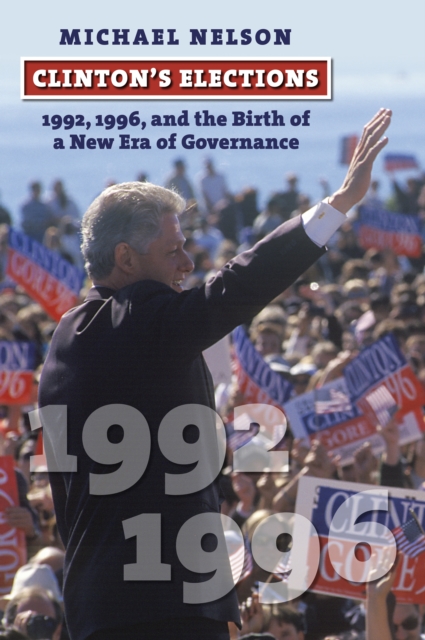
Clinton's Elections
In the presidential elections of 1980, 1984, and 1988, the three Democratic nominees won an average of about 10 percent of the Electoral College vote-a smaller share than any party in any three consecutive presidential elections in US history. In the next seven elections, Democrats won the popular vote in all but one (2004), a feat not achieved by a political party since the Democratic Party's inception in the 1820s. What separated these record-setting runs was the election and presidency of Bill Clinton, whose pivotal role in ushering in a new era of American politics-for better and for worse-this book explores. Perhaps because Clinton's presidency was hobbled by six years of divided government, ended in a sex scandal and impeachment, and was sandwiched between Republican administrations, it is easy to forget that he revived a presidential party that had become nearly moribund. InClinton's Elections Michael Nelson describes how, by tacking relentlessly to the center, Clinton revived the Democrats' presidential fortunes-but also, paradoxically, effectively erased the center, in the process introducing the new political reality of extreme partisan divisiveness and dysfunctional government. Tracing Clinton's place in American politics from his emergence as a potential nominee in 1988 to his role in political campaigns right up to 2016, Nelson draws a deft portrait of a savvy politician operating in the midst of divided government and making strategic moves to consolidate power and secure future victories. With its absorbing narrative and incisive analysis, his book makes sense of a watershed in the modern American political landscape-and lays bare the roots of our current era of political dysfunction.
eBook

Change and continuity in the 2016 elections
Is America in the midst of an electoral transformation? What were the sources of Trump's victory in 2016, and how do they differ from Republican coalitions of the past? Does his victory signal a long-term positive trajectory for Republicans' chances in presidential elections? Change and Continuity in the 2016 Elections attempts to answer those questions by analyzing and explaining the voting behavior in the most recent election, as well as setting the results in the context of larger trends and patterns in elections studies. New co-author Jamie L. Carson brings years of congressional and election research experience to help this top-notch author team meticulously explain the latest National Election Studies data and discuss its importance and impact. You will critically analyze a variety of variables such as the presidential and congressional elections, voter turnout, and the social forces, party loyalties, and prominent issues that affect voting behavior. You will also walk away with a better understanding of this groundbreaking election and what those results mean for the future of American politics.
eBook

Decoding the Digital Church
\"This investigation tries to understand why many
Evangelical pastors were blamed for endorsing Trump when, in
fact, most did not. This book joins other attempts by scholars
and journalists to analyze the relationship between Trump and
Evangelicals. Recommended.” —CHOICE As
a political constituency, white conservative evangelicals are
generally portrayed as easy to dupe, disposed to vote against
their own interests, and prone to intolerance and knee-jerk
reactions. In Decoding the Digital Church: Evangelical
Storytelling and the Election of Donald J. Trump, Stephanie A.
Martin challenges this assumption and moves beyond these overused
stereotypes to develop a refined explanation for this
constituency’s voting behavior. This volume offers a fresh
perspective on the study of religion and politics and stems from
the author’s personal interest in the ways her experiences
with believers differ from how scholars often frame this
group’s rationale and behaviors. To address this disparity,
Martin examines sermons, drawing on her expertise in rhetoric and
communication studies with the benefits of ethnographic research
in an innovative hybrid approach she terms a “digital
rhetorical ethnography.” Martin’s thorough research
surveys more than 150 online sermons from America’s largest
evangelical megachurches in 37 different states. Through
listening closely to the words of the pastors who lead these
conservative congregations, Martin describes a gentler discourse
less obsessed with issues like abortion or marriage equality than
stereotypes of evangelicals might suggest. Instead, the
politicaleconomic sermons and stories from pastors encourage true
believers to remember the exceptional nature of the
nation’s founding while also deemphasizing how much
American citizenship really means. Martin grapples with and pays
serious, scholarly attention to a seeming contradiction: while
the large majority of white conservative evangelicals voted in
2016 for Donald J. Trump, Martin shows that many of their pastors
were deeply concerned about the candidate, the divisive nature of
the campaign, and the potential effect of the race on their
congregants’ devotion to democratic process itself.
In-depth chapters provide a fuller analysis of our current
political climate, recapping previous scholarship on the history
of this growing divide and establishing the groundwork to set up
the dissonance between the political commitments of evangelicals
and their faith that the rhetorical ethnography addresses.
eBook

A Functional Analysis of Political Television Advertisements
A Functional Analysis of Political Television Advertisements examines theory and research on election advertisements.William Benoit employs the Functional Theory of Political Campaign Discourse to understand the nature or content of television spots in election campaigns.
eBook

Mapping the Ideological Marketplace
I develop a method to measure the ideology of candidates and contributors using campaign finance data. Combined with a data set of over 100 million contribution records from state and federal elections, the method estimates ideal points for an expansive range of political actors. The common pool of contributors who give across institutions and levels of politics makes it possible to recover a unified set of ideological measures for members of Congress, the president and executive branch, state legislators, governors, and other state officials, as well as the interest groups and individuals who make political donations. Since candidates fundraise regardless of incumbency status, the method estimates ideal points for both incumbents and nonincumbents. After establishing measure validity and addressing issues concerning strategic behavior, I present results for a variety of political actors and discuss several promising avenues of research made possible by the new measures.
Journal Article